
Create Video Sitemap: Enhance Medical Video Discovery
To create video sitemap for your clinic’s website, this guide details the process from understanding XML sitemap format to submission. Learn how to structure the <video:video> tag with essential metadata for medical content, ensuring proper video indexing and discovery by search engines. A well-configured video sitemap enhances your clinic’s E-E-A-T signals, making educational videos and patient testimonials more visible in Google Search Console results. This strategy is crucial for improving video SEO and patient engagement for medical clinics.
Abdurrahman Şimşek, a Semantic SEO Strategist, specializes in optimizing digital presence for medical clinics. His expertise in semantic engineering and technical SEO ensures medical content achieves maximum visibility and contributes to strong E-E-A-T signals, particularly for YMYL topics.
To explore your options, contact us to schedule your consultation.
For medical clinics, video content educates and engages patients. To be discovered, search engines must know these videos exist. This guide explains how to create video sitemap and submit it for your clinic’s website, increasing visibility for medical procedure videos and patient testimonials in 2026 and beyond.
What is a Video Sitemap and Why Your Clinic Needs One?
A video sitemap is an XML file providing search engines with metadata about videos on your website. It informs search engines like Google about the existence, location, and details of your videos to aid their discovery and indexing. For medical clinics, this ensures educational content like surgical procedure explanations, patient testimonials, and expert interviews is visible to patients searching for health information.
For Your Money or Your Life (YMYL) content, a video sitemap helps search engines understand the context and authority of your medical videos. It signals to Google that your clinic is a reliable source of information, contributing to your E-E-A-T (Experience, Expertise, Authoritativeness, Trustworthiness) signals. Without a video sitemap, search engines might overlook or misinterpret your video assets, hindering their visibility in search results and video carousels.
The Role of Video Sitemaps in Medical Content Discovery
Video sitemaps detail each video’s attributes, guiding Google to categorize and rank medical content. For sensitive YMYL topics, clear, accurate, and expert-backed video content builds patient trust. With improved visibility, procedure videos, patient success stories, and expert insights from your medical team are more likely to be found by individuals seeking information about treatments or conditions, which enhances patient education and engagement.
Understanding the Video Sitemap Format: Key Elements for Medical Content
A video sitemap is an XML file with extensions for video content. The `
Each “ entry in the sitemap can contain one or more `
Essential `
Optimizing each tag for medical specificity enhances video SEO. The key tags include:
- ` A concise, accurate title describing the video. For medical content, this should clearly state the procedure or topic, e.g., “Rhinoplasty Procedure Explained by Dr. Smith.”
- ` A detailed summary of the video’s content. This is crucial for YMYL, providing context and demonstrating expertise. Include relevant medical terms and patient benefits.
- ` The URL of the video’s thumbnail image. A high-quality, relevant thumbnail can improve click-through rates in search results.
- ` The direct URL to the video file itself (e.g., .mp4) or the URL of the player.
- ` (Optional) The URL of the video player page. This is often the page where the video is embedded.
- ` The video’s duration in seconds.
- ` The date the video was published in W3C format (YYYY-MM-DD). This helps signal freshness and relevance.
- ` (Optional) Keywords associated with the video, such as “breast augmentation,” “recovery,” or “London plastic surgeon.”
- ` (Optional) Specifies countries where the video may or may not be played.
Populating these tags accurately for all surgical and explainer videos on your clinic’s website is foundational for video indexing.
How to Create a Video Sitemap for Your Clinic’s Website
To generate a video sitemap, compile all video metadata into the specified XML format. The method depends on your site’s size and number of videos. Manual creation is feasible for small sites with few static videos. Automated tools are more efficient for larger clinics with dynamic or frequently updated video libraries. The goal is an accurate, error-free sitemap reflecting your video assets.
When creating a video sitemap, consider how new videos will be added and existing ones updated. A scalable solution keeps your video SEO consistent over time, adapting to your content strategy in 2026 and beyond. This prevents video content from being missed by search engine crawlers.
Manual Creation vs. Automated Video Sitemap Generators
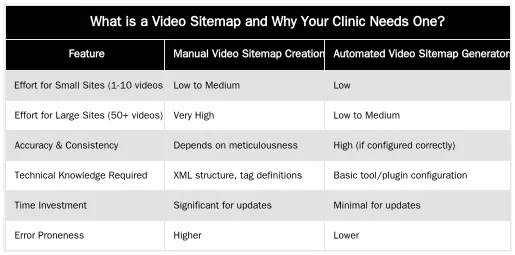
The choice between manual and automated methods to generate a video sitemap depends on your resources and technical comfort. Manual creation offers granular control but is time-consuming and error-prone for large inventories. Automated generators, available as CMS plugins or standalone tools, streamline the process by extracting video metadata and formatting the XML file. These tools are beneficial for clinics with extensive video libraries, ensuring consistency and reducing missed videos.
Integrating Video Entries into Your Existing XML Sitemap
You can integrate video sitemap entries in two ways: include them directly in your main XML sitemap, or reference a separate video sitemap from your main sitemap. For clinics with many videos, creating a separate video sitemap and linking to it from your `sitemap.xml` file is more manageable. This keeps the main sitemap concise. Ensure your main sitemap includes a line like `https://yourclinic.com/video-sitemap.xml` to point Google to the video sitemap.
Submitting Your Video Sitemap to Google Search Console (and Beyond)
After creating a video sitemap, submit it to Google Search Console (GSC). This informs Google about your video content and metadata, initiating crawling and indexing. In your GSC account, select your property and navigate to the “Sitemaps” section. Enter the full URL of your video sitemap (e.g., `https://yourclinic.com/video-sitemap.xml`) and click “Submit.” You can monitor the sitemap’s status in GSC.
Submit your sitemap to other platforms like Bing Webmaster Tools, which offers a similar process, to increase video visibility across search ecosystems. Consistent submission and monitoring are key to video discovery.
Monitoring Sitemap Performance and Troubleshooting Errors
Google Search Console reports help monitor your submitted sitemaps’ performance. The “Sitemaps” section shows the submission date, discovered URLs, and any processing errors. Common issues include incorrect video URLs, inaccessible thumbnails, or malformed XML syntax. Regularly checking these reports helps you resolve problems to ensure Google can crawl and index your video content. Proactively addressing indexing issues maintains video SEO. For more on resolving indexing problems, see our guide on fixing indexing issues in 2026.
Advanced Strategies: Maximizing Video Discovery for Medical Clinics
A video sitemap is one component of a technical SEO strategy. Abdurrahman Şimşek integrates video sitemaps within a broader framework using semantic engineering and information retrieval to enhance topical authority and optimize the “Cost of Retrieval” for video content. This approach helps search engines discover, understand, and prioritize medical videos, especially in the competitive London private healthcare market.
Video sitemaps contribute to a semantic content network beyond simple indexing. Providing structured data about your videos helps search engines understand your clinic’s expertise and topics. This contextual understanding is vital for E-E-A-T signals, positioning your clinic as an authoritative source for medical information.
Integrating Video Sitemaps with VideoObject Schema for Rich Results
To achieve rich results, combine a video sitemap with VideoObject Schema. A video sitemap provides location and basic metadata, while VideoObject Schema offers a granular, machine-readable description of the video’s content, creator, and context on the page. This redundant information increases the likelihood of videos appearing with enhanced listings like thumbnails and descriptions in SERPs. This dual approach gives search engines the data to display your medical videos.
For example, a video sitemap might list a video titled “Understanding Breast Augmentation.” The corresponding VideoObject Schema on the page could specify the surgeon (Physician entity), the clinic (MedicalClinic entity), the procedure (Procedure entity), and detailed descriptions of the video’s segments. This layered data strengthens the semantic understanding of your content.
Video Sitemaps as a Component of a Holistic Technical SEO Framework
Video sitemaps are integral to a technical SEO framework for medical websites. They improve site crawlability and indexability by guiding bots to video assets that might otherwise be missed, like those embedded from third-party platforms or loaded dynamically. This guidance reduces the “Cost of Retrieval” for video content, as search engines expend less effort to discover and process your videos. For clinics with extensive content, optimizing crawl budget is critical for indexing all pages and media. A video sitemap supports search visibility and topical authority for your medical practice.
This approach aligns with semantic engineering, where content and metadata contribute to a cohesive, machine-understandable knowledge base. Detailing video content reinforces a clinic’s expertise and supports organic growth. For more on optimizing your clinic’s SEO strategy, see medical SEO services for surgeons.
Ensure Your Clinic’s Videos Drive Patient Engagement
Video content educates patients and builds trust. Creating a video sitemap and integrating it into your SEO strategy makes these videos discoverable. Video indexing and visibility lead to patient engagement and acquisition.
Implement these strategies to optimize your clinic’s video SEO in 2026. For guidance on building a semantic content network and local organic search in London, visit abdurrahmansimsek.com.
Frequently Asked Questions
What is the primary advantage of implementing a video sitemap for a clinic?
The primary advantage is significantly improved discovery and indexing of your valuable video content. A video sitemap explicitly guides search engines like Google to all your videos, providing essential metadata such as titles, descriptions, and thumbnails that might otherwise be overlooked by standard crawling processes. This ensures your educational procedure videos and patient testimonials are more likely to appear in relevant search results.
Should I include direct YouTube video URLs in my video sitemap?
No, your video sitemap should always point to the URL of the specific page on your clinic’s website where the video is embedded, not the direct YouTube URL. The sitemap entry for that particular page will then contain detailed video tags describing the embedded content, including its player location and duration.
How do I create a video sitemap if I’m not a developer?
Many popular SEO plugins for content management systems like WordPress offer built-in functionality to automatically generate a video sitemap. Alternatively, several user-friendly online video sitemap generator tools are available where you can input your page URLs and video details to create a video sitemap XML file without needing coding expertise.
After I create a video sitemap, what is the next step for my clinic’s website?
After you create a video sitemap, the crucial next step is to upload the generated XML file to the root directory of your website (e.g., `https://yourclinic.com/video-sitemap.xml`). Subsequently, you must log into your Google Search Console account, navigate to the ‘Sitemaps’ section, and submit the URL of your newly created video sitemap to inform Google of its existence and content.
Does submitting a video sitemap guarantee higher rankings for my clinic’s videos?
While submitting a video sitemap is a fundamental step for visibility, it does not guarantee specific rankings. It primarily ensures that Google can efficiently find, understand, and index your video content. Ranking performance ultimately depends on numerous factors, including the video’s quality, relevance, user engagement, and the overall authority of the embedding page.
Where can I get expert help to create a video sitemap and optimize my clinic’s video SEO?
For comprehensive assistance to create a video sitemap and implement advanced video SEO strategies tailored for medical clinics, you can consult with a specialist like Abdurrahman Şimşek. As a London-based Semantic SEO Strategist, he offers expertise in enhancing the visibility and E-E-A-T of healthcare content. Visit abdurrahmansimsek.com for more information.
Ruxi Data brings together multi-model AI, automated website crawling, live indexation checks, topical authority mapping, E-E-A-T enrichment, schema generation, and full pipeline automation — from crawl to WordPress publish to social posting — all in one platform built for agencies and freelancers who run on results.