
Competing Clinic Ranking Higher: a 5-step Diagnostic SEO Audit
This diagnostic SEO audit explains why a competing clinic ranking higher is often due to superior technical health, comprehensive content, robust backlink profiles, and strong E-E-A-T signals. For medical clinics in the YMYL niche, Google’s quality guidelines amplify these factors. This 5-step process details how to analyze SERP and on-page SEO, conduct technical and content gap analyses, and assess backlink and E-E-A-T profiles. Understanding these disparities provides actionable data to improve your clinic’s search performance and overcome a competing clinic ranking higher.
Abdurrahman Şimşek, a London-based Semantic SEO Strategist with over 10 years of experience, specializes in building high-authority semantic content networks for medical clinics. His expertise in holistic SEO strategy and E-E-A-T optimization provides the framework for this diagnostic approach.
To explore your options, contact us to schedule your consultation.
This 5-step diagnostic SEO audit for medical and aesthetic clinics explains why a competing clinic is ranking higher on Google. It analyzes technical health, content relevance, backlink profiles, and E-E-A-T signals to identify weaknesses, leverage competitor strengths, and provide a data-driven strategy to improve search performance.
Why Is a Competing Clinic Ranking Higher? Understanding the Core Problem
A competing clinic ranks higher due to a better-optimized online presence. This is caused by stronger technical foundations, more comprehensive content, a healthier backlink profile, and higher E-E-A-T (Experience, Expertise, Authoritativeness, Trustworthiness) signals. For medical clinics in the YMYL (Your Money Your Life) niche, these factors are amplified by Google’s quality guidelines. An SEO audit pinpoints these disparities to create actionable data.
The medical niche requires verifiable medical accuracy, practitioner credentials, and patient safety information, as search engines prioritize trustworthy sources for health queries. A rival clinic may outperform yours by better addressing these requirements beyond general SEO practices.
Step 1: Unpacking SERP & On-Page SEO for Medical Clinics
Analyze the SERP (Search Engine Results Page) for your target keywords to understand a competitor’s success. Examine their title tags, meta descriptions, and on-page content structure to see how they integrate keywords and address user intent for medical queries. For instance, a search for “liposuction London” might reveal competitors offering detailed procedure explanations, recovery timelines, and surgeon qualifications.
Medical search intent is critical; patients seek information, reassurance, and trusted practitioners. High-ranking competitors provide content that answers these needs with comprehensive guides, FAQs, or patient stories, not just service descriptions.
Analyzing Competitor Content & Schema Markup
Evaluate competitor content for E-E-A-T signals like author bios with medical credentials, references to scientific studies, and clear disclaimers. Analyze their use of structured data (schema markup). Medical clinics use schema types like MedicalOrganization, Physician, and LocalBusiness to qualify for rich results like star ratings and service details in SERPs. This structured data helps search engines understand content context and authority, improving rankings.
Step 2 & 3: Technical Health & Content Gap Analysis
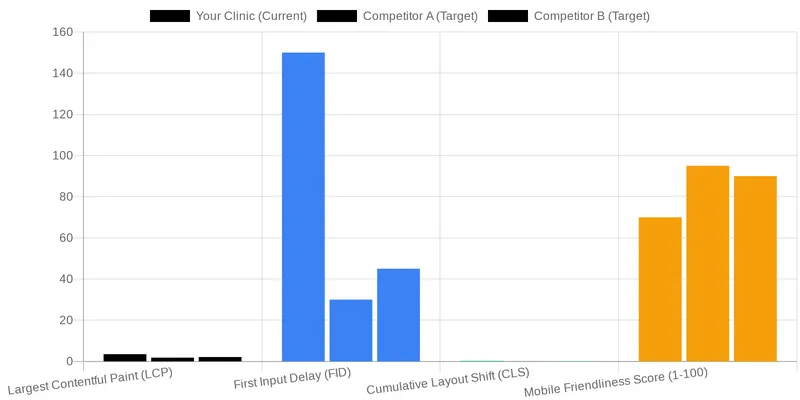
A website’s technical foundation impacts its crawlability, indexability, and user experience, while content gap analysis reveals opportunities to expand topical authority. Assessing Core Web Vitals, mobile-friendliness, and site architecture is critical for medical websites to ensure reliable patient access to information.
Diagnosing Core Web Vitals & Site Architecture
Core Web Vitals (Largest Contentful Paint, First Input Delay, Cumulative Layout Shift) measure website speed, responsiveness, and visual stability, which influence user experience and search rankings. Slow or unstable sites can deter patients, especially on mobile. Use tools like Google PageSpeed Insights to benchmark competitor performance. A logical site architecture with clear navigation and internal linking helps users and search engines understand content hierarchy. A comprehensive technical SEO audit provides more detail.
Identifying Topical Authority & Content Gaps
Content gap analysis identifies topics and keywords your competitors rank for, but your clinic does not. This is crucial for building topical authority in specialized fields like plastic surgery and aesthetic medicine. Use competitor analysis tools to find these content opportunities. Building topical authority means creating content clusters around core medical entities to demonstrate deep knowledge. For example, if a competitor ranks for various types of breast augmentation, your site should cover each variation with equal depth and accuracy.
| Content Type/Topic | Your Clinic Coverage | Competitor Coverage | Gap Opportunity |
|---|---|---|---|
| Procedure Guides (e.g., Rhinoplasty) | Basic overview | Detailed, before/after, FAQs | Expand depth, add visuals |
| Recovery & Aftercare | Limited | Comprehensive, daily logs | Create detailed guides |
| Patient Testimonials/Case Studies | Text-only | Video, detailed stories | Diversify formats, add detail |
| Surgeon Bios & Credentials | Brief | Extensive, publications | Enhance E-E-A-T signals |
Step 4 & 5: Backlink & E-E-A-T Profile Assessment
Backlinks and E-E-A-T (Experience, Expertise, Authoritativeness, Trustworthiness) are critical for ranking in the medical niche. High-quality backlinks signal trust and authority, and strong E-E-A-T is paramount for YMYL content. Assessing these factors reveals a competitor’s advantage. The relevance and quality of referring domains matter more than quantity; links from health organizations, academic institutions, or news outlets carry substantial weight.
Performing a Backlink Gap Analysis for Medical Domains
A backlink gap analysis identifies high-quality, medically relevant links your competitors have that your clinic lacks. Use SEO tools to analyze competitor backlink profiles, focusing on authoritative healthcare domains. Prioritize acquiring links from medical journals, professional associations, health blogs, or local news outlets. For YMYL content, link quality and relevance are more important than volume. A single link from an authoritative medical institution can outweigh many low-quality directory links.
Optimizing E-E-A-T Signals for Harley Street Clinics
E-E-A-T is critical for medical websites. For Harley Street clinics and other premium London healthcare providers, showcase practitioner credentials, clinic accreditations, and medical content. Include detailed surgeon bios with qualifications, board certifications, and professional memberships. Publish patient testimonials and case studies, complying with medical advertising regulations. All medical content must be factually accurate, updated, and authored or reviewed by qualified professionals. Display contact information, physical addresses, and regulatory body registrations to build trust. These E-E-A-T signals directly influence search visibility and patient confidence for YMYL content.
From Audit to Action: Implementing a Semantic SEO Strategy
Insights from the 5-step diagnostic audit inform a semantic SEO strategy. This approach moves beyond keyword density to build topical authority and establish your clinic as a comprehensive resource. Abdurrahman Şimşek uses advanced methodologies to create Semantic Content Networks, structuring content around core medical entities and their relationships so search engines understand your expertise. The goal is to surpass competitors with an entity-driven content architecture.
Building Topical Authority with Semantic Content Networks
Building topical authority means creating content clusters that cover every aspect of a medical topic with interconnected articles, guides, and FAQs. For instance, a plastic surgery clinic should cover “rhinoplasty,” “rhinoplasty recovery,” “types of rhinoplasty,” “choosing a rhinoplasty surgeon,” and “rhinoplasty cost.” This interconnected content, supported by methodologies like Ruxi Data for semantic infrastructure integration and Cost of Retrieval (CoR) Optimization, signals deep subject matter understanding to search engines and differentiates your clinic.
The Abdurrahman Şimşek Advantage: Medical SEO for London Clinics
Specialized medical SEO is crucial for London’s private healthcare market, including Harley Street. Abdurrahman Şimşek offers strategies to attract high-value patients, requiring an understanding of the YMYL search landscape, E-E-A-T optimization, and UK-specific local search ranking factors. By focusing on semantic content architecture and topical authority, clinics can establish a dominant online presence. Explore live competitor analysis and AI-driven strategies for more details.
Reclaim Your Rankings: Partner with a Specialist SEO Strategist
A diagnostic SEO audit provides the data for an effective strategy. Implementing semantic SEO, topical authority building, and E-E-A-T optimization requires specialized expertise. Partnering with an SEO strategist ensures precise execution for sustained organic growth and patient acquisition.
Conclusion
The 5-step diagnostic SEO audit—covering SERP analysis, technical health, content gaps, backlinks, and E-E-A-T—provides a roadmap for why a competing clinic ranks higher. For medical clinics in competitive markets like London, a specialized semantic SEO strategy is essential. Building topical authority helps clinics attract patients and achieve lasting search visibility.
To improve your clinic’s SEO and surpass competitors, connect with Abdurrahman Şimşek for guidance tailored to the medical sector.
Frequently Asked Questions
What is the first step in analyzing why a competing clinic is ranking higher?
The initial step involves a thorough SERP analysis for your primary target keywords. This audit examines your competitor’s on-page content, schema markup, backlink profile, and E-E-A-T signals to pinpoint their strengths and your areas for improvement. Understanding these elements is crucial to diagnose why a competing clinic ranking higher is outperforming you.
How much do backlinks matter in the medical niche when a competing clinic is ranking higher?
High-quality, relevant backlinks from authoritative medical or local London publications are exceptionally crucial in the YMYL niche. If a competing clinic ranking higher possesses a significantly stronger and more relevant backlink profile, it’s a major contributor to their superior search performance. These links signal trust and authority to search engines.
Could my website’s technical SEO be the reason a competing clinic is ranking higher?
Absolutely. Suboptimal technical SEO, such as poor Core Web Vitals, slow page speed, incorrect schema implementation, or indexation issues, can severely impede your rankings. Even with excellent content, these technical flaws can explain why a competing clinic ranking higher is outperforming your site. A comprehensive technical audit is therefore indispensable.
How do I perform a ‘content gap’ analysis to understand why a competing clinic is ranking higher?
A content gap analysis involves identifying valuable patient-focused keywords and topics that your competitor ranks for, but your website currently lacks content on. Creating superior, comprehensive content for these identified gaps is a direct and effective strategy to capture their existing traffic. This helps you understand and address why a competing clinic is ranking higher for specific queries.
My competitor has been around longer. Can I still outrank them?
Yes, absolutely. While domain age can be a minor factor, a superior and proactive SEO strategy can certainly overcome an older, less optimized competitor. Focusing on technical excellence, building robust topical authority with high-quality content, and demonstrating stronger E-E-A-T signals are key to surpassing an established website.
How can I get started with a diagnostic SEO audit for my clinic?
To begin, you can contact Abdurrahman Şimşek, a London-based Semantic SEO Strategist, directly through the website. We’ll discuss your specific challenges and outline a tailored 5-step diagnostic audit to understand why your clinic might not be ranking as high as it should. This initial consultation will set the foundation for improving your online visibility.
Ruxi Data brings together multi-model AI, automated website crawling, live indexation checks, topical authority mapping, E-E-A-T enrichment, schema generation, and full pipeline automation — from crawl to WordPress publish to social posting — all in one platform built for agencies and freelancers who run on results.