
Automating Internal Linking: Building Semantic Content Networks at Scale
Automating internal linking scales content operations by programmatically connecting related pages to build robust semantic content networks. This process leverages AI and semantic SEO principles, including Natural Language Processing, to identify optimal linking opportunities, forming cohesive topic clusters and improving information architecture. By efficiently automating internal linking, sites enhance topical authority, optimize link equity distribution, and boost crawlability, ultimately driving organic growth and search engine visibility. This strategy moves beyond manual efforts to create a dense, logical site structure that mirrors search engine interpretation.
Abdurrahman Şimşek, a Semantic SEO Strategist, provides expert guidance on implementing these advanced linking strategies. His insights help businesses leverage AI and semantic principles to transform their information architecture and achieve measurable SEO improvements.
To explore your options, contact us to schedule your consultation.
Automating internal linking scales content operations and builds semantic content networks. It addresses the time-consuming challenge of manual linking and its missed SEO opportunities. AI and semantic principles enhance topical authority, improve crawlability, and optimize link equity flow to drive organic growth.
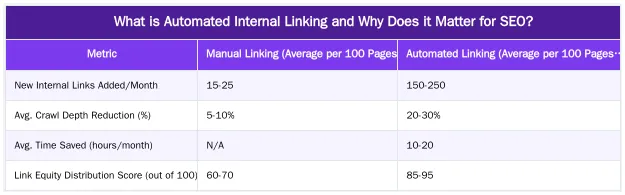
What is Automated Internal Linking and Why Does it Matter for SEO?
Automated internal linking uses software, often powered by artificial intelligence and natural language processing, to identify relevant connections between pages and programmatically insert internal links. This process builds a semantic content network by efficiently interconnecting related content. For SEO, it strengthens topical authority, enhances crawlability, and distributes link equity across a site’s information architecture.
Systematically linking related content helps search engines understand a site’s topical depth and breadth. This ensures important pages receive internal link signals, which can boost their visibility and ranking potential. A well-executed internal linking strategy also improves user experience by guiding visitors to relevant content, increasing engagement and reducing bounce rates. Explore the principles of automated internal linking.
How AI and Semantic SEO Power Automated Internal Linking
Effective automated linking uses AI and semantic SEO principles. Natural Language Processing (NLP) algorithms analyze content to understand its meaning, identify key entities, and recognize conceptual relationships between articles. This semantic analysis moves beyond keyword matching to discern topical relevance.
By understanding these relationships, AI can programmatically identify optimal linking opportunities, forming cohesive topic clusters and content silos. For instance, a system can recognize that an article about “rhinoplasty recovery” is semantically related to “post-operative care for plastic surgery” and automatically suggest or insert a link. Custom scripts, often using Python for SEO, allow for customized and scalable link insertion based on site structure and content strategies.
The goal is a dense, logical network that mirrors search engine information interpretation, where all content contributes to the domain’s topical authority.
The Role of Ruxi Data in Semantic Link Automation
Ruxi Data is a semantic engine that streamlines and optimizes internal linking. It uses Entity-Attribute-Value (EAV) modeling to map relationships between concepts, procedures, and conditions in a content set. By identifying these connections, Ruxi Data automates internal linking, ensuring links are semantically meaningful and contextually relevant.
This precision in link placement and anchor text selection reduces the Search Engine Cost of Retrieval (CoR). When a search engine understands content relationships, it uses less computational effort to crawl, index, and rank pages. This efficiency is an advantage for large websites or those in complex niches. Explore automated internal linking with Ruxi Data.
Building a Semantic Content Network: Strategies & Best Practices
A successful automated internal linking strategy requires planning and best practices. A foundational step is defining pillar pages and their topic clusters. Pillar pages are comprehensive guides on broad subjects, while cluster content covers specific sub-topics. Automated systems connect these pages, ensuring a logical flow of authority and relevance.
Monitoring crawl depth is critical. A well-linked site keeps important content accessible to crawlers, typically within three clicks from the homepage. Automation maintains a shallow crawl depth, preventing content from being orphaned or buried. Periodic human oversight is valuable to refine strategies and align with content goals. This process can be streamlined with an automated topic cluster linking workflow.
Optimizing Anchor Text and Link Placement for Maximum Impact
Anchor text signals a linked page’s topic to users and search engines. Automated systems require more than exact keyword matching for effective anchor text. It requires semantic relevance, using variations and synonyms that fit the content. The goal is diverse, contextually appropriate anchor text that avoids over-optimization and clearly indicates the linked page’s subject.
Strategic link placement is also important. Links should appear naturally within the body text, ideally in paragraphs discussing related concepts. Placing links too frequently or in irrelevant sections can dilute their impact. Automated systems identify optimal insertion points, like the start of a relevant paragraph or a sentence introducing a related entity, to maximize contextual value and distribute link equity.
Elevating E-E-A-T: Automated Linking for YMYL Niches
For Your Money Your Life (YMYL) sectors like medical clinics, plastic surgery practices, and healthcare providers, establishing E-E-A-T (Experience, Expertise, Authoritativeness, and Trustworthiness) is critical. Automated internal linking helps by creating a dense, semantically interconnected content network, which signals comprehensive knowledge and expertise on medical topics to search engines.
For example, a plastic surgery clinic with intelligently linked articles on procedures, recovery, and testimonials demonstrates deep understanding of its field. This structured information architecture helps search engines assess the site’s authority, vital for ranking in sensitive areas like medical advice. The linking pattern reinforces the site’s position as a reliable source, contributing to its E-E-A-T signals.
The Impact on Topical Authority State for Healthcare Domains
An automatically linked content network builds a ‘Topical Authority State’ for complex medical topics. In competitive markets like London’s private healthcare sector, demonstrating expertise is essential. Automated linking interconnects all relevant content, from procedure guides to patient articles, forming a cohesive knowledge base.
This interconnectedness signals to search engines that the site covers a topic exhaustively and authoritatively. For a plastic surgeon’s website, this means content on “breast augmentation” is linked to “implant types,” “recovery timelines,” and “patient testimonials,” creating a comprehensive view of the subject. This depth is crucial for high rankings and trust with search engines and potential patients in markets like Harley Street. The National Institutes of Health’s extensive resources on medical information underscore the importance of accurate, well-organized health content for public trust.
Measuring Success: What to Expect from Automated Internal Linking
Automated internal linking yields measurable improvements in key performance indicators. Organic visibility improves as search engines better understand and rank content. Crawl budget efficiency improves as crawlers navigate the site more effectively, reaching deeper pages with less effort. User engagement metrics like time on site and pages per session increase as visitors are guided to relevant information.
These improvements can lead to higher conversion rates, as better user experience and topical authority build trust. Monitoring these metrics shows the strategy’s impact and allows for refinement.
| Feature | Manual Internal Linking | Automated Internal Linking |
|---|---|---|
| Scalability | Limited, resource-intensive | High, efficient for large sites |
| Consistency | Variable, prone to human error | High, rule-based and AI-driven |
| Semantic Accuracy | Human-dependent, can be subjective | AI-driven, entity-based precision |
| Time Investment | Significant ongoing effort | Minimal after initial setup |
| Error Rate | Higher potential for broken or irrelevant links | Lower with proper configuration and oversight |
Transform Your SEO: Partner with a Semantic SEO Strategist
Strategic automated internal linking scales SEO efforts and builds semantic content networks. This approach is impactful for businesses in competitive, high-value sectors. For London-based medical and aesthetic clinics, these strategies can enhance online visibility and patient acquisition.
Abdurrahman Şimşek specializes in implementing these semantic SEO frameworks. Focusing on YMYL niches, his expertise helps your website rank higher and establish a strong E-E-A-T foundation. To explore how these strategies can benefit your practice, book a Semantic SEO Audit today.
Conclusion
Automating internal linking is necessary for scaling SEO and building semantic content networks. Using AI and semantic principles, businesses can enhance topical authority, improve crawlability, and reinforce E-E-A-T, which is vital in competitive YMYL sectors. Partner with an expert to implement these strategies. For tailored semantic SEO solutions, visit abdurrahmansimsek.com.
Frequently Asked Questions
How does automating internal linking work?
Automating internal linking leverages AI and Natural Language Processing (NLP) to deeply understand the semantic meaning of your content. It then programmatically identifies and inserts highly relevant links between pages, creating a dense, logical network. This process reinforces your topical authority on specific subjects, such as complex medical procedures for a healthcare domain.
Is automating internal linking different from a generic ‘related posts’ plugin?
Yes, it is vastly different. Generic plugins often link based on simple keyword or tag overlap, lacking true contextual understanding. A sophisticated system for automating internal linking understands entity-level relationships, ensuring links are contextually relevant and strategically placed to build comprehensive topical authority, not just show related articles.
What is the main benefit of automating internal linking for SEO?
The primary benefit is unparalleled scalability and precision. For large websites, especially in YMYL niches like healthcare, manually creating and maintaining an optimal linking structure is impossible. Automation ensures every piece of content is perfectly integrated into your topical map, strengthening the entire network and improving search engine crawlability and understanding.
Can automated content linking negatively impact my SEO?
If implemented poorly with spammy or unsophisticated tools, yes, it could. However, a well-designed, rules-based semantic system significantly enhances SEO. It creates a logical site architecture that helps Googlebot discover content faster, understand context better, and distribute PageRank more effectively, leading to improved rankings.
How does this approach benefit YMYL niches like London Private Healthcare?
For YMYL (Your Money Your Life) sectors, establishing E-E-A-T (Experience, Expertise, Authoritativeness, Trustworthiness) is crucial. A semantic content network built through automated linking demonstrates comprehensive authority to search engines. This is vital for London Private Healthcare clinics, as it helps prove their expertise across various medical topics, enhancing trust and visibility.
How can I get started with building a semantic content network for my healthcare domain?
To transform your SEO with a semantic content network, consider partnering with a specialist like Abdurrahman Şimşek. As a Semantic SEO Strategist, he focuses on YMYL & E-E-A-T optimization for surgeons and clinics, delivering a topical authority state for healthcare domains. You can explore services tailored for Harley Street & Central London Aesthetic Clinics to begin.
Ruxi Data brings together multi-model AI, automated website crawling, live indexation checks, topical authority mapping, E-E-A-T enrichment, schema generation, and full pipeline automation — from crawl to WordPress publish to social posting — all in one platform built for agencies and freelancers who run on results.