Algorithmic Authorship: Verifying Surgeon Expertise for SEO
Algorithmic authorship explains how Google identifies and validates a surgeon’s real-world credentials to enhance their online authority. This article details Google’s multi-faceted approach, including entity reconciliation and the analysis of E-E-A-T signals, to connect a GMC-registered surgeon’s expertise with their digital identity. Readers will learn how medical publications, author schema, and a robust online presence contribute to Google’s understanding of a physician’s qualifications, crucial for YMYL content and semantic SEO success in competitive markets like Harley Street.
Abdurrahman Şimşek, a Semantic SEO Strategist, specializes in building high-authority semantic content networks for medical clinics and surgeons. His expertise in information retrieval and entity-attribute-value modeling ensures content aligns with Google’s E-E-A-T requirements, enhancing digital trust and visibility.
To explore your options, contact us to schedule your consultation.
In the highly competitive and trust-sensitive world of medical search, understanding algorithmic authorship is paramount for surgeons. This article will demystify how Google connects your real-world expertise and credentials as a GMC-registered surgeon to your online content, ensuring your authority is recognized and rewarded in search results. We’ll explore the signals Google prioritizes and provide actionable strategies to strengthen your digital identity, crucial for private practices in London and Harley Street.
How Google Verifies a Surgeon’s Expertise: Key Signals
Google employs a multi-faceted approach to verify a surgeon’s expertise and establish their digital identity. This involves analyzing a broad spectrum of data points and signals across the web. These signals go beyond a simple author bio, delving into a surgeon’s professional footprint to build a comprehensive understanding of their qualifications and contributions to the medical field.
Beyond the Bio: The Role of Entity Reconciliation
Entity reconciliation is a core process Google uses to build a surgeon’s comprehensive digital identity. It involves connecting disparate mentions of a surgeon—their name, clinic affiliation, medical publications, professional profiles, and academic contributions—across the vast expanse of the internet. Google consolidates these various data points into a single, verifiable entity within its Knowledge Graph. This process allows Google to understand that “Dr. Jane Doe” mentioned on a university research page, a Harley Street clinic website, and a LinkedIn profile are all the same individual. This unified entity strengthens the surgeon’s perceived authority and expertise. For a deeper dive into this concept, explore entity reconciliation for SEO.
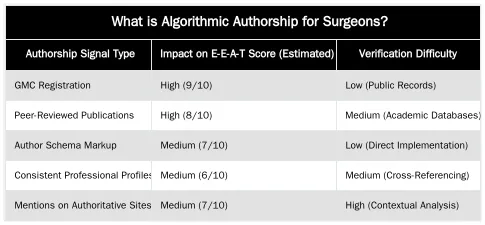
GMC Registration and Medical Publications as Trust Signals
Official medical registrations, such as the General Medical Council (GMC) registration in the UK, are paramount trust signals. Google likely cross-references these public records to confirm a surgeon’s active and legitimate status. Similarly, peer-reviewed medical publications, research papers, and citations in reputable journals serve as strong indicators of a surgeon’s expertise and authority. These academic contributions demonstrate a surgeon’s active involvement in their field and their commitment to advancing medical knowledge. Google’s algorithms are designed to identify and prioritize content authored by individuals with such verifiable credentials, especially for sensitive health topics.
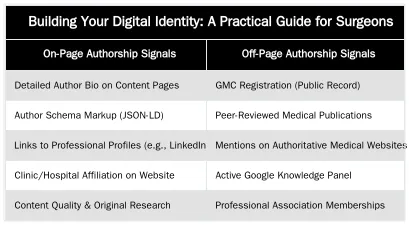
Building Your Digital Identity: A Practical Guide for Surgeons
Proactively building and strengthening your digital identity is essential for surgeons aiming to enhance their online visibility. This involves a strategic approach to how your professional information is presented and connected across the web. By implementing specific technical and content strategies, surgeons can provide clear signals to search engines about their expertise and authority.
Leveraging Author Schema and Structured Data
Implementing Author schema markup is a direct way to communicate your credentials to search engines. This structured data explicitly tells Google about the content’s author, their qualifications, affiliations, and links to their professional profiles. For medical content, using specific schema types like `MedicalWebPage` or `Physician` in conjunction with `Author` schema can further enhance clarity. This helps Google understand who is behind the content and their relevance to the medical field. Learn more about implementing medical schema for surgeons to optimize your online presence.
Cultivating a Robust Online Presence & Professional Network
Maintaining consistent and comprehensive professional profiles across various platforms is vital. This includes LinkedIn, official hospital directories, medical association websites, and academic platforms. Actively contributing to reputable medical platforms, participating in academic discussions, and securing mentions on authoritative healthcare websites further solidify your digital footprint. Each consistent mention and verified profile acts as a signal, reinforcing your expertise and contributing to your overall digital identity. This network of interconnected professional data points helps Google build a clearer picture of your standing within the medical community.
Conclusion
Understanding and actively cultivating your digital identity through strong content attribution is non-negotiable for surgeons in 2026. Google’s sophisticated algorithms prioritize verifiable expertise, especially for YMYL content. By strategically leveraging signals like GMC registration, medical publications, and structured data, surgeons can significantly enhance their E-E-A-T, improve search rankings, and build patient trust. For London-based private healthcare practitioners seeking to optimize their online presence and dominate local organic search, specialized guidance is invaluable. To develop a robust semantic content network and strengthen your digital identity, connect with an expert in medical SEO today. Visit abdurrahmansimsek.com to learn more.
Frequently Asked Questions
What is algorithmic authorship in the context of a surgeon?
Algorithmic authorship is Google’s sophisticated system for identifying and verifying the real-world identity and credentials of a content creator. For surgeons, this process connects your online content to your GMC registration and professional expertise. It ensures that medical information presented online originates from a genuine, qualified expert, building trust and authority in search results.
What is the most important signal for establishing strong expertise recognition?
Consistency across your digital footprint is paramount. Ensure your name, specialization, and credentials, such as your GMC number, are uniform across your website, professional profiles, medical directories, and any publications. This consistent digital identity helps Google confidently reconcile your entity and understand your expertise.
How does an author page on my website contribute to algorithmic authorship?
A comprehensive author page is crucial for establishing your online authority. It should detail your education, qualifications, professional affiliations, and any publications or presentations. This dedicated page explicitly provides search engines with structured information about your expertise, reinforcing your claim as the authoritative source for your content.
Do I need to be a published author in medical journals to achieve algorithmic authorship?
While academic publications are a very strong signal for expertise, they are not strictly essential for all medical professionals. For a practicing surgeon, demonstrating your knowledge through detailed case studies, conference presentations, and comprehensive patient guides on your own site can also effectively establish your digital authority. The key is to consistently showcase your deep understanding and experience in your field.
Can a ghostwriter create content for my website while maintaining my algorithmic authorship?
Yes, content can be ghostwritten, but it is critical that the qualified surgeon thoroughly reviews, fact-checks, and ultimately approves the material. The surgeon must be clearly credited as the author, and the website should have a transparent editorial policy confirming that all medical content is vetted by a qualified expert for accuracy and reliability. This ensures the content reflects your verified expertise.
How can a semantic SEO strategist help improve my online authority and expertise signals?
A semantic SEO strategist specializes in building high-authority content networks that clearly communicate your expertise to search engines. They can help structure your website’s information, optimize your digital identity across platforms, and implement strategies to enhance Google’s understanding of your professional credentials. This strategic approach ensures your medical practice gains the recognition it deserves in competitive search landscapes like Harley Street.
Ruxi Data brings together multi-model AI, automated website crawling, live indexation checks, topical authority mapping, E-E-A-T enrichment, schema generation, and full pipeline automation — from crawl to WordPress publish to social posting — all in one platform built for agencies and freelancers who run on results.