
WordPress SEO Automation: Scaling Medical Clinic Digital Presence
WordPress SEO automation in 2026 is essential for medical clinics to achieve local organic search dominance and attract high-value patients. This guide details how strategic wordpress seo automation streamlines content operations, automates internal linking, and enhances schema generation for medical clinics. It outlines a workflow leveraging programmatic SEO and semantic networks to build robust topical authority. Understanding these automated processes is crucial for medical practices to manage extensive YMYL content, ensure compliance, and maintain a competitive edge in the evolving search landscape, particularly in competitive markets like London.
Abdurrahman Şimşek, a Semantic SEO Strategist, specializes in building high-authority semantic content networks for medical clinics. His expertise focuses on leveraging advanced automation techniques to optimize digital presence within the competitive London healthcare market.
To explore your options, contact us to schedule your consultation.
In 2026, wordpress seo automation is no longer a luxury but a necessity for medical clinics aiming to dominate local organic search and attract high-value patients. This guide explores how strategic automation can transform your clinic’s digital presence, streamline content operations, and build unparalleled topical authority, specifically for the competitive London healthcare market. Understanding and implementing these automated workflows is crucial for maintaining a leading position in the ever-evolving search landscape.
What is WordPress SEO Automation and Why It Matters for Medical Clinics?
WordPress SEO automation involves using tools, plugins, and custom scripts to perform repetitive search engine optimization tasks on a WordPress website without manual intervention. For medical clinics, this means automating processes like internal linking, schema markup generation, content deployment, and technical audits. This approach ensures consistency, reduces human error, and frees up valuable time for strategic initiatives, which is critical in the highly regulated and competitive healthcare sector, especially for Your Money Your Life (YMYL) content.
The core components of SEO automation include programmatic content generation, structured data implementation, and efficient content distribution. For medical practices, this translates into accurately representing services, procedures, and physician information across their digital footprint. Automation helps clinics manage vast amounts of medical content, ensuring it is always up-to-date, compliant, and optimized for search engines. This is particularly relevant for London-based clinics, where competition for local organic search visibility is intense.
Why Medical Clinics Need SEO Automation in 2026: The Competitive Edge
The SEO landscape for medical clinics in 2026 demands efficiency, accuracy, and deep topical authority. Manual SEO efforts often struggle to keep pace with the volume of content required to cover a clinic’s full range of services, conditions, and locations. Automation addresses critical pain points such as slow content velocity, the need for stringent compliance in medical information, and the complex management of extensive medical data. By automating routine tasks, clinics can allocate resources to higher-level strategic planning and patient care.
Programmatic SEO, a key aspect of this automation, allows clinics to scale their content creation and optimization efforts significantly. This approach ensures that every service page, doctor profile, or treatment guide adheres to established SEO best practices and compliance standards. For clinics in areas like Harley Street, Marylebone, and Chelsea, where patient acquisition is highly competitive, leveraging automation provides a distinct advantage in capturing relevant organic traffic.
Scaling Content & Compliance with Programmatic SEO
Programmatic SEO for WordPress sites enables medical clinics to generate high-quality, compliant content at scale. By utilizing custom post types and Advanced Custom Fields (ACF), clinics can define structured data for various medical entities such as procedures, conditions, symptoms, and physician profiles. This structured data then feeds into templates, allowing for the rapid creation of hundreds or thousands of unique, yet consistent, pages.
For instance, a plastic surgery clinic can use ACF to store data points for each procedure (e.g., recovery time, ideal candidate, benefits, risks). This data can then be programmatically pulled to generate unique service pages, ensuring accuracy and compliance across all content. This method not only accelerates content deployment but also maintains a consistent brand voice and medical accuracy, which is paramount for YMYL content.
Key Areas for Automation: A Workflow Breakdown for Medical Sites
Implementing effective SEO automation tools requires a clear understanding of which tasks yield the most impact. For medical WordPress sites, the focus should be on areas that are repetitive, prone to human error, and crucial for search engine understanding. A strategic content deployment workflow integrates these automated processes seamlessly, enhancing overall site performance and visibility.
Key areas include intelligent internal linking, precise schema markup generation, and efficient content publishing. These elements contribute directly to building a robust semantic content network. By leveraging specialized plugins or custom scripts, clinics can ensure their digital presence is not only extensive but also deeply interconnected and easily digestible by search engines.
Automated Internal Linking for Semantic Topic Clusters
Automated internal linking is fundamental for building robust topic clusters around medical procedures and conditions. This process involves using plugins or custom Python scripts that analyze your content for semantic relationships between pages. For example, a page on “Rhinoplasty” can automatically link to related pages like “Nose Reshaping Techniques,” “Recovery After Nose Surgery,” and “Surgeon Profiles.”
This systematic approach enhances topical authority by demonstrating comprehensive coverage of a subject to search engines. It also improves user navigation, keeping potential patients engaged longer. Implementing a sophisticated automated internal linking system requires a deep understanding of content entities and their connections, ensuring that links are contextually relevant and valuable. Learn more about this process in our automated internal linking guide.
Streamlining Schema Markup Generation & Deployment
Accurate schema markup is crucial for medical sites, as it helps search engines understand the specific entities and relationships within your content. Automating schema generation and deployment ensures that every page, from a doctor’s bio to a service description, includes precise structured data. This can be achieved using a dedicated schema generation plugin or custom solutions that dynamically pull data from Advanced Custom Fields.
For medical clinics, this means automatically applying `MedicalProcedure`, `Physician`, `Clinic`, `Service`, and `Review` schema types. This structured data improves how your content appears in search results, potentially leading to rich snippets and enhanced visibility. Consistency and accuracy in schema are paramount for YMYL sites to build trust and authority with search engines. Explore detailed strategies in our automated schema markup guide.
Measuring Success and Future-Proofing Your Clinic’s SEO
Measuring the success of SEO automation efforts involves tracking key performance indicators (KPIs) that reflect both efficiency gains and improved organic visibility. Relevant metrics include organic traffic growth, keyword rankings for medical terms, conversion rates for patient inquiries, and the time saved on manual SEO tasks. Regular analysis of these KPIs allows clinics to refine their automation strategies and ensure they align with evolving search engine algorithms and patient needs.
Future-proofing your clinic’s SEO involves continuous adaptation. This means regularly reviewing automated processes, updating data sources for programmatic content, and staying informed about Google’s algorithm changes, especially those impacting YMYL content. By maintaining a flexible and data-driven approach, medical clinics can ensure their automated semantic networks continue to deliver long-term visibility and patient engagement.
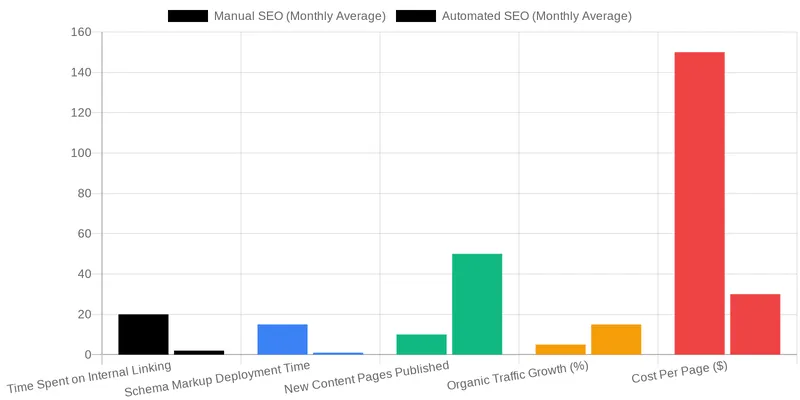
Manual vs. Automated SEO Tasks: A Performance Comparison
The distinction between manual and automated SEO tasks highlights the significant advantages of implementing automation. While manual efforts offer granular control, they are inherently time-consuming, prone to inconsistencies, and difficult to scale. Automation, conversely, excels in speed, accuracy, and scalability, making it ideal for managing the extensive content requirements of medical clinics.
| SEO Task | Manual Approach | Automated Approach |
|---|---|---|
| Internal Linking | Time-intensive, inconsistent, difficult to maintain across large sites. | Rapid, consistent, entity-aware, scales with content volume. |
| Schema Markup | Manual coding, high risk of errors, slow to update. | Dynamic generation, error-reduced, ensures compliance. |
| Content Deployment | Slow, requires human oversight for each page, limited velocity. | Programmatic publishing, high velocity, consistent formatting. |
| Technical Audits | Periodic, resource-heavy, reactive issue resolution. | Continuous monitoring, proactive issue identification. |
| Content Updates | Manual review and editing for each page. | Data-driven updates, ensures accuracy across related content. |
Elevate Your Clinic’s Digital Presence with Semantic SEO Automation
Implementing a robust wordpress seo automation workflow is essential for medical clinics aiming to achieve and sustain top organic search rankings in 2026. This strategic shift streamlines operations, ensures content accuracy and compliance, and builds a powerful semantic content network. By embracing automation, clinics can enhance their topical authority, attract high-value patients, and solidify their position in competitive markets like London.
Conclusion
The future of medical SEO on WordPress is intrinsically linked to intelligent automation. For plastic surgeons, aesthetic clinic owners, and private healthcare providers, leveraging programmatic SEO, automated internal linking, and precise schema generation is no longer optional. These strategies, combined with advanced semantic engineering and data integration, create a resilient and authoritative digital presence. To transform your clinic’s online visibility and dominate local organic search, consider a tailored semantic SEO strategy. Partner with Abdurrahman Şimşek to build a high-converting website and attract high-value patients across London’s premium postcodes. Discover how semantic SEO can elevate your clinic.
Frequently Asked Questions
What is WordPress SEO automation and why is it crucial for medical clinics?
WordPress SEO automation involves using specialized tools, plugins, and custom scripts to perform repetitive search engine optimization tasks on a WordPress website. For medical clinics, it’s crucial because it streamlines complex processes like schema markup, internal linking, and content updates, allowing clinics to maintain a competitive edge in the highly regulated and competitive healthcare search landscape. This efficiency frees up valuable time for medical professionals to focus on patient care.
How can WordPress SEO automation help medical clinics improve E-E-A-T?
One significant benefit of WordPress SEO automation is its ability to enhance E-E-A-T signals. You can automate the application of ‘Physician’ and ‘ReviewedBy’ schema to all relevant medical articles. By using Advanced Custom Fields to assign a reviewing doctor to each post, a script can automatically inject the correct structured data, ensuring these crucial E-E-A-T signals are consistently applied across your site.
What is the most impactful SEO task to automate on a medical WordPress site using these methods?
Automating internal linking is arguably the most impactful SEO task for a medical WordPress site. Using a system that understands semantic relationships between procedures, conditions, and related services can build a powerful topic cluster architecture at scale. This is a task that is difficult and extremely time-consuming to manage manually, yet it’s vital for establishing topical authority.
Can WordPress SEO automation accelerate content indexing for medical practices?
Absolutely. A key part of WordPress SEO automation is integrating the Google Indexing API directly into your site’s workflow. This allows you to automatically notify Google as soon as a new article or procedure page is published or updated. Consequently, this significantly speeds up the time it takes for your fresh medical content to be discovered and indexed by search engines.
What are the potential risks of implementing too much SEO automation on a medical website?
The main risk of excessive automation in SEO, especially for medical content, is a potential loss of nuance and quality control. While automation excels at repetitive, data-driven tasks like schema generation or internal linking based on set rules, the core content creation and final medical review must always have rigorous human oversight. This ensures clinical accuracy, maintains patient trust, and prevents the dissemination of misinformation.
How can a medical clinic get started with advanced SEO automation strategies?
Medical clinics looking to implement advanced SEO automation strategies should seek expert guidance from a specialist in semantic SEO for healthcare. Abdurrahman Şimşek, a London-based Semantic SEO Strategist, offers tailored consulting to build high-authority semantic content networks for medical clinics. You can explore his services and discuss your clinic’s specific needs by visiting his website or contacting him directly for a strategic consultation.
Ruxi Data brings together multi-model AI, automated website crawling, live indexation checks, topical authority mapping, E-E-A-T enrichment, schema generation, and full pipeline automation — from crawl to WordPress publish to social posting — all in one platform built for agencies and freelancers who run on results.