Clinic Not Ranking Google Maps: Fixing Your Local Visibility in London
If your clinic not ranking Google Maps in London, this guide identifies common issues and provides actionable local SEO strategies. Many medical practices struggle with local search visibility due to inconsistent NAP information, unoptimized Google Business Profiles, and insufficient local citations. Understanding proximity ranking factors and leveraging patient reviews are crucial. This article details how to optimize your Google Business Profile, ensure NAP consistency across medical directory listings, and implement advanced local SEO for doctors to improve your clinic’s online presence and attract more patients.
Abdurrahman Şimşek, a London-based Semantic SEO Strategist with 10 years of experience, specializes in building high-authority semantic content networks for medical clinics. His expertise in medical SEO, Google Business Profile optimization, and local search strategies helps clinics dominate competitive markets like Harley Street.
To explore your options, contact us to schedule your consultation.
Is your London clinic not ranking Google Maps, leaving you invisible to potential patients searching for local healthcare services? Many medical practices in competitive urban areas like London struggle with local search visibility. This guide explains the core reasons why your clinic might not be appearing prominently and provides actionable strategies to enhance your local SEO. By understanding and implementing these solutions, your clinic can attract more patients, improve its online presence, and secure a dominant position in the London healthcare market.
Why Isn’t Your London Clinic Showing Up on Google Maps?
Many factors contribute to a medical practice’s absence or low ranking on Google Maps. The primary culprits often involve incomplete or inconsistent online information, a poorly optimized Google Business Profile, and a lack of local authority signals. Google prioritizes accuracy and relevance, meaning any discrepancies or missing details can significantly hinder your clinic’s visibility in local search results.
The Core Problem: Inconsistent NAP Information
One of the most frequent reasons a medical clinic struggles to rank on Google Maps is inconsistent NAP (Name, Address, Phone Number) information. When your clinic’s name, address, or phone number varies across different online platforms—your website, Google Business Profile, social media, and various directories—Google’s algorithms become confused. This inconsistency erodes Google’s trust in your business data, making it less likely to display your clinic for relevant local searches. Maintaining absolute accuracy and uniformity across all online mentions is fundamental for strong local search performance.
Mastering Your Google Business Profile for Local Visibility
Your Google Business Profile (GBP) is the cornerstone of local SEO for any medical practice. It acts as your digital storefront on Google Search and Maps. A fully optimized GBP provides Google with comprehensive information about your clinic, directly influencing your ranking and visibility. Neglecting this crucial tool means missing out on a significant source of patient inquiries and appointments.
Choosing the Right GBP Categories for Medical Clinics
Selecting precise and relevant categories for your GBP is paramount. Google uses these categories to understand your clinic’s core services and match them with user queries. For specialized medical fields, choosing the most specific primary category is vital (e.g., “Plastic Surgeon” instead of just “Doctor”). Supplement this with relevant secondary categories like “Skin Care Clinic” or “Dermatologist” to cover all services offered. This strategic categorization ensures your clinic appears for highly targeted searches, attracting patients specifically seeking your expertise. For a deeper dive into optimizing for competitive areas, consider exploring a dedicated Harley Street SEO strategy.
Optimizing Your Business Description, Services, and Photos
Beyond categories, every element of your GBP requires careful optimization. Craft a compelling business description that highlights your clinic’s specializations, unique selling points, and the patient experience. List all services accurately and comprehensively, using keywords patients might search for. High-quality, geo-tagged images of your clinic’s interior, exterior, staff, and procedures build trust and engagement. Regularly updating these elements signals to Google that your profile is active and current, further boosting its prominence.
The Critical Role of NAP Consistency & Local Citations
NAP consistency and a robust local citation strategy are foundational for any medical clinic aiming for high rankings on Google Maps. Citations are online mentions of your clinic’s Name, Address, and Phone Number, even without a direct link to your website. Google cross-references these citations to verify your business information, building confidence in your legitimacy and accuracy. A strong, consistent citation profile acts as a powerful trust signal, directly impacting your local search performance.
Auditing Your Clinic’s Online Presence for NAP Errors
Begin by conducting a thorough audit of your clinic’s online presence. Manually search for your clinic across major directories, social media platforms, and industry-specific listings. Look for any discrepancies in your Name, Address, or Phone Number. Even minor variations, such as “St.” vs. “Street” or different phone number formats, can confuse search engines. Tools like BrightLocal or Moz Local can assist in identifying these inconsistencies, but a manual check ensures no stone is left unturned. Correcting these errors is a critical step in establishing trust with Google.
Building High-Quality Local Citations and Medical Directory Listings
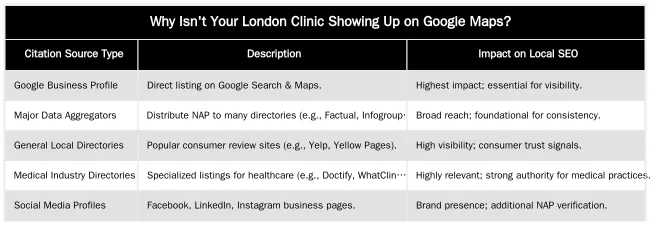
Once NAP consistency is established, actively build high-quality local citations. Prioritize reputable general directories (e.g., Yelp, Foursquare) and, crucially, industry-specific medical directories. These specialized listings carry significant weight for healthcare providers. Data aggregators also distribute your information widely. Focus on quality over quantity, ensuring each citation is accurate and complete. Here’s a comparison of key citation sources:
How Patient Reviews and Proximity Impact Your Clinic’s Ranking
Patient reviews and geographical proximity are two powerful, often underestimated, factors that significantly influence your clinic’s ranking on Google Maps. Positive reviews signal trustworthiness and quality to both potential patients and search engines, while proximity ensures your clinic appears for those searching nearby. Leveraging these elements effectively can provide a substantial competitive advantage, particularly in dense urban environments like London.
Strategies for Earning More Positive Patient Reviews
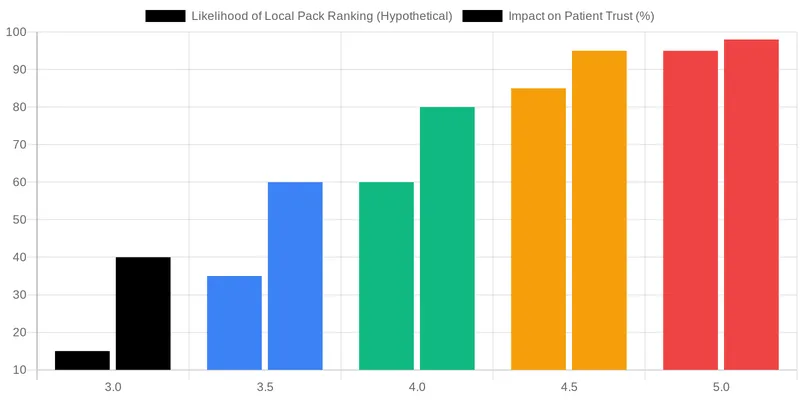
Actively encouraging satisfied patients to leave reviews is crucial. Implement ethical strategies such as sending follow-up emails with direct links to your Google Business Profile review page, placing clear signage in your clinic, or verbally asking for feedback after a positive experience. Respond professionally to all reviews, both positive and negative. A high volume of recent, positive reviews not only boosts your local ranking but also builds social proof, attracting more new patients. According to a 2023 study by BrightLocal, businesses with more reviews tend to rank higher in local search results.
Understanding Proximity and Geo-Fencing for London Clinics
Google’s local search algorithm heavily prioritizes businesses closest to the searcher. This “proximity” factor is especially critical in a city like London, where numerous clinics might offer similar services. While you cannot change your physical location, you can optimize your online presence to maximize your reach within your target geographical areas. Geo-fencing, in an SEO context, involves optimizing content and GBP for specific London postcodes or neighborhoods (e.g., Harley Street, Marylebone, Mayfair). This ensures your clinic is highly relevant for searches originating from or targeting these premium locations. For example, a clinic in Marylebone should ensure its GBP and website content explicitly mention “Marylebone clinic” or “doctors in Marylebone” where appropriate.
Advanced Local SEO for Medical Clinics: An Expert’s Perspective
Achieving true local search dominance for medical clinics, especially in London’s competitive landscape, requires moving beyond basic optimization. As a Semantic SEO Strategist with over a decade of experience, Abdurrahman Şimşek emphasizes a holistic approach that integrates semantic engineering, robust technical foundations, and a deep understanding of the medical search environment. This advanced methodology ensures sustained visibility and patient acquisition.
Beyond Basics: Semantic SEO and Technical Foundations for Local Success
Semantic SEO involves structuring your online content to help search engines understand the meaning and context of your services, not just keywords. For medical clinics, this means implementing structured data markup (like LocalBusiness Schema) to explicitly tell Google about your clinic’s services, specialties, and location. Integrating advanced semantic infrastructure, such as Ruxi Data, allows for precise entity-attribute-value modeling, enhancing Google’s ability to connect your clinic with highly specific patient queries. Furthermore, optimizing for Cost of Retrieval (CoR) ensures that search engines can efficiently access and process your clinic’s information, leading to better indexing and ranking. This technical precision is vital for standing out in a crowded market.
Navigating the Competitive London Healthcare Search Landscape
The London healthcare market, particularly in areas like Harley Street, Mayfair, and Knightsbridge, presents unique challenges. These premium postcodes are saturated with highly reputable clinics, making local search extremely competitive. A specialized approach is essential, focusing on building topical authority around your specific medical specializations. This involves creating comprehensive, expert-authored content that addresses patient needs and concerns, establishing your clinic as a trusted authority. For plastic surgeons and aesthetic clinics, this often means a tailored plastic surgery SEO London strategy that targets high-value patient segments and specific procedures, ensuring your clinic captures the attention of the right audience.
Understanding the nuances of Google’s E-E-A-T (Experience, Expertise, Authoritativeness, Trustworthiness) guidelines is also critical for medical content. Google places immense importance on the credibility of health information. Ensuring your website content is authored or reviewed by GMC-registered professionals, citing authoritative medical sources like the NHS or World Health Organization, and showcasing practitioner credentials significantly boosts your clinic’s perceived trustworthiness in the eyes of search engines.
Achieving Local Search Dominance: What to Expect
Implementing a comprehensive local SEO strategy for your medical clinic yields tangible results beyond just appearing on Google Maps. Expect a significant improvement in your clinic’s local pack rankings, leading to increased visibility for relevant patient searches. This enhanced online presence translates directly into more patient inquiries, website visits, and ultimately, a higher volume of appointments. Your clinic’s brand visibility will strengthen within your target London postcodes, establishing you as a leading healthcare provider in your specialty.
The journey to local search dominance is continuous, requiring ongoing monitoring and adaptation. However, with a solid foundation and expert guidance, your clinic can achieve sustained growth and a competitive edge in the bustling London healthcare sector. The goal is not just to rank, but to rank effectively, attracting high-value patients who are actively seeking your specific medical services.
Measuring Success: Key Metrics for Local SEO Performance
To track the effectiveness of your local SEO efforts, monitor key performance indicators (KPIs). Google Business Profile Insights provides valuable data on how patients interact with your listing, including calls, direction requests, and website clicks. Track your local pack rankings for target keywords and monitor changes in Google Maps visibility. Beyond these, focus on patient acquisition rates directly attributable to local search, conversion rates from your website, and the overall growth in patient inquiries. These metrics offer a clear picture of your return on investment and guide future optimization strategies.
Ready to Transform Your Clinic’s Local Visibility in London?
If your London clinic isn’t ranking Google Maps as effectively as it should be, it’s time for a strategic intervention. Navigating the complexities of local SEO, especially in a competitive market like London, requires specialized expertise. Abdurrahman Şimşek offers tailored semantic SEO and web development solutions designed specifically for medical clinics, skin clinics, and plastic surgeons. Partner with an expert who understands the nuances of the London private healthcare market to build a high-converting website and dominate local organic search. Discover how to attract high-value patients and achieve lasting local search dominance.
Frequently Asked Questions
What is the most common reason a clinic not ranking Google Maps?
The most common reason is inconsistent NAP (Name, Address, Phone Number) information across the web. If your details differ between your Google Business Profile, website, and other online directories, it confuses Google and erodes trust, causing your ranking to drop. Ensuring uniformity across all platforms is crucial for local search visibility.
Why might a clinic not ranking Google Maps despite having many positive patient reviews?
While positive patient reviews are critically important, a strong review profile alone might not be enough if other foundational elements are weak. Factors like an unoptimized Google Business Profile, inconsistent NAP information, or a lack of relevant local citations can still prevent a clinic from achieving top rankings. A holistic approach to local SEO is essential.
My London clinic not ranking Google Maps even though it’s on Harley Street. What could be the issue?
While proximity is a major factor, a competitor might have a more optimized Google Business Profile, more high-quality reviews, or stronger local citations from authoritative medical directories. A situation where a clinic not ranking Google Maps despite a prime location often points to weaknesses in these other areas. Addressing these aspects can significantly improve your local ranking.
Is keyword stuffing in my Google Business Profile name a good strategy if my clinic isn’t ranking well?
No, this is against Google’s guidelines and is known as ‘keyword stuffing’. Your Google Business Profile name must be your actual, registered business name, exactly as it appears on your signage and legal documents. Attempting to manipulate it can lead to a profile suspension and negatively impact your local visibility.
What is a quick actionable step to improve local map visibility for a medical practice?
Ensure every service you offer (e.g., ‘Rhinoplasty’, ‘Dermal Fillers’) has its own dedicated page on your website. Then, link to these pages from the ‘Services’ section of your Google Business Profile. This helps Google understand the full scope of what you offer, improving relevance for specific patient searches.
How can Abdurrahman Şimşek help if my clinic not ranking Google Maps effectively?
Abdurrahman Şimşek specializes in building high-authority Semantic Content Networks and optimizing Google Business Profiles specifically for medical clinics in London. He can conduct a comprehensive audit, identify the root causes why your clinic not ranking Google Maps, and implement a tailored strategy to improve your local search visibility and attract more patients. You can contact him via his website for a consultation.
Ruxi Data brings together multi-model AI, automated website crawling, live indexation checks, topical authority mapping, E-E-A-T enrichment, schema generation, and full pipeline automation — from crawl to WordPress publish to social posting — all in one platform built for agencies and freelancers who run on results.