
URL Structure Best Practices: Optimizing Medical Website Visibility
Implementing url structure best practices is fundamental for medical websites aiming to enhance search engine visibility and user experience. This guide details how to create SEO-friendly URLs, leveraging clear subfolders and logical information architecture to improve crawlability and establish E-E-A-T. Strategic URL design for medical clinics and plastic surgeons ensures search engines accurately interpret content hierarchy, improving ranking potential. Understanding these principles helps optimize for both user navigation and effective semantic SEO.
Abdurrahman Şimşek, a Semantic SEO Strategist specializing in medical clinics, provides expert guidance on optimizing website architecture. His approach focuses on building high-authority content networks and improving information retrieval for specialized healthcare providers.
To explore your options, contact us to schedule your consultation. You can also reach us via: Book a Semantic SEO Audit, Direct WhatsApp Strategy Line: +90 506 206 86 86
For London’s medical clinics and plastic surgeons, a well-optimized url structure best practices guide is a foundational element of semantic SEO and patient acquisition. This guide covers URL structure best practices for medical websites in 2026 to make your online presence clear, crawlable, and conversion-ready for search engines and patients.
What are URL Structure Best Practices for Medical Websites?
The ideal URL structure for medical websites is simple, logical, and descriptive, using subfolders to create a clear hierarchy. This enhances readability for users and search engines. A well-structured URL provides immediate context about the page’s content, improving navigation and search engine understanding. For medical practices, this means organizing services, doctor profiles, and educational content in a predictable manner.
The Core Principles of an SEO-Friendly URL
An SEO-friendly URL should be human-readable. It must be concise to avoid truncation in search results. Relevant keywords in the URL slug signal the page’s topic to search engines. A logical, hierarchical folder structure helps users and crawlers navigate the website. For instance, a URL like yourclinic.com/treatments/facial-surgery/rhinoplasty communicates its content and position within the site’s information architecture.
Why a Strategic URL Structure is Crucial for Medical SEO & E-E-A-T
A strategic URL design directly influences how search engines perceive and rank a medical website. For Your Money Your Life (YMYL) content, a clear and logical URL hierarchy helps establish E-E-A-T (Experience, Expertise, Authoritativeness, and Trust). Search engines prioritize sites that demonstrate these qualities, and an organized URL structure helps convey them.
Enhancing User Experience and Navigational Clarity
Clear URLs guide patients through your website, improving their experience. A descriptive URL allows users to anticipate page content before clicking, which can reduce bounce rates and increase engagement. Navigational elements like breadcrumbs also improve clarity by visually representing the website hierarchy and showing users their location. For a London-based aesthetic clinic, a URL like clinicname.com/treatments/skin/acne-treatment informs the user about the service offered.
Signaling Expertise and Authority to Search Engines
Logical categorization via URLs helps Google understand the topical depth and expertise of a medical practice. Grouping related content under clear subfolders (e.g., /doctors/, /procedures/, /conditions/) signals an organized information architecture. This structure reinforces E-E-A-T by demonstrating a comprehensive, authoritative approach to specific medical fields. Search engines interpret this as a trustworthy resource. For more on Google’s guidelines, refer to their SEO Starter Guide.
Implementing SEO-Friendly URL Structures: A Practical Guide for Clinics
Subfolders vs. Subdomains: Choosing the Right Hierarchy
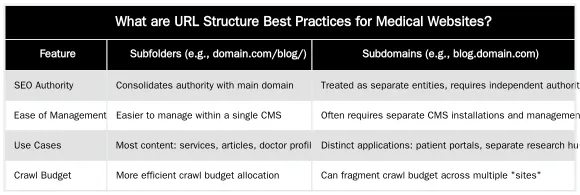
The choice between subfolders and subdomains impacts how search engines perceive your content. For most medical content like procedure pages, doctor profiles, and articles, subfolders are recommended to consolidate SEO authority under the main domain. Subdomains are treated as separate entities by search engines, requiring individual SEO effort. They are appropriate for distinct functions like a patient portal or an independent research blog.
For a deeper dive into content organization, consider exploring content silo architecture.
Crafting Effective URL Slugs and Managing Parameters
URL slugs identify a specific page (e.g., /rhinoplasty in domain.com/treatments/rhinoplasty). Best practices include using relevant keywords, keeping slugs concise, and separating words with hyphens. Avoid stop words (like “a,” “the,” “and”) unless needed for clarity. URL parameters (e.g., ?sessionid=123) can cause duplicate content issues if not managed. Implement canonical URLs to specify the preferred page version to search engines, preventing dilution of SEO value.
Optimizing for Crawl Budget & Cost of Retrieval with Smart URLs
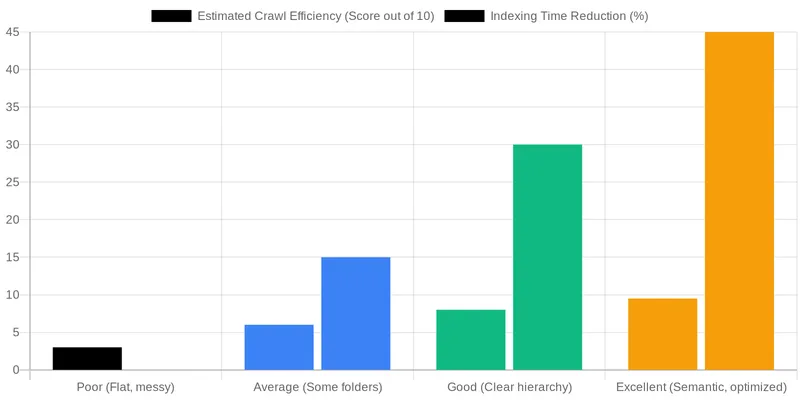
For extensive medical websites with thousands of pages, an efficient URL structure directly impacts the ‘Cost of Retrieval’ for search engines. This refers to the resources (time, processing power) Google expends to crawl and index content. Optimizing your URL structure streamlines this process, helping your medical information get discovered and ranked.
Streamlining Indexing for Extensive Medical Content
A clean, hierarchical URL structure helps search engines discover and index medical content. Logically organized URLs allow bots to understand relationships between pages, such as a surgeon’s profile, their procedures, and related articles. This structured approach helps crawlers map your semantic content network. An optimized structure reduces indexing effort, allowing more content to be processed within your allocated crawl budget.
The Role of HTTPS and Canonicalization in URL Health
For medical websites, HTTPS is non-negotiable. It encrypts data between the user and the site, protecting patient information and signaling trustworthiness to users and search engines. Google considers HTTPS a ranking signal. Canonicalization prevents duplicate content issues from URL variations (e.g., www.domain.com vs. domain.com, or URLs with different parameters). Correctly implemented canonical tags direct search engines to attribute all SEO value to your preferred URL, consolidating authority and improving ranking potential. Understanding and reducing your Cost of Retrieval is part of this optimization.
Future-Proofing Your Medical Website: URL Structure in 2026 & Beyond
As search engines and generative AI evolve, a semantically rich, well-structured website becomes more important. For London’s medical clinics, future-proofing your URL structure means designing it for entity recognition and AI models. My 10+ years of experience in semantic engineering support this approach.
URL Structure and Semantic Content Networks
URLs are integral to building a semantic content network. They help search engines understand relationships between medical entities, such as a surgeon, their procedures, and their clinic. A URL like /surgeons/dr-smith/rhinoplasty links the surgeon entity to the procedure entity. This structured approach aids entity recognition, allowing search engines to build a more accurate knowledge graph of your practice, which helps ranking in an entity-driven search landscape. Learn more about semantic architecture for surgeons.
Adapting URLs for Mobile-First Indexing and Voice Search
With mobile-first indexing as the standard, URLs must be mobile-friendly. A clear, concise structure supports mobile users and voice search queries. Shorter, descriptive URLs are easier to read on small screens and are more easily understood by voice assistants. For local medical queries like “find a plastic surgeon near me,” an organized website with clear URLs makes content more discoverable. For insights into AI’s impact on search, consider resources like Search Engine Land.
Transform Your Online Presence: Partner with a Semantic SEO Expert
For London’s private healthcare providers, a strategic approach to information architecture combined with semantic SEO expertise can enhance patient acquisition and topical authority. Abdurrahman Şimşek specializes in these strategies for medical clinics, skin clinics, and plastic surgeons.
Book a Semantic SEO Audit or connect directly via WhatsApp: +90 506 206 86 86.
Conclusion
Effective URL structure best practices are fundamental for a medical website’s visibility and patient trust in 2026. A clear, logical, keyword-rich URL hierarchy enhances user experience, navigational clarity, search engine crawlability, and E-E-A-T signals. Optimizing for ‘Cost of Retrieval’ and using semantic principles future-proofs an online presence against evolving search algorithms and generative AI.
Explore plastic surgery SEO strategies or learn how to fix crawl budget issues. Book a Semantic SEO Audit or reach out directly: Direct WhatsApp Strategy Line: +90 506 206 86 86.
Frequently Asked Questions
What are the url structure best practices for medical websites?
The ideal structure is simple, logical, and descriptive, using subfolders to create a clear hierarchy. For example, `domain.com/treatments/face/facelift`. This approach enhances readability for both users and search engines, aligning with url structure best practices for clarity and navigation.
How do keywords contribute to effective url structure best practices?
Including relevant keywords in your URL slug is a confirmed, albeit minor, ranking factor. It helps both search engines and users quickly grasp the page’s topic. This practice is a key component of effective URL structuring, improving contextual relevance and adhering to url structure best practices.
Why are url structure best practices crucial for medical SEO and crawl budget?
Adhering to these practices helps search engines understand your site’s hierarchy and the relationships between pages. This improves crawling and indexing efficiency, reducing the Cost of Retrieval (CoR). A logical structure also helps distribute link equity more effectively across your site and is a core element of url structure best practices for SEO.
Is HTTPS a part of modern URL structuring for medical sites?
Yes, HTTPS is absolutely critical, especially for medical websites handling sensitive patient information. It’s a fundamental requirement for patient trust, data security, and a core ranking signal. Ensuring your URLs use HTTPS is non-negotiable for any healthcare provider.
Should medical clinics use subfolders or subdomains for different locations?
For SEO purposes, subfolders (e.g., `domain.com/london-clinic/`) are generally preferred over subdomains (e.g., `london.domain.com`). Subfolders consolidate your domain authority, whereas subdomains can dilute it across separate entities. This is a key consideration in effective URL organization.
How can I get expert help implementing url structure best practices for my clinic?
Abdurrahman Şimşek, a Semantic SEO Strategist, specializes in optimizing medical websites. You can book a Semantic SEO Audit directly through his website to discuss your specific needs. Alternatively, a direct WhatsApp strategy line is available at +90 506 206 86 86 for immediate consultation.
Ruxi Data brings together multi-model AI, automated website crawling, live indexation checks, topical authority mapping, E-E-A-T enrichment, schema generation, and full pipeline automation — from crawl to WordPress publish to social posting — all in one platform built for agencies and freelancers who run on results.