
Migrate Procedure Urls: Preserve SEO Rankings & Link Equity
To migrate procedure urls effectively, medical clinics must implement a meticulous strategy to prevent SEO ranking drops. This guide outlines a comprehensive framework for relocating web pages, emphasizing the critical role of 301 redirects in preserving link equity and E-E-A-T signals. Understanding the technical and semantic implications of URL structure changes is essential to maintain search engine authority and patient trust. A detailed 1-to-1 redirect map and post-migration monitoring are crucial steps to secure organic visibility for medical procedure content.
Abdurrahman Şimşek, a Semantic SEO Strategist specializing in medical clinics, provides expert guidance on navigating complex URL migrations. His approach focuses on building robust semantic content networks and ensuring topical authority, particularly for YMYL healthcare domains.
To explore your options, contact us to schedule your consultation.
To migrate procedure URLs for a medical clinic, a meticulous approach is essential to avoid SEO ranking drops. This guide provides a framework for relocating web pages without losing organic visibility. Understanding the technical and semantic implications of URL changes is critical to preserving search engine authority and patient trust in 2026.
Why URL Migration for Medical Procedures is a High-Stakes SEO Challenge
URL migration for medical websites involves changing page web addresses, often during a site redesign, content restructuring, or platform change. This process is high-stakes for SEO because it impacts how search engines discover, crawl, and rank content. For Your Money or Your Life (YMYL) medical content, preserving E-E-A-T (Experience, Expertise, Authoritativeness, Trustworthiness) and link equity is paramount. The most critical step is a comprehensive 1-to-1 301 redirect map, ensuring every old URL points to its new location.
Understanding the SEO Impact of Changing Procedure URLs
Changing URLs disrupts core SEO signals. Without proper redirection, a changed URL becomes inaccessible, leading to 404 errors. This harms crawlability, as search bots waste resources on broken links, and indexability, as pages may drop from search results. Link equity, the “SEO value” passed through links, is lost if redirects are not implemented correctly. For YMYL medical content, broken links can erode user trust, negatively affect E-E-A-T signals, and lead to significant SEO ranking drops.
The Definitive Pre-Migration Checklist for Medical Procedure URLs
Successful URL migration begins with planning. Create a complete inventory of all existing URLs, including procedure pages, surgeon bios, before-and-after galleries, and patient testimonials. Define a new URL structure that is logical, user-friendly, and semantically relevant. Conduct a content audit to identify pages for updates, consolidation, or removal.
Crafting a Comprehensive 1-to-1 Redirect Map
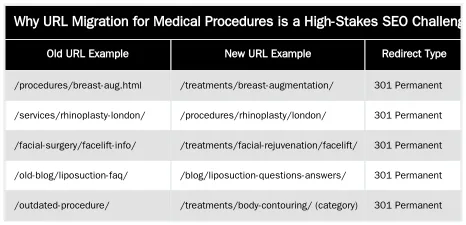
A 1-to-1 redirect map is the cornerstone of a successful URL migration. Every old URL must be mapped to its most relevant new counterpart. This includes pages for deprecated procedures, which should redirect to a relevant category page, a related procedure, or a guide. A 301 (permanent) redirect signals to search engines that the page has moved permanently, transferring most of its link equity and preventing SEO ranking drops.
Auditing Content & Internal Links for E-E-A-T Preservation
Before and during migration, audit content for accuracy, comprehensiveness, and E-E-A-T signals. Ensure surgeon profiles are updated, medical claims cited, and patient testimonials current. Update all internal links to point to the new URLs. This maintains link equity and ensures correct site navigation for users and search engines. For guidance on managing website migrations and redesigns, refer to our resources.
Implementing 301 Redirects: Best Practices for Medical Sites
Correctly implementing 301 redirects is necessary to preserve SEO value during a URL change. A 301 redirect is a server-side instruction telling browsers and search engines a page has permanently moved. It passes 90-99% of the link equity (ranking power) from the old URL to the new one. Incorrect implementation, such as using 302 (temporary) redirects or creating redirect chains, can severely impact SEO performance.
Ensuring Proper Redirect Chains and Server-Side Implementation
Use direct 1-to-1 redirects. A redirect chain occurs when an old URL redirects to an intermediate URL before the final destination. Chains slow page loading, consume crawl budget, and can dilute link equity. Implement 301 redirects at the server level. For Apache servers, edit the .htaccess file; for Nginx, configure server blocks. Consult Google’s official guidance on 301 redirects for best practices.
Validating Redirects with Google Search Console & Screaming Frog
Post-implementation validation is critical. Use Google Search Console’s URL Inspection tool to test individual redirects. For a site-wide audit, tools like Screaming Frog SEO Spider can identify all redirects, broken links, and redirect chains. This helps identify and correct issues like redirect loops or incorrect destination URLs before they harm SEO. For insights into automated redirect management, explore our resources.
Post-Migration Monitoring: Key Signals for Medical Clinic Websites
Post-migration monitoring is a continuous, critical phase for YMYL medical websites. It allows for quick identification and resolution of issues that could impact rankings or user experience. Establish a routine for checking key performance indicators and technical reports.
Tracking Rankings, Traffic, and Index Coverage in Google Search Console
After migration, monitor your Google Search Console (GSC) account. Check the ‘Performance’ report for organic traffic and keyword rankings. The ‘Pages’ report (formerly ‘Index Coverage’) is vital for identifying indexing issues, such as new 404 errors, pages excluded by ‘noindex’ tags, or crawl anomalies. Set up GSC alerts for critical errors. For detailed guidance on the ‘Pages’ report, refer to Google’s official documentation.
Addressing Broken Backlinks and User Experience Issues
Some backlinks may break despite 301 redirects. Use backlink analysis tools to identify high-value broken external backlinks and request updates from the linking sites. Monitor user behavior metrics in Google Analytics, such as bounce rate, time on page, and conversion rates. Negative shifts could indicate user experience issues with the new URL structure, requiring investigation and optimization.
Partner with an Expert for Seamless Medical Website Migrations
Medical website migrations are complex, requiring a deep understanding of technical SEO and the healthcare sector’s unique requirements. The risks of losing rankings and patient trust are significant. Abdurrahman Şimşek, a London-based Semantic SEO Strategist with over 10 years of experience, specializes in these challenges for private healthcare providers, particularly plastic surgeons and aesthetic clinics in premium London postcodes like Harley Street.
Why Specialist Medical SEO Expertise is Non-Negotiable
Specialist medical SEO expertise is crucial for successful migrations. Abdurrahman’s background in Semantic Engineering and Information Retrieval ensures the preservation of semantic integrity and topical authority for your medical content. This focus is vital for YMYL content, where E-E-A-T signals are heavily scrutinized by search engines. Leveraging Ruxi Data as a core semantic infrastructure, Abdurrahman ensures your website’s content architecture is algorithm-proof. Partnering with a specialist medical SEO consultant provides the strategic foresight to protect and enhance your digital presence during critical transitions.
Secure Your Rankings: Migrate Your Clinic’s URLs with Confidence
Migrating procedure URLs is a significant undertaking, but careful planning and expert execution can preserve SEO rankings. A comprehensive redirect strategy, preserved semantic relationships, and diligent post-migration monitoring ensure your medical content continues to thrive in organic search. For a strategically optimized URL migration, partner with an expert. Visit abdurrahmansimsek.com to discuss your needs and secure your digital future.
Frequently Asked Questions
What is the most critical step to migrate procedure URLs successfully?
The most critical step when you migrate procedure URLs is creating a comprehensive 1-to-1 redirect map. Every old procedure URL must be permanently (301) redirected to its new, most relevant equivalent. This ensures that search engines and users are seamlessly directed to the correct new page, preserving link equity and user experience.
Should the content on the new procedure page be identical to the old one when you migrate procedure URLs?
The content on the new page should be substantially the same or improved. Migrating these URLs presents an excellent opportunity to update and enhance information, incorporate new E-E-A-T signals, and add better media. This proactive approach can help mitigate any temporary ranking fluctuations and improve overall page quality.
How do I handle internal links pointing to old procedure URLs after a migration?
After the migration, it’s crucial to crawl your new site to identify and update all internal links. These links should point directly to the new URLs, bypassing any redirects. Relying on redirects for internal links can create unnecessary server load and slightly dilute the transfer of link equity.
How soon will Google recognize the new URLs after we migrate procedure URLs?
Google will begin recognizing the 301 redirects as it recrawls your old URLs. Submitting an updated XML sitemap in Google Search Console can significantly speed up this process. Typically, the full effect and transfer of ranking signals when you migrate procedure URLs can take anywhere from a few weeks to a couple of months.
How can Abdurrahman Şimşek help my London clinic successfully migrate procedure URLs?
Abdurrahman Şimşek specializes in holistic SEO strategies for medical clinics, including how to migrate procedure URLs without losing rankings. We provide expert guidance on redirect mapping, content optimization, and post-migration monitoring to ensure your London clinic preserves its rankings and topical authority. Contact us for a tailored consultation to discuss your specific migration needs.
Is it acceptable to change the URL structure when migrating medical procedure pages?
Yes, changing your URL structure, for example, from `/tummy-tuck.html` to `/procedures/abdominoplasty/`, is often beneficial. This creates a more organized and semantically rich structure, which can improve user experience and SEO. The key is to implement correct 301 redirects from every old URL to its new equivalent to maintain search engine visibility.
Ruxi Data brings together multi-model AI, automated website crawling, live indexation checks, topical authority mapping, E-E-A-T enrichment, schema generation, and full pipeline automation — from crawl to WordPress publish to social posting — all in one platform built for agencies and freelancers who run on results.