Cost of Retrieval SEO: Optimizing Search Engine Processing
The cost of retrieval seo quantifies the computational resources search engines expend to crawl, render, and understand a webpage. This article explains how optimizing CoR improves information retrieval efficiency, crucial for competitive sectors like London’s private healthcare. Readers will learn to identify technical factors increasing CoR, such as DOM complexity and rendering inefficiencies, and apply semantic engineering strategies to enhance crawl budget optimization. A lower CoR ensures search engines process more content effectively, leading to better indexation and organic visibility.
Abdurrahman Şimşek, a Semantic SEO Strategist, specializes in optimizing complex web architectures for medical clinics. His expertise in semantic engineering and Ruxi Data integration helps improve site efficiency, directly impacting search engine processing and topical authority for high-value content.
To explore your options, contact us to schedule your consultation.
The cost of retrieval seo is a critical, yet often overlooked, technical SEO metric that directly impacts how efficiently search engines like Google crawl, render, and understand your website. For complex platforms, especially in the competitive London private healthcare sector, ignoring CoR can significantly hinder organic visibility and ranking potential. This article will demystify CoR, explain its profound impact on your site’s performance, and provide actionable strategies to optimize it, ensuring your web developer isn’t missing this vital component of your semantic SEO strategy.
What is Cost of Retrieval (CoR) in Technical SEO?
Cost of Retrieval (CoR) quantifies the computational resources a search engine expends to crawl, render, and understand a webpage. It represents the total effort required for Googlebot to process your content, from fetching the initial HTML to executing JavaScript and interpreting the page’s semantic meaning. A lower CoR indicates greater efficiency for search engines, allowing them to process more of your site’s content with fewer resources.
The Hidden Resource Drain on Search Engines
Search engines operate on vast scales, processing billions of pages daily. Every resource consumed to process a webpage contributes to their operational costs. Consequently, Google has an inherent incentive to prioritize websites that are efficient to crawl and render. Websites with a high CoR effectively drain more of Google’s resources, potentially leading to less frequent crawling or a reduced ability to fully understand the page’s content and context. This efficiency metric is a silent but powerful signal in the complex world of information retrieval.
Why High CoR is Hurting Your Medical Website’s Rankings
For medical clinics, plastic surgeons, and aesthetic practices in competitive markets like London, a high Cost of Retrieval poses significant challenges to organic visibility. It directly impacts how effectively Google can discover, index, and rank your valuable medical content, from detailed procedure pages to expert surgeon profiles. In a sector where trust and authority are paramount, any barrier to search engine understanding can severely limit your reach to potential patients.
Crawl Budget & Indexation Bottlenecks for Healthcare Sites
Excessive CoR can quickly deplete a website’s crawl budget, especially for large medical platforms with numerous service pages, blog posts, and doctor profiles. When Googlebot expends too many resources on a few complex pages, it may crawl fewer pages overall or visit your site less frequently. This leads to slower indexation of new content and updates, meaning critical information about new treatments or clinic locations might not appear in search results promptly. Efficient crawl budget optimization is essential for ensuring all relevant medical content is discovered and indexed.
The Link Between CoR and Topical Authority Erosion
A high Cost of Retrieval can hinder Google’s ability to fully grasp the semantic relationships and topical depth of your medical website. If pages are difficult to render or understand, the search engine may struggle to connect related entities, services, and conditions. This inefficiency can erode your site’s perceived topical authority, making it harder to rank for complex medical queries and establish your clinic as a leading expert in its field, particularly in specialized areas like plastic surgery or dermatology.
Key Technical Factors Increasing Your Website’s CoR
Several technical elements contribute to a higher Cost of Retrieval, often stemming from web development practices that prioritize visual design over search engine processing efficiency. Identifying and addressing these factors is a core component of any comprehensive technical SEO audit, especially for content-rich medical websites.
DOM Complexity & Inefficient JavaScript Rendering
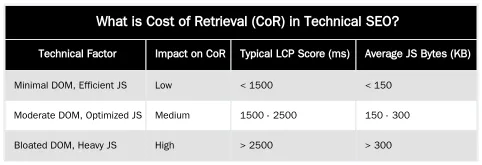
A bloated Document Object Model (DOM) structure, characterized by excessive nested elements and unnecessary HTML, forces search engines to parse a larger, more complex tree. Similarly, heavy, render-blocking JavaScript files can significantly increase the time and resources Googlebot needs to fully render a page. This directly impacts metrics like Largest Contentful Paint (LCP), as the browser (and Googlebot) must process more code before displaying the main content. Optimizing these elements is crucial for improving rendering efficiency and reducing CoR.
For a detailed examination of these issues, consider a professional technical SEO audit.
Table 1: Impact of DOM Complexity and JavaScript on CoR Metrics (Illustrative Data)
The Role of Semantic HTML and Index Bloat
Non-semantic HTML, which uses generic tags like `
` for structural elements that have specific semantic meanings (e.g., `
`, `
Ruxi Data brings together multi-model AI, automated website crawling, live indexation checks, topical authority mapping, E-E-A-T enrichment, schema generation, and full pipeline automation — from crawl to WordPress publish to social posting — all in one platform built for agencies and freelancers who run on results.
Abdurrahman Simsek is a content specialist at Abdurrahman Şimşek, creating well-researched, expert-level articles. Every piece is crafted to deliver genuine value to readers, backed by thorough research and industry knowledge.