Structure Medical Procedure Pages: Optimize for AI Overviews & Rich Snippets
Effectively structure medical procedure pages is crucial for private healthcare providers aiming for high visibility in AI Overviews and rich snippets. This guide details strategies for optimizing content architecture, ensuring medical information is accurately interpreted by search algorithms and accessible to patients. Learn to leverage semantic HTML5, robust information architecture, and schema markup to enhance visibility and satisfy Google’s Search Generative Experience (SGE) requirements. Proper page structure improves E-E-A-T signals and reduces the Cost of Retrieval, driving high-value patient acquisition.
Abdurrahman Şimşek, a Semantic SEO Strategist, provides expert guidance on building high-authority semantic content networks. His 10+ years of experience in medical SEO and information retrieval ensures content is optimized for both user understanding and algorithmic interpretation, particularly for YMYL sectors.
To explore your options, contact us to schedule your consultation. You can also reach us via: Book a Semantic SEO Audit, Direct WhatsApp Strategy Line: +90 506 206 86 86
Effectively structuring medical procedure pages is paramount for private healthcare providers seeking visibility in 2026. This guide provides strategies for plastic surgeons and clinic owners to optimize procedure pages for Google’s AI Overviews, rich snippets, and high-value patient acquisition. A precise content architecture ensures medical information is accessible to patients and accurately interpreted by search algorithms.
Why Structuring Medical Procedure Pages is Critical for AI Overviews and Rich Snippets
Organized content is fundamental for search engines, influencing AI Overviews, Google SGE, and rich snippets. A clear page structure helps Google’s algorithms understand entities and their relationships. Without it, even authoritative medical content may lack visibility in search results.
Understanding Google’s AI Overviews and SGE for Medical Content
Google’s AI Overviews, powered by its Search Generative Experience (SGE), provide AI-generated summaries at the top of search results. For medical content, a page’s ability to be summarized and featured depends on its logical flow and semantic clarity. Generative AI models extract direct answers and key information. Pages with a clear hierarchy, distinct sections, and precise language are more likely to be sourced for these AI-generated responses, which increases visibility. This is critical for YMYL (Your Money Your Life) content, where accuracy and trustworthiness are paramount. For deeper insights, see AI Overviews and Technical SEO in 2026.
The Foundational Elements: Semantic HTML5 and Information Architecture
Effective medical procedure pages rely on technical and structural components. Semantic HTML5 tags create a logical, parsable content hierarchy, clarifying each content block’s purpose for users and search engines. This allows algorithms to process information efficiently. A planned information architecture guides patients through medical details, reducing cognitive load and improving engagement.
Crafting a Clear Content Hierarchy with H1s, H2s, and Lists
A single `
` tag should define the procedure name, serving as the primary topic identifier. Major sections like “Candidacy” or “Recovery” should use `
` tags. Sub-topics within these sections, like “Pre-Procedure Instructions,” should use `
` tags. Ordered (`
`) and unordered (`
`) lists break down complex information into digestible points for procedure steps or risks. Descriptive headings are crucial for clarity and search engine understanding. For more detailed best practices, refer to how to structure all medical procedure pages.
Essential Sections for Every High-Converting Procedure Page
High-converting medical procedure pages include several key content blocks. An “Overview” provides a concise summary. “Candidacy” outlines suitable patients. “Procedure Steps” details the operation. “Recovery Timeline” sets expectations for post-operative care. “Potential Risks” transparently addresses complications. “Cost/Pricing Information” provides financial details. An “FAQ” section addresses common questions, feeding into rich snippet opportunities. A practical example can be found in a template for a high-converting tummy tuck service page.
` tags. Ordered (`
`) and unordered (`
`) lists break down complex information into digestible points for procedure steps or risks. Descriptive headings are crucial for clarity and search engine understanding. For more detailed best practices, refer to how to structure all medical procedure pages.
Essential Sections for Every High-Converting Procedure Page
High-converting medical procedure pages include several key content blocks. An “Overview” provides a concise summary. “Candidacy” outlines suitable patients. “Procedure Steps” details the operation. “Recovery Timeline” sets expectations for post-operative care. “Potential Risks” transparently addresses complications. “Cost/Pricing Information” provides financial details. An “FAQ” section addresses common questions, feeding into rich snippet opportunities. A practical example can be found in a template for a high-converting tummy tuck service page.
- `) lists break down complex information into digestible points for procedure steps or risks. Descriptive headings are crucial for clarity and search engine understanding. For more detailed best practices, refer to how to structure all medical procedure pages.
Essential Sections for Every High-Converting Procedure Page
High-converting medical procedure pages include several key content blocks. An “Overview” provides a concise summary. “Candidacy” outlines suitable patients. “Procedure Steps” details the operation. “Recovery Timeline” sets expectations for post-operative care. “Potential Risks” transparently addresses complications. “Cost/Pricing Information” provides financial details. An “FAQ” section addresses common questions, feeding into rich snippet opportunities. A practical example can be found in a template for a high-converting tummy tuck service page.
Implementing Schema Markup for Enhanced Visibility and Rich Snippets
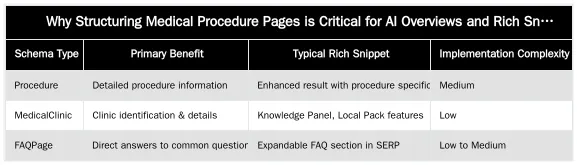
Schema markup is vital for enhancing visibility and generating rich snippets for medical procedure pages. By adding structured data, clinics provide search engines with explicit information, improving entity recognition and the likelihood of appearing with enhanced search features. This semantic layer helps algorithms understand the context of medical services, leading to more accurate and prominent displays.
Leveraging Procedure, MedicalClinic, and FAQPage Schema
`Procedure` schema defines properties like `name`, `description`, `medicalSpecialty`, and `procedureType`. `MedicalClinic` schema associates the procedure with your clinic’s details, including address, contact information, and medical specialties. `FAQPage` schema enables questions and answers to appear directly in search results as rich snippets. These schema types work synergistically to create a comprehensive, machine-readable profile of your medical services. For a deeper dive into their combined use, see implementing advanced medical schema.
Mapping Entity-Attribute-Value (EAV) to Your Procedure Content
The Entity-Attribute-Value (EAV) model is a method to structure content for internal use and schema. It involves identifying entities, such as ‘Rhinoplasty’, and defining their attributes, like ‘recovery time’, ‘anesthesia type’, or ‘cost range’. Mapping these attributes to their values provides granular, machine-readable data to search engines. This detail improves algorithmic understanding of medical procedures, making content more discoverable for specific patient queries. Learn more about this approach in Entity-Attribute-Value (EAV) SEO.
Optimizing for E-E-A-T and Cost of Retrieval on Medical Procedure Pages
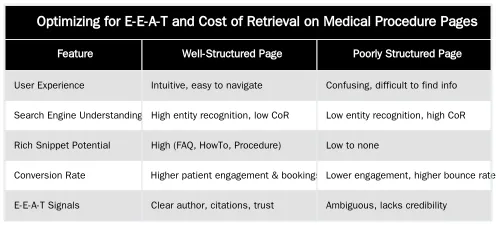
The quality and structure of medical procedure pages are linked to Google’s E-E-A-T (Experience, Expertise, Authoritativeness, Trustworthiness) guidelines and the concept of ‘Cost of Retrieval.’ Semantic SEO Strategist Abdurrahman Şimşek emphasizes these principles for building high-authority medical websites. An optimized page signals E-E-A-T and is easier for search engines to process and rank.
Showcasing Expertise and Trust Signals Directly on Procedure Pages
For YMYL content, clear author attribution is non-negotiable. This includes displaying the names and qualifications of GMC-registered surgeons who contributed to or reviewed the content. Citing authoritative medical sources, such as the NHS or medical journals, bolsters expertise and trustworthiness. Integrating patient testimonials and reviews provides social proof and enhances trust. These elements reinforce E-E-A-T, signaling credibility to users and search engines. Further strategies for building trust can be found in semantic architecture for surgeons.
Reducing Google’s ‘Cost of Retrieval’ with Semantic Efficiency
Google’s ‘Cost of Retrieval’ (CoR) is the computational resource required to understand, process, and index a webpage. A structured, semantically rich page reduces this cost. When content is organized with clear headings, schema markup, and an EAV model, search engines can extract entities and attributes with less effort. This efficiency can lead to better crawl budget allocation, faster indexing, and higher rankings. Minimizing CoR improves search performance and helps Google prioritize content. The Google Search Central documentation provides foundational insights into how search works.
The Impact of Well-Structured Procedure Pages on Patient Acquisition
Beyond technical SEO, organized medical procedure pages offer business benefits. Improved visibility, user experience, and semantic clarity help attract and convert high-value patients. These structural optimizations create a patient journey from initial search to booking a consultation.
Improving User Experience and Conversion Rates
A logical, easy-to-navigate page structure enhances user experience. When patients can quickly find information on candidacy, procedure steps, recovery, and costs, engagement increases. This reduces bounce rates and encourages longer time on page, signaling positive user interaction to search engines. Guiding patients through information clearly builds confidence and trust, leading to higher conversion rates for consultations. This patient-centric approach is a core component of the patient acquisition content blueprint.
Attracting High-Value Patients Through Semantic Clarity
Semantic structuring and schema markup enable Google to match complex patient queries with relevant procedure pages. When a patient searches for “non-surgical facelift recovery time London,” a semantically optimized page is more likely to appear. This precision attracts high-intent patients who are further along in their decision-making process and more likely to convert.
Ready to Transform Your Medical Procedure Pages?
Organizing medical service pages is a strategic imperative for private healthcare clinics in London. Using semantic HTML5, schema markup, and an EAV model enhances visibility in AI Overviews and rich snippets, attracts high-value patients, and solidifies clinic authority. Contact us to discuss a tailored semantic SEO strategy for your practice.
Conclusion
Strategic organization of medical procedure pages is fundamental for search visibility. Implementing semantic HTML5, schema markup, and an Entity-Attribute-Value model provides the clarity search engines need to understand and feature content. This approach boosts visibility in AI Overviews and rich snippets, enhances user experience, and increases conversion rates. For London’s private healthcare providers, mastering these structural elements is key to building topical authority and attracting high-value patients. Book a Semantic SEO Audit with Abdurrahman Şimşek, or reach out directly via WhatsApp Strategy Line: +90 506 206 86 86.
Frequently Asked Questions
What is the most critical element to structure medical procedure pages for AI Overviews?
The most critical element is establishing a clear, logical hierarchy using semantic HTML tags like H1, H2, and H3, along with lists. Each page should begin with a concise summary that directly answers the primary question, followed by well-defined sections covering candidacy, risks, recovery, and costs. This structured approach ensures both patients and AI can easily digest the information, making it easier to structure medical procedure pages effectively.
Which types of schema are essential when you structure medical procedure pages?
To enhance visibility and rich snippets, essential schema types include `MedicalProcedure`, `FAQPage`, and `HowTo`. `MedicalProcedure` defines the service itself, providing critical details to search engines. `FAQPage` and `HowTo` schema are crucial for capturing rich snippets by structuring common questions and outlining step-by-step processes, helping to optimize how you structure medical procedure pages.
How does the Entity-Attribute-Value (EAV) model help to structure medical procedure pages effectively?
The EAV model is instrumental in logically organizing the data on these pages. Here, the ‘Entity’ is the specific medical procedure (e.g., Rhinoplasty), while ‘Attributes’ are its defining properties (e.g., Anesthesia Type, Recovery Time, Cost). ‘Values’ then provide the specific details for each attribute (e.g., General, 2-3 weeks, £5,000-£8,000), making the information highly parsable for AI and improving how you structure medical procedure pages.
Should a Q&A section be included directly on a medical procedure page?
Yes, incorporating a dedicated FAQ section is highly recommended for any medical procedure page. This section should use H2 or H3 tags for each question and can be marked up with `FAQPage` schema. This not only provides immediate answers to patient queries but also makes the content eligible for direct display in SERPs and AI Overviews.
How can the introduction of a procedure page be optimized for featured snippets?
To optimize for featured snippets, craft a concise, factual paragraph of 40-60 words immediately following the H1 tag. This introductory text should directly define the procedure and answer the implied main question of the page. For instance, begin with a sentence like, “A rhinoplasty is a surgical procedure that reshapes the nose…”
How can I get expert help to optimize my clinic’s procedure pages?
To ensure your clinic’s procedure pages are fully optimized for AI Overviews and rich snippets, consider booking a Semantic SEO Audit with Abdurrahman Şimşek. He offers specialized consulting for medical clinics, leveraging 10+ years of experience to build high-authority content networks. You can also reach out directly via WhatsApp for strategic guidance.
Ruxi Data brings together multi-model AI, automated website crawling, live indexation checks, topical authority mapping, E-E-A-T enrichment, schema generation, and full pipeline automation — from crawl to WordPress publish to social posting — all in one platform built for agencies and freelancers who run on results.