Physician Schema Guide: Enhancing UK Aesthetic Clinic Visibility
For UK aesthetic clinics, this physician schema guide details how structured data, specifically Physician and MedicalProcedure Schema, enhances online visibility. It explains implementing JSON-LD to strengthen E-E-A-T signals and secure prominent rich snippets. Readers will learn to leverage advanced semantic engineering for digital authority, attracting high-value patients in London’s competitive medical landscape. This comprehensive guide provides actionable strategies for improving search engine understanding of medical practitioners and their services, crucial for YMYL domains.
Abdurrahman Şimşek, a Semantic SEO Strategist, specializes in building high-authority semantic content networks for medical clinics. His expertise in advanced schema implementation and semantic engineering helps practitioners achieve superior search performance and establish digital trust.
To explore your options, contact us to schedule your consultation.
For UK aesthetic clinics aiming for superior online visibility, a comprehensive physician schema guide is essential. This article details how structured data, specifically Physician and MedicalProcedure Schema, can significantly enhance your clinic’s E-E-A-T signals, secure prominent rich snippets, and establish digital authority across London’s competitive medical landscape. Learn to implement best practices and leverage advanced semantic engineering to attract high-value patients in 2026.
What is Physician & MedicalProcedure Schema and Why is it Crucial for UK Aesthetic Clinics?
Physician Schema and MedicalProcedure Schema are types of structured data markup that explicitly define medical practitioners and the procedures they offer, respectively. For UK aesthetic clinics, these JSON-LD implementations are crucial because they directly communicate expertise, experience, authority, and trustworthiness (E-E-A-T) signals to search engines like Google, which is paramount in Your Money Your Life (YMYL) fields. This structured data helps search engines understand the qualifications of doctors and the specifics of treatments, leading to enhanced visibility and credibility in search results.
Aesthetic medicine operates within a highly sensitive YMYL domain. Search engines prioritize accuracy and reliability for health-related queries. By implementing structured data, clinics can clearly articulate the credentials of their practitioners and the details of their services, ensuring that search engines accurately represent their offerings to potential patients.
The Role of Structured Data in Medical SEO
Structured data, typically implemented using JSON-LD, provides search engines with a standardized way to interpret the content on your website. For medical entities, this means clearly defining who a practitioner is, their specializations, and the services they provide. This clarity enables search engines to generate rich snippets and contribute to the Google Knowledge Graph, offering users more informative search results. For a deeper understanding of medical schema applications, explore our guide on medical schema for surgeons.
How Advanced Schema Enhances E-E-A-T for Medical Practitioners
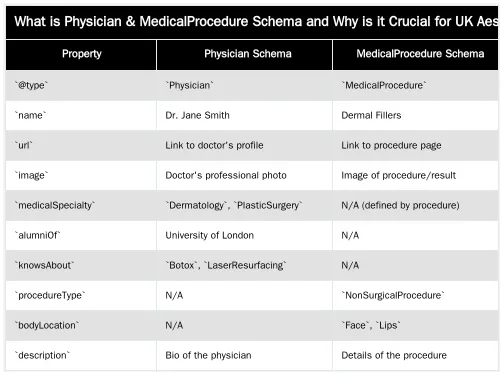
Comprehensive schema markup directly contributes to Google’s E-E-A-T assessment by providing explicit, machine-readable information about medical practitioners and their services. Physician schema allows clinics to declare properties such as a doctor’s `medicalSpecialty`, `alumniOf` (universities/colleges), `knowsAbout` (specific conditions or treatments), and `hasCredential` (medical licenses or certifications). MedicalProcedure schema, conversely, details the `procedureType`, `bodyLocation`, and `preOp` or `postOp` instructions, showcasing the depth of service knowledge.
For aesthetic clinics in the UK, particularly those in competitive areas like Harley Street, these properties are vital. They help search engines connect practitioners to their specific areas of expertise, building a robust entity profile. This precise entity recognition is crucial for establishing topical authority within niche aesthetic treatments, differentiating a clinic from competitors. The explicit declaration of credentials and specializations through schema strengthens the clinic’s perceived authority and trustworthiness in the eyes of search algorithms.
Building Trust with Google’s Knowledge Graph
Schema markup feeds directly into the Google Knowledge Graph, a vast database of facts about people, places, and things. When a medical practitioner or clinic is consistently defined through structured data across their web presence, they are more likely to be recognized as an authoritative entity within the Knowledge Graph. This recognition can lead to the display of a Knowledge Panel in search results, providing a verified summary of the practitioner or clinic. Consistent entity recognition across various online sources, supported by accurate schema, is a powerful signal of trustworthiness for YMYL queries, helping to build patient confidence.
Implementing Physician & MedicalProcedure Schema: A Step-by-Step Guide
Implementing structured data for medical entities requires precision. For UK aesthetic clinics, JSON-LD is the recommended format, embedded directly into the HTML of your web pages. The process involves identifying the relevant schema types, populating their properties with accurate information, and ensuring proper nesting for complex relationships. Combining multiple schema types on a single page, such as `Physician`, `MedicalProcedure`, and `MedicalBusiness`, creates a holistic semantic profile for your clinic and its services.
For example, on a doctor’s profile page, you would embed `Physician` schema. On a service page detailing a specific treatment, you would use `MedicalProcedure` schema, potentially nested within a `MedicalBusiness` or `Service` schema. This layered approach provides search engines with a comprehensive understanding of your offerings.
Key Properties for Physician & MedicalProcedure Schema
Understanding the essential properties for each schema type is fundamental. Here’s a comparison of key properties:
For more detailed guidance on automated schema generation, refer to our automated schema markup guide.
Schema Validation and Troubleshooting Common Errors
After implementing your structured data, validation is a critical step. Use Google’s Rich Results Test (developers.google.com/search/docs/appearance/structured-data/testing-tool) and the Schema.org Validator to check for syntax errors and ensure your markup is eligible for rich results. Common pitfalls in medical schema include missing required properties, incorrect `@type` declarations, or failing to nest related entities properly. For instance, a `Physician` entity should be linked to the `MedicalBusiness` they work for, and `MedicalProcedure` entities should ideally reference the performing `Physician` or `MedicalBusiness`. Addressing these errors ensures your structured data is correctly interpreted by search engines, maximizing its impact on SERP features.
Mastering Medical Schema: Leveraging Semantic Engineering for UK Clinic Visibility
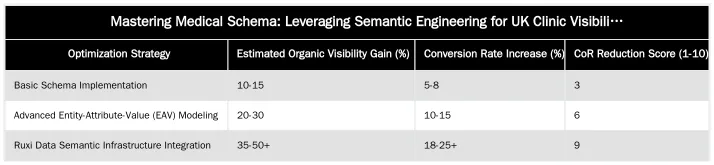
Beyond basic schema implementation, advanced semantic engineering offers a competitive advantage for UK aesthetic clinics. This involves strategies like Entity-Attribute-Value (EAV) modeling, which precisely defines the relationships between entities and their characteristics, and Cost of Retrieval (CoR) optimization, which structures data to minimize the computational effort search engines need to understand it. With over 10 years of experience, Abdurrahman Şimşek specializes in building robust semantic content networks for medical clinics, integrating solutions like Ruxi Data to enhance entity recognition and topical authority. This specialized approach ensures London clinics, particularly those in premium postcodes, can dominate local search and attract high-value patients.
For example, by meticulously mapping every procedure, practitioner, and clinic location as distinct entities with rich attributes, search engines gain a deeper, more nuanced understanding of the clinic’s offerings. This level of semantic detail is crucial for algorithmic authorship, where Google assesses the authority and expertise of content creators, and for topical authority mapping, ensuring the clinic is recognized as a definitive source for specific aesthetic treatments.
Beyond Basic Markup: The Ruxi Data Advantage
Ruxi Data integration elevates semantic infrastructure by enabling more precise entity relationships and deeper contextual understanding for search engines. This goes beyond standard schema markup, creating a comprehensive knowledge graph for your clinic. For Harley Street clinics, this means every practitioner, every specialized treatment, and every patient testimonial can be semantically linked, forming a powerful network of interconnected information. This advanced approach directly influences topical authority mapping, allowing search engines to confidently associate your clinic with specific, high-value medical topics. By optimizing the Cost of Retrieval (CoR), Ruxi Data ensures that this rich semantic information is easily processed by search engines, leading to improved visibility and relevance in search results. For further insights into structuring content for AI, consider our guide on semantic HTML for AI overviews.
What Rich Snippets & Enhanced SERP Features Mean for Your Clinic’s Growth?
Correctly implemented schema markup translates into tangible benefits for aesthetic clinics through rich snippets and enhanced SERP features. Rich snippets, such as star ratings, pricing information, or procedure duration, make your search listings more visually appealing and informative. This increased prominence directly improves click-through rates (CTR) by making your clinic stand out from standard blue links. For example, a search for “lip fillers London” could display a clinic’s average rating, price range, and a direct link to book, all within the search result.
Beyond rich snippets, robust schema contributes to Knowledge Panels for individual practitioners or the clinic itself. These panels provide a comprehensive overview, including contact details, specializations, and reviews, directly on the search results page. This enhanced visibility builds immediate trust and authority, attracting high-value patients who are actively researching medical procedures. For aesthetic clinics, securing these prominent SERP features means capturing attention at the crucial decision-making stage, driving more qualified leads and bookings.
Driving High-Value Patient Acquisition in London
Enhanced visibility and trust signals generated by advanced schema directly translate into increased patient inquiries and bookings, particularly in highly competitive locations like Harley Street, Marylebone, Mayfair, Knightsbridge, Chelsea, and Kensington. When a clinic’s search listing displays detailed information about a practitioner’s qualifications or the specifics of a procedure, it instills confidence in potential patients. This is crucial for local organic search performance, as patients often seek local practitioners for aesthetic treatments. By providing search engines with clear, structured data, clinics can improve their ranking for geo-specific queries, ensuring they appear prominently when patients search for “best dermatologists London” or “aesthetic clinics Harley Street.” This strategic advantage helps clinics attract and convert high-value patients seeking specialized aesthetic services.
Ready to Elevate Your Clinic’s Digital Presence?
Navigating the complexities of advanced medical schema and semantic engineering requires specialized expertise. For UK aesthetic clinics aiming to establish unparalleled digital authority and dominate competitive markets like Harley Street, partnering with a seasoned semantic SEO strategist is a strategic imperative. Unlock the full potential of your online presence and attract high-value patients by leveraging bespoke semantic solutions. Implement a robust structured data strategy that ensures your clinic stands out in 2026 and beyond.
Conclusion
Implementing advanced Physician and MedicalProcedure Schema is no longer optional for UK aesthetic clinics; it is a fundamental requirement for establishing E-E-A-T and securing prominent search visibility. By meticulously structuring data, clinics can communicate their expertise and services with clarity, influencing rich snippets, Knowledge Graph presence, and ultimately, patient acquisition. Leveraging specialized semantic engineering, including Entity-Attribute-Value modeling and Ruxi Data integration, provides a distinct competitive edge in London’s demanding medical landscape. To transform your clinic’s digital footprint and achieve sustainable organic growth, consider a strategic partnership with an expert in medical semantic SEO. Visit abdurrahmansimsek.com to learn more.
Frequently Asked Questions
Why is a dedicated physician schema guide essential for UK aesthetic clinics?
Aesthetic medicine is a YMYL (Your Money Your Life) field where expertise is paramount. A proper physician schema guide explains how to use structured data to explicitly declare a practitioner’s qualifications, specializations (alumniOf, knowsAbout), and connection to the clinic, sending unambiguous E-E-A-T signals to Google. This is crucial for building trust and authority online.
How does following a comprehensive physician schema guide enhance E-E-A-T for medical practitioners?
A robust physician schema guide outlines how to structure data to highlight a doctor’s credentials, professional affiliations, and the specific medical procedures they perform. This structured information directly communicates expertise, authoritativeness, and trustworthiness to search engines, significantly boosting your clinic’s E-E-A-T signals. It helps Google understand the depth of your practitioners’ knowledge and experience.
What are the risks of not following an expert physician schema guide for implementation?
Incorrect or spammy structured data can lead to a manual action from Google, resulting in the loss of rich results and potentially harming your search rankings. Following an expert physician schema guide is crucial to ensure compliance with Google’s guidelines and avoid such penalties. Precise implementation is key to leveraging schema benefits without risks.
What is the most critical property in MedicalProcedure schema for demonstrating expertise?
While `procedureType` is vital for categorization, linking the procedure to the performing physician via the `performer` property using their unique ID is arguably the most powerful connection. This explicitly attributes the procedure to a qualified expert, reinforcing E-E-A-T. It helps Google understand who is responsible for the medical service.
Can schema implementation be automated for all clinic procedures?
Yes, automating schema generation is a core part of effective semantic SEO. By structuring your procedure data in a central system, unique and accurate JSON-LD can be programmatically deployed for every service page. This ensures consistency and scalability across all your services without manual errors.
How can my UK aesthetic clinic get started with advanced medical schema implementation?
To begin enhancing your clinic’s digital presence with advanced medical schema, you can contact Abdurrahman Şimşek for a strategic consultation. We specialize in building high-authority semantic content networks for medical clinics, ensuring precise implementation tailored to your services and practitioners. Our expertise helps secure prominent rich snippets and establish digital authority.
Ruxi Data brings together multi-model AI, automated website crawling, live indexation checks, topical authority mapping, E-E-A-T enrichment, schema generation, and full pipeline automation — from crawl to WordPress publish to social posting — all in one platform built for agencies and freelancers who run on results.