Automate Internal Linking: Enhance Topical Authority & SEO Performance
To automate internal linking based on semantic relevance is crucial for scaling digital presence and building robust content architecture. This article explains how leveraging NLP, entity extraction, and machine learning algorithms moves beyond simple keyword matching to identify deep contextual connections between content. Implementing intelligent internal linking strategies helps automate internal linking suggestions, enhancing topical authority, improving search engine crawlability, and distributing link equity effectively. This approach is vital for complex content networks, especially for YMYL sectors like medical clinics, ensuring content discoverability and reinforcing expertise.
Abdurrahman Şimşek, a Semantic SEO Strategist, specializes in building high-authority semantic content networks for medical clinics. His expertise in semantic engineering, information retrieval, and Python for SEO provides a data-driven approach to optimizing content architecture and achieving topical authority.
To explore your options, contact us to schedule your consultation. You can also reach us via: Book a Semantic SEO Audit, Direct WhatsApp Strategy Line: +90 506 206 86 86
To scale a digital presence, automate internal linking suggestions based on semantic relevance. This SEO technique uses artificial intelligence to build an interconnected content architecture. This article covers the technologies, implementation, and impact of intelligent linking on topical authority and search visibility. For medical clinics, this process makes content discoverable by users and search engines, reinforcing expertise and trust while streamlining content management and enhancing user experience.
What is Automated Internal Linking & Why it Matters for SEO?
Automated internal linking based on semantic relevance uses algorithms to identify and suggest connections between pages sharing a common meaning or topic. It moves beyond keyword matching to focus on the contextual relationship between entities and concepts. Its purpose is to enhance website structure, improve search engine crawlability, and distribute link equity. For complex content networks, like medical clinic websites, this is a fundamental SEO strategy.
Intelligent internal linking boosts topical authority by signaling to search engines the depth and breadth of a website’s coverage on specific subjects. This establishes the site as a comprehensive resource, vital for Your Money Your Life (YMYL) topics like health and medicine. It also improves user experience by guiding visitors to related content, increasing engagement and time on site. It contributes to higher search rankings and organic visibility.
Defining Semantic Relevance in Internal Linking
Semantic relevance in internal linking transcends keyword usage, requiring an understanding of the meaning, context, and entities within content. For instance, an article about “rhinoplasty techniques” is semantically relevant to one on “nasal anatomy” or “post-operative care for nose surgery,” even without exact keyword alignment. This understanding creates an internal linking strategy that mirrors how experts connect information, ensuring every link adds value and reinforces the website’s topical structure and authority.
How Semantic Relevance Powers Intelligent Internal Link Suggestions
The technical mechanisms behind automated semantic internal linking rely on computational linguistics. Natural Language Processing (NLP) and machine learning algorithms enable systems to analyze content for meaning, not just words. This analysis identifies connections between articles beyond keyword-based linking. The goal is to replicate a human editor’s understanding of related topics at scale.
These systems parse text to extract and understand relationships between key entities—people, places, organizations, medical procedures, or scientific concepts. Mapping these entities allows automation to identify pages on similar subjects, even with different terminology. This ensures suggested links are contextually appropriate and helpful to users and search engine crawlers, reinforcing the website’s topical expertise.
Leveraging NLP and Entity Extraction for Content Analysis
NLP algorithms process and understand human language. For internal linking, NLP techniques parse website content into words, sentences, and paragraphs. Entity extraction then identifies named entities within this text. For a medical website, this might include “breast augmentation,” “Dr. Smith,” “Harley Street Clinic,” or “collagen.” The relationships between these entities are mapped, creating a dataset for semantic matching. This data allows systems to understand that “liposuction recovery” is related to “post-operative care for body contouring,” even without explicit keyword overlap.
From TF-IDF to Vector Space Models: Matching Content Meaning
Term Frequency-Inverse Document Frequency (TF-IDF) measures a word’s importance in a document relative to a corpus. It focuses on individual words. Advanced techniques, like vector space models, represent documents or words as numerical vectors in a multi-dimensional space where similar meanings are positioned closer together. Word embeddings, a type of vector space model, capture semantic relationships, allowing algorithms to understand nuances like “surgeon” being related to “doctor” and “operation.”
Large language models (LLMs) have revolutionized this field. LLMs understand complex contextual similarities and generate relevant link suggestions by processing vast amounts of text data. They can identify implicit connections that vector models might miss, creating more precise internal link recommendations. This capability is crucial for building a comprehensive and resilient semantic SEO for surgeons strategy.
Implementing Automated Internal Linking: Tools & Best Practices
Implementing automated internal linking requires a strategic approach. Methods and tools range from plugins to platforms and custom scripts. The choice depends on website size, complexity, and technical expertise. Best practices are essential for any method, including setting clear rules, managing link density, and maintaining human oversight for relevance and quality.
Choosing the Right Automation Method for Your Website
WordPress plugins are an accessible entry point for internal link automation, providing keyword-based or simple semantic suggestions. For advanced needs, custom Python scripts can perform specific content analysis and link generation, tailored to unique website structures or semantic rules. Dedicated semantic SEO platforms, like Ruxi Data, use AI and machine learning to analyze content, identify semantic relationships, and provide internal linking automation suggestions. They are beneficial for large, complex sites like medical content hubs, offering scalability and precision that simpler tools cannot match.
Avoiding Pitfalls: Over-Optimization and Irrelevant Links
Automation carries risks if not managed correctly. Over-optimization can occur if too many links are generated or if anchor text becomes repetitive, creating a spammy user experience and risking search engine penalties. Irrelevant links, where pages are connected without semantic overlap, dilute link equity and confuse users and crawlers. To mitigate these issues, human oversight is crucial. Auditing automated link suggestions, refining rules, and ensuring anchor text diversity are vital. Create a natural, helpful linking structure that guides users and reinforces topical clusters.

Scaling Topical Authority with Ruxi Data & Python for SEO
For sectors like medical and plastic surgery, building topical authority is paramount. Abdurrahman Şimşek uses platforms like Ruxi Data, combined with custom Python for SEO solutions, for automated internal linking strategies. This approach streamlines content architecture and impacts the ‘Cost of Retrieval’ for search engines. Creating an organized, semantically rich content network makes websites more efficient for crawlers to understand and index, improving visibility and creating algorithm-proof topical authority.
This methodology is effective for London-based medical clinics in local organic search. It ensures all content contributes to a cohesive understanding of the clinic’s expertise, from procedures to surgeon profiles. This precision in content organization is a hallmark of a technical SEO framework for the YMYL search landscape.
Ruxi Data’s Role in Automating Semantic Content Networks
Ruxi Data analyzes content and SERP data to identify semantic relationships. It goes beyond keyword analysis to understand the entities and concepts that form a topic. This allows it to automatically suggest internal links that reinforce topical hubs and clusters, creating a dense, interconnected web of relevant information. For medical SEO, this means linking a procedure page to related conditions, surgeon bios, and recovery guides, based on semantic understanding. This capability is central to scaling medical SEO efforts, helping clinics build content networks efficiently.
By automating the identification of these relationships, Ruxi Data reduces manual effort in content mapping and linking. It ensures new content is integrated into the existing semantic structure, maximizing its impact on topical authority. This approach helps clinics establish themselves as authoritative sources in their fields.
Custom Python Scripts for Advanced Internal Link Audits & Suggestions
While platforms like Ruxi Data offer extensive capabilities, custom Python scripts provide flexibility and precision for internal link analysis. Abdurrahman Şimşek uses Python to build custom solutions that perform specific audits, identify linking opportunities, and generate link suggestions based on custom semantic rules. For instance, a Python script can analyze all procedure pages to ensure they link to the relevant surgeon’s profile or a condition page, reinforcing E-E-A-T signals.
Python can visualize internal link structures, identify orphaned pages, or detect areas with insufficient link equity distribution. This data-driven approach allows for continuous optimization of the internal linking strategy, aligning it with SEO goals and content updates. This technical expertise in SEO automation gives medical clients a competitive edge through an optimized and adaptable website architecture.
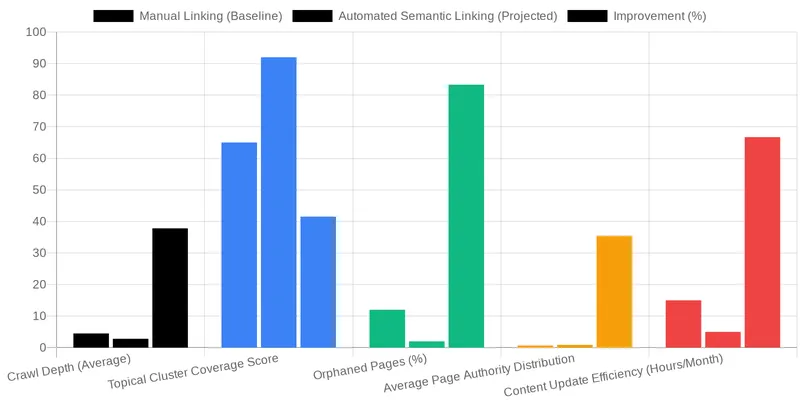
The Impact of Automated Semantic Linking on E-E-A-T & GEO
An automated semantic linking strategy has benefits beyond traditional SEO metrics. It strengthens E-E-A-T (Experience, Expertise, Authoritativeness, Trustworthiness) signals, critical for YMYL websites. By connecting authoritative content, like surgeon bios and research pages, to relevant informational articles, the website’s perceived expertise is elevated. This structured approach prepares websites for Generative Engine Optimization (GEO) by providing clear, semantically rich data that AI models can interpret and source.
This strategy optimizes a medical website for current search algorithms and future-proofs it against evolving AI-driven search experiences. It establishes the site as a reliable and comprehensive source of information, a factor for patient trust and search engine recognition in 2026 and beyond.
Reinforcing E-E-A-T Signals Through Intelligent Link Distribution
Intelligent link distribution is pivotal to reinforcing E-E-A-T. When a high-authority page, like a GMC-registered consultant surgeon’s biography or a page on a clinic’s research, links to a relevant article about a medical procedure, it signals expertise and trustworthiness. This is important for medical content, where source credibility is paramount. Automated semantic linking ensures these connections are consistently made, funneling authority from expert-authored content to educational resources. This approach helps search engines understand the expertise behind the content, boosting the site’s E-E-A-T.
Optimizing for AI Overviews: The Future of Search with Semantic Links
As search engines integrate generative AI for AI Overviews and conversational answers, content clarity and semantic richness become more critical. Automated semantic linking creates an interconnected, contextually relevant content network that is more understandable for these AI models. Generative AI is more likely to accurately source and summarize clear, semantically connected content, improving visibility in AI Overviews and other GEO features. This optimization ensures a medical website’s information is accessible and accurately represented in AI-driven search results, positioning it as a trusted resource for patient queries.
Conclusion
Automating internal linking based on semantic relevance is an advanced SEO strategy. Using NLP, machine learning, and platforms like Ruxi Data, websites build content networks that enhance crawlability, distribute link equity, and solidify topical authority. This is impactful for medical and plastic surgery clinics, where E-E-A-T and clear information architecture are critical for patient trust and search rankings. This methodology optimizes for current search and prepares websites for Generative Engine Optimization. To explore these strategies for your practice, contact us.
Frequently Asked Questions
How does technology automate internal linking based on semantic relevance?
Advanced systems leverage Natural Language Processing (NLP) and machine learning to analyze content, identifying key entities and concepts. They then scan your site for semantically similar pages, proposing highly relevant connections to build a robust content architecture. This process significantly enhances content discoverability and topical authority.
Is it safe to fully automate internal linking, or does it require human oversight?
While tools can provide highly accurate suggestions, human oversight remains crucial for optimal results. An SEO specialist should review proposed links to ensure contextual appropriateness, prevent unnatural patterns, and guarantee genuine user value. This hybrid approach combines efficiency with strategic control.
What are the main benefits of using a tool to automate internal linking?
The primary benefits are immense efficiency and scalability for large websites. Such tools save countless hours of manual work, uncover linking opportunities that might otherwise be missed, and ensure a consistent, data-driven linking strategy. This frees up SEOs to focus on higher-level strategic tasks.
Can these automated systems also suggest optimal anchor text?
Yes, sophisticated platforms analyze the context of both the source and target pages to recommend relevant and varied anchor text. This intelligent suggestion helps avoid over-optimization, creates a more natural link profile, and improves the overall user experience.
How does a platform like Ruxi Data enhance internal link suggestions compared to standard plugins?
Unlike basic plugins that rely on simple keyword matching, a sophisticated semantic infrastructure like Ruxi Data builds a comprehensive knowledge graph of your entire site. This allows it to understand true topical relationships and provide far more accurate, context-aware linking recommendations, crucial for building strong topical authority.
How can I get started with implementing intelligent internal linking for my medical website?
To transform your medical website’s authority, you can book a Semantic SEO Audit with Abdurrahman Şimşek. This consultation will assess your current architecture and outline a tailored strategy for leveraging semantic relevance to enhance your site’s interconnectedness and search visibility.
Ruxi Data brings together multi-model AI, automated website crawling, live indexation checks, topical authority mapping, E-E-A-T enrichment, schema generation, and full pipeline automation — from crawl to WordPress publish to social posting — all in one platform built for agencies and freelancers who run on results.