
Troubleshoot Schema Errors: Enhance Medical Website Visibility
This guide helps medical professionals troubleshoot schema errors to improve search engine visibility and E-E-A-T signals. It covers diagnosing common issues like JSON-LD syntax errors, missing required fields, and incorrect schema type usage (e.g., using LocalBusiness instead of MedicalClinic). Readers will learn to leverage tools like Google’s Rich Result Test and Schema Markup Validator for effective schema validation. Correcting these structured data problems is crucial for achieving rich results, building trust with search engines, and attracting patients in competitive healthcare markets.
Abdurrahman Şimşek, a Semantic SEO Strategist, specializes in optimizing medical websites for high-authority semantic content networks. His expertise ensures accurate structured data implementation, crucial for E-E-A-T and rich result eligibility in competitive healthcare markets like London’s Harley Street.
To explore your options, contact us to schedule your consultation.
Incorrectly implemented structured data on medical websites hinders visibility and compromises E-E-A-T signals. This guide helps practitioners and web managers troubleshoot schema errors, understand their impact on search performance, and implement best practices for structured data. Correcting these issues helps medical content achieve rich results and builds trust with search engines and patients.
What Are Common Schema Errors on Medical Websites?
The most frequent schema errors on medical websites involve misusing specific schema types and omitting required properties. These errors prevent search engines from understanding page entities, which stops rich result generation and can impact perceived authority.
Misuse of Medical Schema Types and Their Impact
A common error is using generic schema types like LocalBusiness instead of specific types like MedicalClinic, Physician, or Procedure. A plastic surgeon’s profile should use Physician schema, which allows for properties like medicalSpecialty (e.g., ‘PlasticSurgery’) and hasCredential (e.g., ‘FRCS’). Using generic types can cause validation issues, reduce semantic clarity for search engines, and diminish the potential for rich snippets.
Missing Required Properties: A Frequent Validation Failure
Schema validation often fails because of missing mandatory fields. For a MedicalClinic, essential properties include name, address, and telephone. A Procedure schema requires name and description. Without these data points, search engines cannot comprehend the entity, causing structured data errors. This impacts qualification for rich results, which are crucial for attracting patients in competitive markets like London’s Harley Street.
How to Diagnose and Validate Structured Data Effectively
Identifying and resolving structured data issues is fundamental to maintaining a medical website. Several tools can diagnose these problems and provide insights for web managers and SEOs.
Leveraging Google’s Rich Result Test and Schema Markup Validator
Google provides two primary tools for schema validation. The Rich Result Test evaluates a URL or code snippet to determine if it’s eligible for rich results, highlighting specific errors or warnings. Errors prevent rich results, while warnings indicate optional improvements. The Schema Markup Validator offers a comprehensive view of all structured data on a page, regardless of rich result eligibility. It helps identify syntax issues and missing recommended properties. Errors demand immediate attention; warnings are opportunities for enhancement.
Interpreting Google Search Console’s Schema Reports
Google Search Console (GSC) provides site-wide insights into structured data performance. The ‘Enhancements’ section reports display detected errors, warnings, and valid items for rich result types like ‘FAQ’, ‘Local Business’, and ‘Product’. An ‘unparsable structured data’ error in GSC indicates a syntax problem preventing Google from reading the structured data on that page. Monitoring these reports allows proactive identification of site-wide issues, enabling prioritization of fixes based on the number of affected pages and their importance.
Decoding Specific JSON-LD Syntax and Missing Field Errors
JSON-LD is the recommended format for structured data, but minor syntax errors can invalidate the markup. Understanding common pitfalls and addressing missing fields is critical for compliance and visibility.
Common Syntax Pitfalls and How to Resolve Them
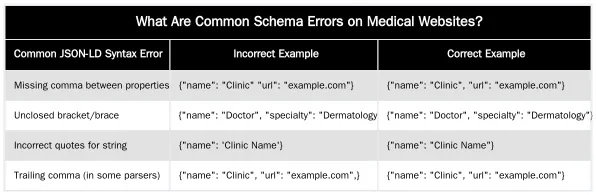
JSON-LD syntax errors often involve incorrect punctuation. Missing commas between properties, unclosed brackets or braces, or incorrect quotation marks around string values are frequent culprits. These mistakes can cause ‘unparsable structured data’ errors. A JSON-LD validator can pinpoint the exact line and character of an error, simplifying debugging. Forgetting a comma after a property-value pair within an object is a common oversight.
Addressing Missing Required Fields for YMYL Compliance
For Your Money Your Life (YMYL) medical websites, missing required fields is a technical error and a potential E-E-A-T signal issue. For a MedicalClinic, address, telephone, and url are fundamental. For a Procedure, name, description, and image are often expected. These fields help search engines verify the entity’s legitimacy and completeness. Reviewing schema documentation for medical types helps identify and populate mandatory and recommended properties, reinforcing site trustworthiness and authority.
The Impact of Incorrect Schema on Medical SEO & E-E-A-T
For medical websites, incorrect structured data has consequences beyond technical issues. It directly affects SEO and the site’s E-E-A-T signals, which are paramount for YMYL content.
Eroding Trust and Visibility: Why Accuracy is Paramount for YMYL
Incorrect or incomplete schema can prevent a medical website from achieving rich results like star ratings, FAQs, or local business listings. This loss of prominence in search results can reduce click-through rates. For YMYL topics, structured data errors can signal a lack of detail or completeness to Google, potentially lowering perceived E-E-A-T. Google’s algorithms use structured data to understand entities; inaccuracies can cause misinterpretations, eroding trust and hindering visibility. Google’s ranking systems prioritize reliable information, making accurate schema a foundational element for medical sites.
Enhancing Entity Recognition with Correct Medical Schema
Properly implemented medical schema is crucial for entity recognition. By defining entities like surgeons, clinics, and procedures, structured data helps Google connect them in its Knowledge Graph. This understanding is vital for building topical authority and strengthening semantic SEO. Linking a Physician to a MedicalClinic and to Procedure pages via schema creates a network of interconnected information. This clarity helps search engines present a medical practice as an authoritative source. To delve deeper into this, explore implementing advanced medical schema for entity recognition.
Advanced Debugging and Prevention Strategies for Clinics
Medical websites often require advanced structured data approaches beyond basic validation. Debugging nested schema and implementing prevention strategies are key to maintaining error-free markup.
Debugging Complex Nested Schema Markup
Medical websites often use nested schema, like a Physician within a MedicalClinic, or a Procedure within a Service. Debugging these structures requires attention to how entities are linked with properties like memberOf, hasOffer, or performer. Common challenges include ensuring nested entities are closed, have required properties, and have accurately defined relationships. Validating each nested layer individually before combining them can help identify failure points. Semantic engineering principles advocate for a clear hierarchy and consistent property usage to avoid ambiguity in schema graphs.
Proactive Schema Audits and Automated Validation
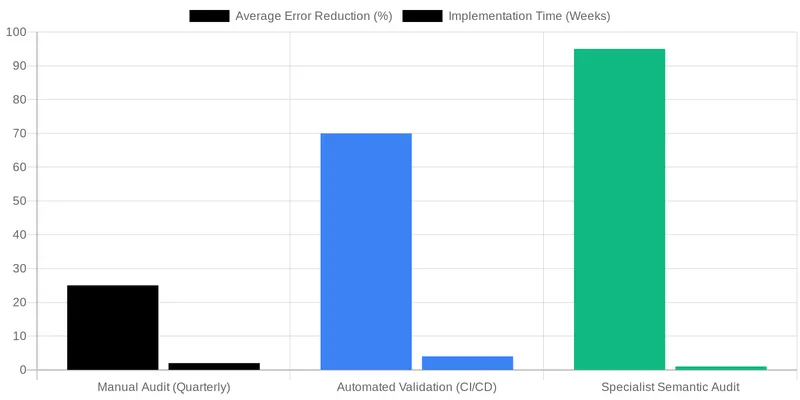
To prevent errors, medical clinics should implement regular schema audits. This involves reviewing all site-wide structured data periodically, not just reactively. Integrating automated schema validation into the development workflow is an effective prevention strategy. Tools and scripts can automatically check new or updated schema before it goes live, catching syntax errors or missing fields early. This approach ensures the structured data architecture remains scalable and aligned with search engine guidelines. Clinics that implement automated checks often see a significant reduction in reported schema errors.
Secure Your Rich Results: Partner with a Semantic SEO Expert
The complexity of structured data for YMYL medical websites often requires specialized expertise. Ensuring a clinic’s schema is correct and strategically implemented is crucial for securing rich results and building trust.
Why Specialist Medical SEO Expertise Matters
Medical schema challenges, from defining Physician and MedicalClinic types to navigating YMYL compliance, require understanding technical SEO and the healthcare industry. Partnering with a specialist can improve online visibility. Abdurrahman Şimşek, a London-based Semantic SEO Strategist, specializes in semantic engineering for medical clinics, skin clinics, and plastic surgeons. His experience ensures structured data validates and strategically enhances a site’s topical authority and E-E-A-T signals, driving patient acquisition in competitive markets like Harley Street.
Conclusion
Addressing and preventing structured data errors is a cornerstone of medical SEO. By understanding validation issues, using diagnostic tools, and implementing proactive strategies, medical websites can improve visibility and reinforce E-E-A-T. Correctly implemented schema helps search engines interpret expertise and services, leading to better rich result eligibility and increased patient trust. For London-based private healthcare providers, mastering structured data is necessary to attract patients through local organic search. To optimize a medical website’s structured data, consider partnering with a semantic SEO and web development expert. Visit abdurrahmansimsek.com to learn about building a semantic content network for your practice.
Frequently Asked Questions
How can I troubleshoot schema errors related to incorrect schema types on my medical website?
A common issue is the misuse of generic schema types, such as using LocalBusiness instead of the more specific MedicalClinic or Physician. Another frequent error involves missing required properties, like a valid address for a clinic or a specialty for a surgeon, which can cause validation failures. When you troubleshoot schema errors, start by ensuring the most specific and complete markup is used to accurately represent your medical entity. This precision helps search engines better understand your services and improve visibility.
How can Google Search Console help me troubleshoot schema errors effectively?
Google Search Console (GSC) is an invaluable diagnostic tool. Its ‘Enhancements’ reports specifically highlight structured data issues, detailing errors or warnings for types like FAQs, How-to, or Physician schema. GSC guides you directly to the affected pages and code, providing actionable insights. This is a crucial first step when you need to troubleshoot schema errors on your medical site, ensuring Google can properly parse your markup.
Why might my schema validate in one tool but show errors in another when I troubleshoot schema errors?
This discrepancy often arises because different tools adhere to varying validation standards. The Schema.org validator primarily checks for syntax correctness and adherence to the Schema.org vocabulary. In contrast, Google’s Rich Result Test specifically evaluates structured data against Google’s stricter requirements for displaying rich results in search. Understanding this distinction is key when you troubleshoot schema errors across different platforms, as Google’s tool should be your priority for SEO purposes.
Can a minor syntax mistake, like a missing comma, completely invalidate my JSON-LD schema?
Yes, absolutely. In JSON-LD, a single misplaced or missing comma, bracket, or quotation mark can render the entire script unparsable. This seemingly small error prevents search engines from reading and understanding your structured data, effectively nullifying its benefits. It’s a highly common mistake that requires careful attention during implementation and debugging to ensure your markup is valid.
What is the significance of a ‘missing field’ warning when implementing medical schema?
A ‘missing field’ warning indicates that while your schema is technically valid, you’ve omitted a property that Google recommends for optimal rich result display. For instance, you might have Review schema without the reviewRating property. While not a critical error that breaks the schema, adding these recommended fields is best practice for full eligibility and to maximize your chances of appearing with enhanced features in search results.
How can Abdurrahman Şimşek assist my medical practice with resolving complex schema issues?
Abdurrahman Şimşek, a London-based Semantic SEO Strategist, specializes in resolving complex structured data challenges for medical clinics and surgeons. With 10 years of experience, we identify, fix, and optimize your schema to ensure compliance with Google’s E-E-A-T guidelines and secure rich results. Partnering with us ensures your medical website’s structured data is accurate, compliant, and optimized for maximum search visibility and authority.
Ruxi Data brings together multi-model AI, automated website crawling, live indexation checks, topical authority mapping, E-E-A-T enrichment, schema generation, and full pipeline automation — from crawl to WordPress publish to social posting — all in one platform built for agencies and freelancers who run on results.