
Nested Schema Medical: Enhancing Entity Recognition for Clinics
Nested schema medical markup explicitly defines relationships between healthcare entities, crucial for medical websites. This guide demonstrates how to combine Physician, MedicalClinic, and MedicalProcedure schema using JSON-LD to build an interconnected data structure. Implementing this nested schema medical approach enhances Google’s understanding of your practice, improving E-E-A-T signals and boosting search visibility. By clarifying the connections between doctors, clinics, and services, websites become more authoritative and reliable sources for search engines and users.
Abdurrahman Şimşek, a Semantic SEO Strategist with 10 years of experience, specializes in building high-authority Semantic Content Networks for medical clinics. His expertise in entity-attribute-value modeling and medical content configuration ensures precise structured data implementation.
To explore your options, contact us to schedule your consultation.
Master nested schema medical markup to increase your medical website’s visibility. This guide explains how to combine Physician, MedicalClinic, and MedicalProcedure schema into an interconnected data structure for Google’s algorithms. Explicitly defining relationships between doctors, clinics, and services enhances a clinic’s E-E-A-T (Experience, Expertise, Authoritativeness, and Trustworthiness) signals and improves search performance, especially in the London private healthcare market.
What is Nested Schema Medical & Why It Matters for Clinics?
Nested schema medical markup explicitly defines the relationships between entities on a medical website. It tells Google, “This MedicalProcedure is performed by this Physician at this MedicalClinic,” creating an interconnected data structure for search engines. This clarity is crucial for YMYL (Your Money Your Life) medical content, where accuracy and trust are paramount.
This structured data helps search engines understand your practice, practitioners, and services. This understanding contributes to stronger E-E-A-T signals, which are vital for ranking in healthcare searches. By reducing ambiguity, your website becomes a more reliable source of information for users and algorithms.
The Power of Entity Relationships in Healthcare SEO
Search engines interpret isolated data differently from interconnected data. When a physician’s profile, a clinic’s location, and a procedure are linked through structured data, Google can construct a more accurate Knowledge Graph entry. This network helps Google associate expertise with specific services and locations, a critical factor for medical SEO.
For medical websites, explicit entity relationships are a cornerstone of an SEO strategy. It signals that your content is organized, factual, and authoritative, supporting advanced medical schema for entity recognition and improving visibility for complex medical queries.
Deconstructing Physician, MedicalClinic, and Procedure Schema
Understanding the individual Physician, MedicalClinic, and MedicalProcedure schema components is essential before nesting. Each type has properties that describe its characteristics and establish connections between entities. Proper implementation of each schema type is the foundation for effective nesting.
Essential Properties for Each Medical Entity
- Physician Schema: Key properties include
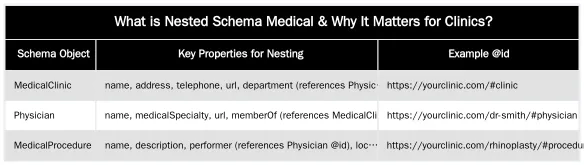
name,url,image,description,medicalSpecialty,specialty,sameAs(for social profiles or professional listings), andmemberOf(to link to a clinic). - MedicalClinic Schema: Important properties are
name,address,telephone,url,image,description,department(to link to physicians or specific service departments), andisLocatedIn(to link to a larger medical organization). - MedicalProcedure Schema: Relevant properties include
name,description,procedureType,medicalSpecialty,performer(to link to a physician),location(to link to a clinic),about(to link to related medical conditions), andbodyLocation.
Properties that reference other entities, like memberOf, department, performer, and location, are crucial for building a semantic network. For more on these properties, see resources on implementing advanced medical schema.
Common Pitfalls in Individual Schema Implementation
Errors in individual schema can undermine nesting efforts. Common pitfalls include omitting required properties, using incorrect data types (e.g., text where a URL is expected), or failing to keep schema updated with the Schema.org vocabulary. Inconsistent naming conventions or URLs can create issues when linking entities, leading to fragmented data.
Step-by-Step: Nesting Medical Schema for Comprehensive Entity Recognition
Implementing nested schema medical markup requires referencing entities using JSON-LD. The principle is to define each entity as a separate object and use the @id property to create unique identifiers. These identifiers are referenced by other schema objects, forming an interconnected data web.
This approach helps search engines understand entity relationships. For instance, a doctor is a member of a clinic and performs procedures there. This detail enhances entity recognition and helps Google understand your medical practice.
Linking Physicians to Clinics: The @id and memberOf Properties
To link a Physician to a MedicalClinic, define each as a JSON-LD object with a unique @id. The Physician schema can then use the memberOf property to reference the MedicalClinic’s @id. Conversely, the MedicalClinic schema can use the department or member property to reference its associated Physicians.
For example, a Physician’s @id might be https://yourclinic.com/dr-smith/#physician, and the MedicalClinic’s @id could be https://yourclinic.com/#clinic. The Physician’s schema would then include "memberOf": { "@id": "https://yourclinic.com/#clinic" }. This explicit linking clarifies the organizational structure for search engines.
Connecting Procedures to Performers and Locations
The MedicalProcedure schema converges these relationships. Within a MedicalProcedure object, the performer property links to the Physician by referencing their @id. The location property connects the procedure to the MedicalClinic.
This linking provides a complete picture: “Dr. Smith (Physician) performs Rhinoplasty (MedicalProcedure) at London Aesthetics Clinic (MedicalClinic).” This detail helps search engines accurately represent your services. For more examples and advanced configurations, refer to guides on implementing advanced medical schema for entity recognition.
Beyond Basics: Advanced Strategies for Medical Schema Integration
Advanced medical schema integration contributes to broader semantic SEO goals. This involves creating an interconnected data layer that mirrors the relationships within your medical practice. This strategy is beneficial for clinics in competitive markets like London.
A semantic network built on structured data helps search engines understand your expertise. This ensures your clinic’s digital presence is adaptable to evolving search algorithms.
Reinforcing E-E-A-T Signals with Interconnected Data
An interconnected schema network provides stronger E-E-A-T signals to Google. Linking a surgeon’s qualifications (Expertise), published articles (Authoritativeness), and association with a clinic (Trustworthiness) creates a clear digital footprint. This reduces ambiguity, allowing search engines to present your clinic as a trusted source for medical information and services.
This data helps Google build a more accurate entity profile for your physicians and clinic, which is crucial for YMYL content. It demonstrates your practice’s credibility, a key component of an advanced schema markup strategy in 2026.
Preparing for Generative AI: Why Detailed Schema Matters More Than Ever
Generative AI and AI Overviews make structured, entity-rich data more critical. AI systems rely on defined relationships and attributes to synthesize information and provide answers. Detailed schema ensures your clinic’s information is understood and represented in new search experiences, influencing how AI models present your services.
Providing clear data through nested schema medical increases the likelihood your clinic’s expertise will be sourced and displayed by AI. This is fundamental to future-proofing your content strategy and a consideration in AI-driven schema generation.
Maximizing Impact: Auditing and Maintaining Your Nested Medical Schema
Schema implementation requires ongoing validation and maintenance. Regular auditing ensures your structured data remains accurate and compliant through service, practitioner, and algorithm changes. This maintains the integrity of your semantic network and its impact on search visibility.
Semantic SEO Strategist Abdurrahman Şimşek emphasizes meticulous oversight in managing medical schema. This ensures structured data reflects the clinic’s offerings and adheres to Schema.org guidelines, particularly for Harley Street and London medical practices.
Tools and Techniques for Schema Validation
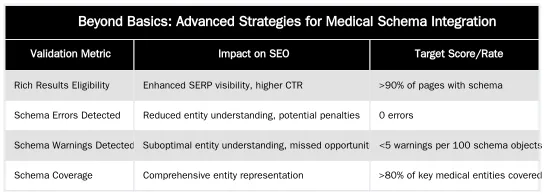
Several tools are indispensable for validating structured data. Google’s Rich Results Test checks schema eligibility for rich snippets and identifies syntax errors. The Schema.org Validator details all detected schema, helping spot inconsistencies or missing properties in nested structures. Regular use of these tools, combined with manual checks, ensures accuracy.
Understanding validator output is key. Errors or warnings often indicate issues with property usage, data types, or incorrect referencing of @ids. Addressing these promptly prevents search engines from misinterpreting your data. For example, ensuring that a MedicalProcedure is correctly linked to a Physician via the performer property is a common validation point.
The Role of a Semantic SEO Strategist in Schema Maintenance
Managing evolving schema for medical websites requires expert oversight. A Semantic SEO Strategist ensures structured data remains accurate, compliant with Google’s guidelines, and optimized for algorithm updates. This includes monitoring, refinement, and adaptation to new Schema.org vocabularies or Google features.
The benefits of partnering with an expert like Abdurrahman Şimşek include sustained visibility, improved E-E-A-T, and a future-proof digital foundation. This ensures your medical website communicates its authority and trustworthiness to search engines, a critical advantage in the healthcare landscape. For further insights into structured data, consult the official Schema.org documentation.
Unlock Deeper Entity Understanding for Your Clinic
Mastering nested schema medical markup is a strategic imperative for medical practices aiming for online visibility. Defining the relationships between your physicians, clinics, and procedures builds a semantic foundation that enhances E-E-A-T and prepares your website for the future of search. This detail ensures your expertise is conveyed to search engines and prospective patients.
For London-based plastic surgeons, aesthetic clinic owners, and private healthcare providers seeking to dominate local search and attract patients, expert guidance is invaluable. Elevate your digital presence with a tailored semantic SEO strategy. Learn how to transform your website into an authoritative entity for Google.
Conclusion
Implementing nested schema for medical websites is an essential strategy for enhancing online visibility and establishing E-E-A-T signals. By connecting Physician, MedicalClinic, and MedicalProcedure schema, you provide search engines with a clear understanding of your practice’s expertise and offerings. This approach improves search performance and future-proofs your content against evolving algorithms and Generative AI.
For medical practices in London, particularly on Harley Street, a strategic partner who understands these nuances is critical. To build a high-converting website and achieve topical authority, consult a specialist. Visit abdurrahmansimsek.com to explore how advanced semantic SEO can transform your clinic’s digital presence.
Frequently Asked Questions
What is the main benefit of using nested schema medical for medical sites?
The main benefit of using nested schema medical markup is to explicitly define the relationships between entities on your website. It allows you to tell Google, “This MedicalProcedure is performed by this specific Physician at this MedicalClinic,” creating a clear, interconnected data structure that search engines value. This approach significantly enhances E-E-A-T signals for your clinic.
How do you technically connect the three schema types for medical entities?
You connect them using properties like `performer` or `provider` to link a `MedicalProcedure` to a `Physician`, and `memberOf` or by nesting the `Physician` within the `MedicalClinic`’s `employee` property. Crucially, using the `@id` attribute allows for efficient referencing of entities without duplicating code across your site. This structured data approach builds a robust entity graph.
On which page should I implement this nested schema medical code?
This nested schema medical code is most effective on individual medical procedure or service pages. On such pages, the `MedicalProcedure` is the primary entity, and you then nest or reference the `Physician`(s) who perform it and the `MedicalClinic`(s) where it’s available. This provides comprehensive context for search engines, improving understanding of your services.
Can I add patient reviews for a specific procedure within this structured data?
Yes, you can integrate patient reviews directly into this structure. You can add an `AggregateRating` or individual `Review` property directly within the `MedicalProcedure` schema. This helps in qualifying for review-based rich snippets in search results, enhancing trust and visibility for specific treatments.
What are the risks of implementing nested schema medical incorrectly?
Incorrectly implemented nested schema medical can lead to validation errors in Google’s Rich Results Test, meaning the markup won’t be processed by search engines. While it’s unlikely to cause a manual penalty, it will prevent you from gaining the significant SEO benefits of properly structured data. Always test your implementation thoroughly to ensure accuracy.
How can I get expert help with implementing advanced medical schema for my clinic?
Abdurrahman Şimşek specializes in building high-authority semantic content networks and advanced schema for medical clinics, especially in the London private healthcare market. You can contact us through the website to discuss a tailored strategy for optimizing your clinic’s digital presence and E-E-A-T signals. We help clinics achieve significant organic growth.
Ruxi Data brings together multi-model AI, automated website crawling, live indexation checks, topical authority mapping, E-E-A-T enrichment, schema generation, and full pipeline automation — from crawl to WordPress publish to social posting — all in one platform built for agencies and freelancers who run on results.