
Calculating SEO ROI Medical: Optimizing Patient Acquisition & Clinic Revenue
Calculating SEO ROI medical provides clinic directors with a structured framework to measure the financial return on organic search investments. This guide outlines essential key performance indicators (KPIs) beyond simple traffic, focusing on patient acquisition cost, conversion tracking, and the lifetime value of patients. Understanding these metrics enables medical practices to accurately attribute leads, optimize marketing spend, and drive sustainable clinic revenue growth. It ensures every SEO effort directly contributes to tangible business outcomes.
Abdurrahman Şimşek, a London-based Semantic SEO Strategist with over 10 years of experience, specializes in building high-authority semantic content networks for medical clinics. His expertise ensures robust digital strategies that drive measurable patient acquisition and clinic growth.
To explore your options, contact us to schedule your consultation.
For private medical practices, understanding the true value of digital marketing is paramount. This guide provides a comprehensive framework for calculating seo roi medical, equipping clinic directors with the knowledge to measure and optimize their organic search investments effectively. It ensures every marketing dollar contributes to patient growth and clinic revenue, moving beyond simple traffic metrics to focus on tangible business outcomes. This approach helps justify marketing spend and strategically plan for sustained expansion in a competitive landscape.
What is SEO ROI for Medical Practices, and Why Does it Matter?
SEO ROI for medical practices quantifies the financial return on investment from organic search engine optimization efforts, specifically focusing on new patient acquisition and the revenue generated from those patients. It matters because it allows clinic directors to justify marketing budgets, understand the profitability of their digital strategies, and make data-driven decisions for business growth. This metric moves beyond superficial engagement to measure actual patient conversions and financial impact.
Unlike general SEO, medical SEO ROI places a critical emphasis on the sensitive nature of healthcare information (YMYL – Your Money Your Life). This means trust, authority, and expertise are paramount for ranking and converting. For a private medical practice, a positive return on investment signifies that the organic search strategy is effectively attracting qualified leads who convert into paying patients, thereby contributing directly to the clinic’s bottom line.
Defining Key Metrics: Beyond Website Traffic
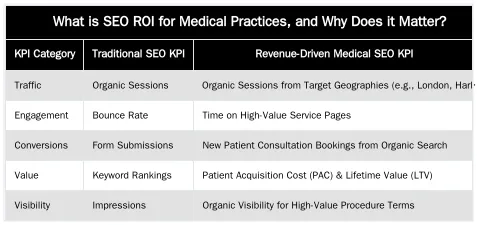
Traditional SEO metrics like website traffic volume or keyword rankings, while foundational, do not directly reflect business success for a medical clinic. Clinic directors need to shift focus to business-centric key performance indicators (KPIs). These include metrics such as the number of new patient inquiries, consultation bookings originating from organic search, and ultimately, the revenue generated from procedures performed on these organically acquired patients. Understanding these deeper metrics provides a clearer picture of an SEO campaign’s true value.
Essential KPIs for Calculating Medical SEO ROI
For clinic directors, identifying and tracking the right key performance indicators (KPIs) is fundamental to understanding the effectiveness of their organic search investments. These metrics provide clear insights into patient acquisition and financial returns. Beyond basic website analytics, a robust KPI framework for medical practices includes specific conversion events that directly correlate with patient engagement and revenue generation.
Here’s a comparison of traditional versus revenue-driven KPIs for medical practices:
Tracking Patient Acquisition Cost (PAC) and Lifetime Value (LTV)
To accurately assess the return on investment, clinic directors must calculate the Patient Acquisition Cost (PAC) for organic search. This involves dividing the total investment in SEO (including agency fees, content creation, and tools) over a specific period by the number of new patients acquired directly through organic channels during that same period. For instance, if £5,000 was spent on SEO in a quarter and 25 new patients were acquired, the PAC is £200 per patient.
Equally important is the Lifetime Value (LTV) of a patient. In a medical context, LTV represents the total revenue a patient is expected to generate for the practice over their entire relationship. For high-value procedures or ongoing treatments common in plastic surgery or aesthetic clinics, a patient’s LTV can be substantial. Comparing PAC to LTV provides a clear picture of long-term profitability and helps justify higher initial acquisition costs for specialized plastic surgery strategies.
Setting Up Conversion Tracking in Google Analytics 4
Effective conversion tracking is the backbone of accurate ROI measurement. Google Analytics 4 (GA4) offers a flexible event-based data model ideal for medical practices. Clinic directors should configure GA4 to track critical medical conversions, such as:
- Form submissions for appointment requests or inquiries.
- Clicks on phone numbers (call tracking).
- Clicks on online booking system links.
- Completions of virtual consultation requests.
- Downloads of informational brochures or patient guides.
By defining these events as conversions within GA4, practices can precisely monitor which organic traffic sources lead to valuable patient actions, providing the data necessary for calculating SEO ROI medical effectively.
How to Accurately Attribute Patient Leads to SEO Efforts
Accurately attributing patient leads to specific marketing channels, especially organic search, is a complex yet crucial aspect of evaluating SEO effectiveness in the medical field. Patients often interact with multiple touchpoints before booking a consultation or procedure. Understanding these multi-channel journeys is essential for assigning appropriate credit to SEO efforts and optimizing future marketing spend for lead generation.
Understanding Multi-Touch Attribution Models for Clinics
Different marketing attribution models distribute credit across various touchpoints in a patient’s journey. Choosing the right model helps clinic directors understand SEO’s true contribution:
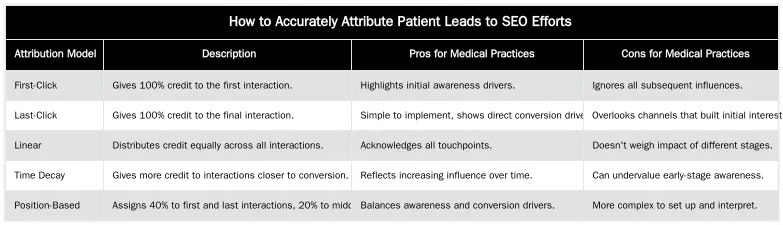
For medical practices, a multi-touch model like Time Decay or Position-Based often provides a more nuanced view, recognizing that SEO might initiate the patient journey, while other channels (e.g., direct search for the clinic name) might close the conversion. This approach provides better business intelligence for strategic planning.
Integrating CRM Data for Holistic Patient Journey Tracking
To gain a truly holistic understanding of patient journeys and accurately attribute revenue, integrating SEO data with a Customer Relationship Management (CRM) system is vital. When a patient inquiry or booking originates from organic search, that information should be logged in the CRM. This allows the practice to track the patient’s entire lifecycle, from initial search query to consultation, procedure, and subsequent follow-ups.
By connecting GA4 conversion data with CRM records, clinic directors can link specific organic search efforts to actual patient names, treatment plans, and generated revenue. This integration provides verifiable data on the lifetime value of patients acquired through SEO, enabling precise calculations of organic search profitability and informing future medical marketing investments.
Maximizing Your Medical SEO ROI with Semantic Strategies
Leveraging advanced semantic SEO strategies is a powerful way for private medical practices to significantly enhance their return on investment. This approach moves beyond simple keyword targeting to build comprehensive topical authority, attracting highly qualified patients who are actively searching for specific medical solutions. As an experienced SEO consultant, Abdurrahman Şimşek specializes in developing such semantic content networks for medical clinics, ensuring content resonates deeply with both search engines and prospective patients.
Building Topical Authority for High-Value Procedures
For medical clinics, building topical authority means creating comprehensive content clusters around specific medical treatments or conditions. For example, instead of just a single page on “rhinoplasty,” a clinic would develop a network of interconnected content covering “rhinoplasty London,” “rhinoplasty recovery,” “types of rhinoplasty,” “choosing a rhinoplasty surgeon,” and patient testimonials. This demonstrates deep expertise to search engines, positioning the clinic as an authoritative source.
This strategic content architecture attracts more relevant traffic, as search engines recognize the clinic’s comprehensive understanding of a topic. This leads to higher conversion rates from visitors who are further along in their decision-making process, ultimately translating into a superior return on investment. A robust Harley Street SEO strategy, for instance, relies heavily on this principle to dominate local organic search for premium medical services.
The Role of Entity-Attribute-Value (EAV) Modeling in Medical SEO
Entity-Attribute-Value (EAV) modeling is a sophisticated approach to structuring medical content that significantly improves search engine understanding and patient matching. In EAV, medical concepts (entities) like “Rhinoplasty” are broken down into their core attributes (e.g., “procedure type,” “recovery time,” “cost,” “surgeon expertise”) and their corresponding values (e.g., “cosmetic surgery,” “2-4 weeks,” “£7,000-£12,000,” “board-certified”).
By structuring content using EAV principles, medical practices provide search engines with highly organized, machine-readable information. This allows search engines to better understand the nuances of medical queries and match them with the most relevant, authoritative content. The result is improved visibility for specific, high-intent searches, leading to more qualified leads and a higher ROI. This advanced content configuration is particularly effective in the YMYL (Your Money Your Life) search landscape, where accuracy and trustworthiness are paramount for ranking. For further reading on semantic search, consult resources like Wikipedia’s entry on Semantic Search.
What to Expect: Realistic Timelines and Continuous Optimization
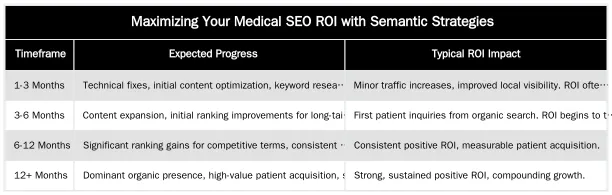
Clinic directors often seek immediate results from SEO, but it is crucial to set realistic expectations regarding the timeline for seeing a positive return on investment. SEO is a long-term strategy that builds authority and trust over time. While initial improvements in rankings and traffic can be observed within a few months, significant and measurable ROI typically requires a more extended period of sustained effort.
Here’s a general outlook on SEO ROI timelines for medical practices:
Benchmarking and Setting Achievable ROI Goals
Setting achievable ROI goals requires benchmarking against industry standards and considering the clinic’s specific circumstances, such as its specialty, location (e.g., London’s competitive medical market), and budget. For medical practices, a good return on investment for SEO often falls within a 3:1 to 5:1 ratio, meaning £3-£5 in revenue for every £1 spent. However, with the high lifetime value of medical patients, this can often be much higher.
Goals should be specific, measurable, achievable, relevant, and time-bound (SMART). For example, a goal might be to “achieve a 4:1 SEO ROI by increasing new patient consultation bookings from organic search by 20% within 12 months.” Regular review against these benchmarks allows for strategic adjustments.
Iterative Optimization: The Key to Sustained Growth
SEO is not a one-time project but an ongoing process of iterative optimization. To maintain and improve ROI, medical practices must continuously monitor performance, analyze data, and adapt their strategies. This includes:
- Regular technical SEO audits to ensure website health.
- Continuous content updates and expansion to maintain topical authority.
- A/B testing of landing pages and calls-to-action to improve conversion rates.
- Adapting to search engine algorithm changes and evolving patient search behaviors.
- Monitoring competitor strategies and market trends.
This continuous cycle of analysis and refinement is essential for sustained organic growth and maximizing the long-term return on investment from SEO efforts.
Ready to Transform Your Clinic’s Online Presence?
Understanding and accurately measuring the return on investment from your SEO efforts is critical for the sustainable growth of your private medical practice. If you’re a clinic director seeking to move beyond vanity metrics and implement a robust framework for calculating SEO ROI medical, expert guidance is invaluable. Partnering with a specialist who understands the unique demands of the medical sector can unlock significant organic growth.
Elevate your clinic’s digital strategy and ensure every marketing investment delivers tangible patient acquisition and revenue. Discover how advanced semantic SEO can transform your online presence and drive measurable results.
Contact Abdurrahman Şimşek to discuss your medical SEO strategy.
Conclusion
Accurately calculating SEO ROI is no longer a luxury but a necessity for private medical practices aiming for sustainable growth. By focusing on key performance indicators like Patient Acquisition Cost and Lifetime Value, leveraging robust conversion tracking in Google Analytics 4, and implementing sophisticated marketing attribution models, clinic directors can gain a clear financial perspective on their organic search investments. Embracing semantic SEO strategies and building topical authority further amplifies these returns, attracting high-value patients.
While SEO demands patience and continuous optimization, the long-term benefits of a strong organic presence—including reduced patient acquisition costs and increased clinic revenue—are substantial. For medical practices ready to transform their digital strategy and achieve measurable success, expert guidance in semantic SEO and web development is a strategic advantage. Explore how a tailored SEO strategy can benefit your clinic.
Frequently Asked Questions
What are the most important KPIs for a clinic director to track when assessing SEO performance?
Beyond basic traffic, focus on ‘New Patient Consultation Bookings from Organic Search’, ‘Cost Per Acquisition (CPA)’, and ‘Organic Visibility for High-Value Procedure Terms’. These metrics are crucial for calculating seo roi medical as they directly link SEO performance to tangible business growth and patient acquisition, providing a clear picture of your investment’s impact.
How long does it typically take to see a positive return on investment from medical SEO efforts?
For competitive private healthcare markets like London, a foundational period of 6-9 months is common to establish authority. Significant, compounding positive returns are generally observed from month 9 onwards as your clinic’s topical authority and online presence strengthen, leading to consistent patient acquisition.
What is a simple formula for determining the financial return of SEO for a medical clinic?
A basic formula is: ( (Value of New Patients from SEO – SEO Investment) / SEO Investment ) * 100. The critical step is accurately attributing new patients to SEO and assigning a realistic lifetime value to each. This approach helps in effectively measuring the financial impact of your SEO spend.
How can I accurately track phone call leads generated by my website’s organic traffic?
Implementing dynamic number insertion (DNI) is the most precise method for tracking phone calls. This technology displays unique phone numbers to organic search visitors, enabling accurate tracking of calls as conversions within analytics platforms like Google Analytics. This helps in understanding the direct impact of SEO on patient inquiries.
Why is simply ranking #1 not always the best indicator when assessing the value of SEO for a medical practice?
Achieving a #1 ranking for a keyword with low commercial intent may not translate into new patients or revenue. Instead, focus on rankings for a portfolio of high-intent keywords that directly lead to consultations and procedures. This provides a much clearer picture of your SEO investment’s financial return.
How can Abdurrahman Şimşek’s semantic SEO strategies enhance my clinic’s return on investment?
Abdurrahman Şimşek specializes in building high-authority Semantic Content Networks specifically for medical clinics. This advanced approach ensures your content comprehensively answers patient queries, establishes your clinic as a trusted authority, and targets high-value procedures. Ultimately, this maximizes your organic patient acquisition and overall SEO ROI.
Ruxi Data brings together multi-model AI, automated website crawling, live indexation checks, topical authority mapping, E-E-A-T enrichment, schema generation, and full pipeline automation — from crawl to WordPress publish to social posting — all in one platform built for agencies and freelancers who run on results.