
Automated Topical Map Generation: Enhancing Medical SEO for Plastic Surgeons
Automated topical map generation systematically identifies and organizes all relevant subtopics and entities around a core subject. For plastic surgeons, this process builds robust semantic content networks, establishing deep topical authority and trustworthiness in competitive YMYL niches. This methodology moves beyond simple keyword targeting to create comprehensive content architecture, ensuring thorough coverage of medical topics. It guides content creation to address every facet of a procedure or condition, signaling definitive expertise to search engines and attracting informed patients.
Abdurrahman Şimşek, a Semantic SEO Strategist, specializes in leveraging advanced workflows like Ruxi Data to construct high-authority semantic content networks for medical clinics. His expertise ensures content architecture that drives organic growth and establishes deep online trust.
To explore your options, contact us to schedule your consultation.
For plastic surgeons navigating the highly competitive online landscape, automated topical map generation offers a significant strategic advantage. This article explores how a Ruxi Data workflow enables medical clinics to construct robust semantic content networks, enhancing search visibility and establishing deep authority. Understanding and implementing this advanced content strategy is crucial for dominating organic search and attracting high-value patients in specialized medical fields.
What is Automated Topical Map Generation and Why it Matters for Plastic Surgeons?
Automated topical map generation is the process of using artificial intelligence and advanced algorithms to systematically identify, organize, and map all relevant subtopics, entities, and questions surrounding a core subject. For plastic surgeons, this methodology is critical because it ensures comprehensive content coverage, establishing deep plastic surgery topical authority and trustworthiness in a highly sensitive YMYL (Your Money Your Life) niche. This approach moves beyond simple keyword targeting to build a holistic understanding of a topic area.
In the medical field, where accuracy and expertise are paramount, search engines prioritize content that demonstrates thorough knowledge. A well-constructed topical map acts as a blueprint, guiding content creation to cover every facet of a procedure or condition. This comprehensive approach signals to search engines that a clinic is a definitive source of information, which is essential for ranking highly and attracting informed patients.
Beyond Keywords: The Shift to Semantic Content Architecture
The evolution of search engines has moved past simple keyword matching to a sophisticated understanding of semantic relationships and user intent. Modern SEO requires building a robust semantic content network, where content is structured around entities and their connections, rather than isolated keywords. For plastic surgeons, this means creating content that addresses every aspect of a topic like “rhinoplasty,” from surgical techniques and recovery to potential risks and patient testimonials.
This shift to semantic content architecture is critical for medical authority. By demonstrating comprehensive knowledge across an entire topic, clinics can build trust with both search engines and prospective patients. This approach ensures that all related queries are addressed, positioning the clinic as an expert resource.
How Ruxi Data Automates Topical Map Generation for Medical Clinics
Ruxi Data employs a multi-stage process to automate the creation of topical maps, specifically tailored for the complexities of medical content. The system begins by ingesting vast amounts of data from top-ranking search results, academic papers, medical journals, and public knowledge graphs. It then applies natural language processing (NLP) and machine learning to identify core entities and their semantic relationships within the plastic surgery domain. This automated approach ensures a level of detail and breadth that manual methods cannot easily achieve.
The workflow involves analyzing search intent patterns, common patient questions, and the informational gaps present in existing online content. By understanding how users search for medical information, Ruxi Data constructs a content framework that directly addresses these needs. This systematic generation of content architecture helps medical clinics build a comprehensive and authoritative online presence.
From Knowledge Graph Analysis to Entity Mapping
Ruxi Data leverages advanced knowledge graph analysis to identify core entities relevant to plastic surgery, such as “breast augmentation,” “facelift,” or “liposuction.” It then maps their attributes (e.g., “recovery time,” “cost,” “procedure steps”) and semantic relationships (e.g., “breast augmentation” is related to “implants,” “mammoplasty,” and “post-operative care”). This comprehensive entity mapping process forms the foundation of a robust knowledge base construction, ensuring that every piece of content is contextually rich and interconnected. The system performs sophisticated information retrieval to gather and structure this data effectively.
Identifying Content Gaps and Building Topic Clusters Automatically
A key function of Ruxi Data is its ability to perform automated content gap analysis. By comparing the generated topical map against a clinic’s existing content, the system precisely pinpoints missing areas of information. It then automatically suggests new topic clusters and pillar pages required to achieve comprehensive coverage. For example, if a clinic extensively covers “rhinoplasty” but lacks detailed content on “septoplasty” or “revision rhinoplasty,” Ruxi Data will highlight these gaps. This ensures that the content strategy is always evolving to meet the full spectrum of patient inquiries and search engine expectations, leading to a complete and authoritative content architecture.
Automated vs. Manual Topical Mapping: Efficiency and Accuracy for YMYL
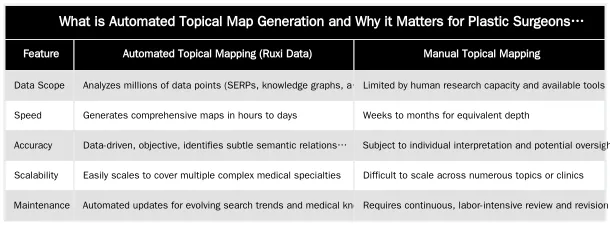
The creation of topical maps can be approached manually or through automation. While manual mapping offers a human touch, it is often time-consuming, resource-intensive, and prone to human bias or oversight, especially in complex fields like medicine. Automated methods, powered by tools like Ruxi Data, offer significant advantages in terms of scale, speed, and data-driven accuracy. For YMYL (Your Money Your Life) medical content, where precision and comprehensiveness are non-negotiable, automation provides a more reliable and efficient solution.
Consider the following comparison:
Why Automation Excels in Complex Medical Niches
Automation excels in complex medical niches due to the sheer volume and dynamic nature of medical knowledge. Manual methods struggle to keep pace with new research, evolving terminology, and changing patient search behaviors. An automated system can continuously monitor these shifts, ensuring that a clinic’s content strategy remains current and comprehensive. This capability is vital for maintaining topical authority and trust with search engines, which heavily scrutinize YMYL content for accuracy and expertise. Automation reduces the cost of retrieval for information, making content strategy more efficient.
Building Unrivaled Topical Authority with Ruxi Data for Plastic Surgeons
For plastic surgeons, establishing deep topical authority is not merely an SEO tactic; it is a fundamental requirement for patient trust and business growth. A Ruxi Data-powered topical map provides the strategic framework to achieve this. By systematically covering every relevant entity and subtopic, clinics demonstrate comprehensive expertise to search engines and prospective patients. This is particularly critical in competitive markets like London, where patients seek highly credible and authoritative information before making significant medical decisions.
The strategic advantage lies in moving beyond fragmented content to a cohesive, interconnected knowledge base. This holistic approach signals to search engines that a website is a definitive resource for a given medical topic, leading to higher rankings and increased organic visibility. This method ensures that all content contributes to a unified semantic content network.
The Abdurrahman Şimşek Advantage: Semantic Engineering for Medical SEO
Abdurrahman Şimşek brings over a decade of specialized experience in semantic engineering and information retrieval to medical SEO. His expertise in Entity-Attribute-Value (EAV) modeling and Cost of Retrieval (CoR) optimization is integrated into Ruxi Data workflows, delivering bespoke content architectures for medical clients. This specialized knowledge ensures that topical maps are not just comprehensive but also strategically optimized for search engine understanding and patient engagement. Abdurrahman’s approach to algorithmic authorship ensures content is structured for maximum semantic impact, a critical factor for YMYL sites.
His deep understanding of how search engines process and rank medical information allows for the creation of content strategies that truly resonate with Google’s algorithms. This includes optimizing for implicit user intent and building robust knowledge graphs that reflect genuine medical authority. For more insights into semantic engineering, one can refer to resources like Wikipedia’s entry on Semantic Networks.
Dominating Local Search: Harley Street to Knightsbridge
A robust topical map, combined with targeted local SEO strategies, empowers plastic surgeons in high-value London postcodes like Harley Street, Marylebone, Mayfair, Knightsbridge, Chelsea, Kensington, and Belgravia to achieve local organic search dominance. By creating content that addresses both broad medical topics and specific local patient concerns, clinics can capture a significant share of local search traffic. For example, a topical map might include content on “rhinoplasty surgeons Harley Street” or “breast augmentation clinic Knightsbridge,” ensuring local relevance.
Consider the potential impact on local patient acquisition:
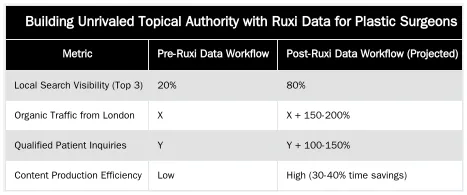
This integrated approach ensures that a clinic’s online presence is not only authoritative but also geographically targeted, attracting the most relevant local patients.
Achieving Measurable Growth: What to Expect from a Ruxi Data Workflow
Implementing an automated topical map generation strategy with Ruxi Data yields tangible, measurable results for plastic surgeons. The primary outcome is a significant increase in organic visibility, driven by enhanced topical authority. This translates directly into higher rankings for a broader range of relevant medical queries, attracting more qualified traffic to the clinic’s website. The strategic content architecture ensures that every piece of content contributes to a cohesive and authoritative online presence, positioning the clinic as a trusted expert.
Beyond visibility, clinics can expect improved user engagement metrics, such as lower bounce rates and longer time on page, as visitors find comprehensive answers to their questions. This positive user experience further signals to search engines the quality and relevance of the content, reinforcing ranking improvements. The systematic identification and filling of content gaps ensure that no potential patient query goes unaddressed.
Increased Organic Visibility and High-Value Patient Acquisition
Improved topical authority directly leads to higher organic rankings, which in turn drives increased organic traffic. For plastic surgeons, this traffic consists of highly qualified individuals actively researching procedures and seeking expert care. The result is a greater volume of patient inquiries and, ultimately, higher conversion rates. For instance, past projects have demonstrated significant organic growth, with one medical practitioner achieving over +400% organic growth, showcasing the potential for substantial patient acquisition. This growth is sustained because the underlying content architecture is built for long-term relevance and authority, rather than short-term keyword gains.
Transform Your Clinic’s Online Presence with Semantic SEO
For plastic surgeons and aesthetic clinic owners seeking to establish a dominant online presence, leveraging advanced semantic SEO and automated content mapping is essential. A robust semantic content network, powered by Ruxi Data, provides the foundation for unparalleled topical authority and sustained organic growth. This strategic approach ensures your clinic ranks for high-value terms, attracts qualified patients, and builds lasting trust in the competitive medical landscape. Partner with an expert to redefine your digital strategy.
Discover how a tailored Ruxi Data workflow can elevate your clinic’s visibility and patient acquisition. Visit abdurrahmansimsek.com to learn more and schedule a consultation.
Conclusion
The digital landscape for plastic surgeons demands a sophisticated approach to content strategy. Automated topical map generation, particularly through a Ruxi Data workflow, offers a powerful solution for building comprehensive semantic content networks. This methodology ensures deep topical authority, addresses critical content gaps, and drives significant organic visibility. By moving beyond traditional keyword strategies to embrace entity-based content architecture, medical clinics can establish themselves as definitive sources of information, fostering trust and attracting high-value patients.
For plastic surgeons aiming to dominate search results in competitive markets like London, implementing such an advanced semantic SEO strategy is no longer optional. It is a prerequisite for sustained growth and patient acquisition. To explore how this transformative approach can benefit your practice, visit abdurrahmansimsek.com.
Frequently Asked Questions
How does Ruxi Data’s automated topical map generation work?
Ruxi Data analyzes top-ranking content and knowledge graph entities relevant to a core medical topic. This process of automated topical map generation then models semantic relationships, attributes, and user questions to build a comprehensive, machine-readable topical map for your domain.
Why is automated topical map generation superior to manual methods for plastic surgeons?
Automation provides unparalleled scale, speed, and data-driven precision that is exceptionally difficult to achieve manually. It identifies non-obvious semantic connections and ensures complete coverage of a topic, which is critical for establishing authority in YMYL medical fields.
How does automated topical map generation specifically benefit a plastic surgery practice?
It enables rapid content strategy planning and execution, covering every facet of a procedure from patient concerns to technical details. This automated topical map generation establishes deep authority, allowing practices to outmaneuver competitors relying on slower, manual processes.
Can the output from automated topical map generation be customized for specific clinic needs?
Yes, the output from Ruxi Data provides a robust data-driven foundation. It is designed for review and refinement by subject matter experts, such as consultant surgeons, ensuring absolute clinical accuracy and brand alignment for your practice.
What is the typical timeframe for automated topical map generation for a complex procedure like rhinoplasty?
The automated topical map generation process can produce a comprehensive blueprint, including hundreds of entities and content briefs, in a matter of hours. This significantly reduces the weeks or months typically required for manual research and planning.
How can plastic surgeons get started with Ruxi Data’s semantic SEO services?
Plastic surgeons and clinic owners can begin by contacting Abdurrahman Şimşek for a strategic consultation. This initial step helps tailor a semantic content network plan to your specific practice goals and target audience, enhancing your online presence.
Ruxi Data brings together multi-model AI, automated website crawling, live indexation checks, topical authority mapping, E-E-A-T enrichment, schema generation, and full pipeline automation — from crawl to WordPress publish to social posting — all in one platform built for agencies and freelancers who run on results.