
SEO Revenue Correlation: Quantifying Patient Bookings & ROI
The seo revenue correlation quantifies the financial link between organic search performance and patient bookings, enabling medical practices to measure marketing ROI. This article details a framework for connecting SEO efforts to actual revenue data, optimizing for higher-value patients and sustainable growth. Readers will learn to track patient acquisition cost, leverage healthcare analytics, and integrate CRM systems for end-to-end lead attribution. Understanding this correlation is crucial for strategic decision-making and proving the tangible impact of SEO on clinic profitability and patient lifetime value.
Abdurrahman Şimşek, a Semantic SEO Strategist specializing in medical clinics, provides expert insights into building high-authority content networks. His approach focuses on leveraging advanced analytics and semantic engineering to drive measurable patient acquisition and revenue growth for healthcare providers.
To explore your options, contact us to schedule your consultation.
The seo revenue correlation quantifies the financial link between SEO efforts and patient bookings, allowing medical practices to measure the return on investment from organic search. This article provides a framework for connecting SEO performance to revenue data to measure marketing ROI and optimize for higher-value patients.
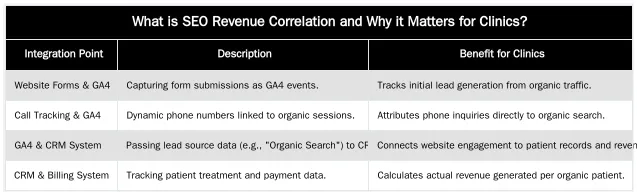
What is SEO Revenue Correlation and Why it Matters for Clinics?
SEO revenue correlation is the quantifiable relationship between a medical practice’s organic search performance and its financial outcomes, like patient bookings and clinic income. For clinics, this correlation moves beyond vanity metrics like rankings or traffic to show how SEO contributes to business growth. Measuring this link allows practices to justify marketing spend, optimize for profitability, and make data-driven decisions.
Defining the Direct Link Between Organic Search and Patient Income
Organic search is a primary channel for patients seeking medical information, procedures, and specialists. A clinic’s website ranking for relevant queries attracts high-intent visitors in the research or decision-making phase of their patient journey. Optimized content and user experience guide these visitors toward actions like filling out an appointment form, calling, or starting an online consultation. Each action is a potential patient booking, translating into revenue. Establishing this link requires tracking mechanisms that connect organic website visits to patient transactions in the clinic’s management systems.
Key Metrics & Tools: How to Track Patient Bookings from SEO
Tracking the journey from an organic search query to a patient booking requires integrating tools and focusing on specific metrics. The goal is to understand the patient acquisition cost from organic channels. This requires using analytics platforms, CRM systems, and specialized tracking solutions.
Implementing Google Analytics 4 for Healthcare Conversion Tracking
Google Analytics 4 (GA4) is essential for monitoring user behavior and conversions on a medical website. Clinics should configure GA4 to track events that signify patient intent, including form submissions, clicks on phone numbers (call tracking), clicks on email addresses, and views of consultation pages. Custom events can be set up for each interaction, allowing detailed reporting on which organic traffic sources lead to these actions. Analyzing these conversion rates measures how effectively organic content prompts patient engagement.
Integrating CRM for End-to-End Patient Journey Attribution
Connecting website analytics with a patient CRM system is necessary for marketing ROI tracking. This integration allows clinics to follow a lead from its organic source through booking, treatment, and payment. When a patient fills out a form or calls from an organic search result, the lead’s source should be tagged in the CRM. This enables the clinic to attribute revenue to the organic channel. This visibility helps medical practices understand the value of each organic patient. For more insights on measuring SEO goals and KPIs, review setting realistic SEO goals and KPIs.
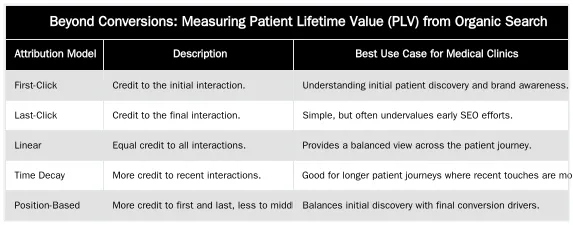
Beyond Conversions: Measuring Patient Lifetime Value (PLV) from Organic Search
Focusing on immediate conversions overlooks the long-term financial impact of organic patient acquisition. Understanding Patient Lifetime Value (PLV) from organic channels provides a more accurate picture of SEO’s return on investment. PLV considers repeat visits, additional procedures, and referrals, showing the sustained revenue from one organically acquired patient.
Calculating PLV for Different Medical Procedures and Patient Segments
Calculating PLV involves tracking the total revenue from a patient over their relationship with the clinic, minus the cost of serving them. For organic patients, this means identifying their acquisition channel as “organic search” in the CRM. Clinics can segment patients by their initial procedure (e.g., cosmetic surgery vs. dermatology consultation) to understand which organic keywords and content attract higher-value patients. For example, a patient booking a high-value surgical procedure via organic search may have a higher PLV than one booking a lower-cost consultation. This data informs SEO strategy, guiding content and keyword targeting toward more profitable patient segments. According to the American Medical Association, understanding patient retention metrics is crucial for practice profitability. The AMA provides resources on patient retention strategies.
Optimizing SEO for High-Value Patient Acquisition, Not Just Volume
SEO strategy for medical clinics should prioritize attracting high-value patients over maximizing traffic volume. This requires specific keyword research and content development. Instead of targeting “plastic surgery London,” a clinic might focus on long-tail keywords like “rhinoplasty specialist Harley Street cost” or “best facelift surgeon Marylebone.” These queries indicate higher intent and a greater likelihood of conversion into a high-value booking. Content should be tailored to the information needs of these patient segments to build trust and authority. Aligning SEO efforts with revenue goals makes the organic strategy contribute to financial growth.
Strategic Insights: Leveraging Data for Sustainable Clinic Growth
Abdurrahman Şimşek, a London-based Semantic SEO Strategist with over a decade of experience, emphasizes that raw data becomes valuable when transformed into actionable insights. For medical clinics, this means moving beyond basic analytics to understand the strategic implications of organic performance on revenue. His expertise in semantic engineering and healthcare analytics provides a framework for data-driven decisions.
From Data to Decisions: Informing Content Strategy and Budget Allocation
Revenue data from organic channels guides content strategy and justifies SEO investment. When a clinic sees which organic content leads to the highest-value patient bookings, it can allocate resources to create more of it. If detailed procedure pages attract patients for high-revenue treatments, the focus shifts to expanding and optimizing those pages. This data demonstrates the return on investment for SEO to clinic directors, making it easier to secure budgets. Building E-E-A-T (Experience, Expertise, Authoritativeness, Trustworthiness) with medically accurate content is paramount in the YMYL healthcare sector, influencing Google’s perception of trustworthiness, organic visibility, and patient trust.
The Role of Semantic SEO in Enhancing Revenue Attribution Accuracy
A structured semantic content network improves Google’s understanding of a clinic’s services, specialists, and procedures. By defining entities and their relationships, semantic SEO helps search engines connect user queries with relevant and authoritative content. This precision leads to higher quality organic traffic—visitors more likely to convert. For example, if a clinic has a semantic framework around “breast augmentation London,” Google can accurately match patients searching for specific aspects of that procedure (e.g., “silicone vs. saline implants”) with relevant content. This improved relevance translates to better conversion rates and more accurate revenue attribution, as the patient journey becomes clearer. Learning about semantic SEO for surgeons provides insights into building algorithm-proof topical authority.
Overcoming Attribution Challenges and Proving SEO ROI
Attributing patient bookings and revenue to marketing channels like organic search presents challenges. The patient journey is rarely linear, involving multiple touchpoints across platforms before a conversion. Overcoming these complexities demonstrates SEO’s contribution to the clinic’s financial health. Understanding the full patient journey is key to proving the seo revenue correlation.
Navigating Multi-Touch Attribution Models for Complex Patient Journeys
Last-click attribution models often undervalue SEO, which is frequently an initial touchpoint in a long patient journey. Multi-touch attribution models provide a more complete view by distributing credit across all interactions. Common models include:
- First-Click Attribution: Gives 100% credit to the first interaction. Useful for understanding initial awareness.
- Last-Click Attribution: Gives 100% credit to the final interaction before conversion. Simple but often incomplete.
- Linear Attribution: Distributes credit equally across all touchpoints.
- Time Decay Attribution: Gives more credit to touchpoints closer to the conversion.
- Position-Based Attribution: Assigns more credit to the first and last interactions, with remaining credit distributed among middle interactions.
For medical practices, a time decay or position-based model often provides a more realistic representation of SEO’s influence, acknowledging its role in early-stage research and its potential for direct conversion. Implementing these models in GA4 and integrating with CRM data allows for more accurate lead attribution.
Presenting Clear SEO Revenue Reports to Clinic Directors
Translating complex SEO data into clear, actionable revenue reports for non-SEO stakeholders is crucial. Reports should focus on KPIs tied to financial outcomes, including organic traffic growth, conversion rates for high-value actions (e.g., appointment requests), patient acquisition cost from organic search, and total revenue from organic patients. Visualizations like charts and graphs can simplify data, highlighting trends and SEO’s impact on the clinic’s bottom line. Emphasize SEO as a long-term asset compared to short-term advertising. For a deeper dive into reporting, refer to measuring SEO goals and KPIs.
Unlock Your Clinic’s Full Revenue Potential with Semantic SEO
Connecting SEO performance to patient booking and revenue data is necessary for medical clinics. It requires integrating analytics, CRM systems, and an understanding of patient lifetime value. Using semantic SEO principles, clinics can attract more organic traffic and ensure it consists of high-intent, high-value patients. This data-driven methodology transforms SEO from a cost into a measurable revenue driver. Specialized expertise is required to maximize a clinic’s organic revenue potential. A semantic SEO strategist who understands the medical sector can provide the direction needed to grow a patient base and income through organic search.
Conclusion
Connecting SEO performance to patient booking and revenue data is fundamental to modern medical practice marketing. Tracking key metrics, integrating analytics with CRM systems, and focusing on Patient Lifetime Value allows clinics to make data-driven, profitable decisions. Overcoming attribution challenges with multi-touch models and clear reporting shows clinic directors the financial impact of organic search. For London’s private healthcare sector, semantic SEO strategies increase visibility and attract high-value patients, contributing to revenue growth. To explore how a tailored semantic SEO strategy can transform your clinic’s patient acquisition and revenue, visit abdurrahmansimsek.com.
Frequently Asked Questions
How can our clinic directly measure the seo revenue correlation?
Measuring the seo revenue correlation involves integrating your website analytics with your patient CRM. By using conversion tracking for appointment forms and call tracking for phone inquiries, you can attribute patient bookings directly to organic search traffic. This allows for a precise calculation of your SEO ROI and informs strategic adjustments.
What is the most critical metric for connecting SEO to revenue?
The most critical metric is ‘cost per acquisition’ (CPA) for new patients sourced from organic search. This tells you exactly how much you’re investing in SEO efforts to acquire a new, revenue-generating patient. Understanding CPA is vital for proving the financial viability and profitability of your SEO campaigns.
Can we track revenue from specific keywords or pages?
Yes, with proper setup in Google Analytics 4 and integration with your CRM, you can track conversions and revenue back to specific organic landing pages. This granular data allows you to identify high-performing content and keyword themes, enabling data-driven adjustments to your content strategy for improved financial outcomes.
How does E-E-A-T impact patient trust and conversion rates?
High E-E-A-T (Experience, Expertise, Authoritativeness, Trustworthiness) signals to both Google and potential patients that your medical content is reliable and credible. This foundational trust significantly increases the likelihood of users converting from organic traffic into actual patient bookings. It directly strengthens the link between your online visibility and revenue generation.
What’s a realistic timeframe to establish a strong seo revenue correlation?
For competitive markets like London private healthcare, establishing a clear and positive seo revenue correlation typically takes 6-12 months of consistent, strategic SEO. This timeframe accounts for the strategic implementation of SEO, content development, and the time needed for Google to recognize and rank your authority. Consistent effort is key to demonstrating a strong financial return.
Why is understanding the seo revenue correlation crucial for medical clinics?
Understanding the seo revenue correlation is crucial because it shifts focus from vanity metrics like rankings to tangible financial results. It allows clinics to justify SEO investments by directly linking organic search performance to patient bookings and overall clinic income. This insight empowers data-driven decisions for sustainable growth and optimized marketing spend.
How can Abdurrahman Şimşek help my clinic improve its patient bookings and revenue?
Abdurrahman Şimşek specializes in building high-authority Semantic Content Networks for medical clinics, focusing on YMYL and E-E-A-T optimization. By leveraging advanced SEO strategies and Ruxi Data integration, he helps clinics in London and Harley Street attract high-value patients, directly impacting your bottom line. You can learn more or schedule a consultation via the website to discuss your specific needs.
Ruxi Data brings together multi-model AI, automated website crawling, live indexation checks, topical authority mapping, E-E-A-T enrichment, schema generation, and full pipeline automation — from crawl to WordPress publish to social posting — all in one platform built for agencies and freelancers who run on results.