Medical E-e-a-t Infrastructure: Building Trust for Surgeon Websites
Building a robust medical e-e-a-t infrastructure is essential for surgeon websites to establish credibility and achieve prominence in search results. This framework systematically demonstrates Experience, Expertise, Authoritativeness, and Trust, crucial for YMYL content. It outlines technical strategies like algorithmic authorship, physician data optimization, and adherence to quality rater guidelines. Implementing a strong medical e-e-a-t infrastructure ensures clinical accuracy, builds topical authority, and enhances patient confidence, directly impacting search visibility and online reputation.
Abdurrahman Şimşek, a Semantic SEO Strategist, specializes in developing high-authority semantic content networks for medical clinics and plastic surgeons. His 10+ years of experience in medical SEO and information retrieval ensures robust E-E-A-T implementation for healthcare providers.
To explore your options, contact us to schedule your consultation.
Building a robust medical e-e-a-t infrastructure is fundamental for surgeon websites aiming to establish credibility and achieve prominence in search engine results. This technical framework ensures that medical content is not only accurate but also demonstrably trustworthy and authoritative, directly impacting patient perception and search visibility. This article outlines the essential components, technical implementation strategies, and strategic advantages of a comprehensive E-E-A-T approach, vital for medical practitioners in the current digital landscape.
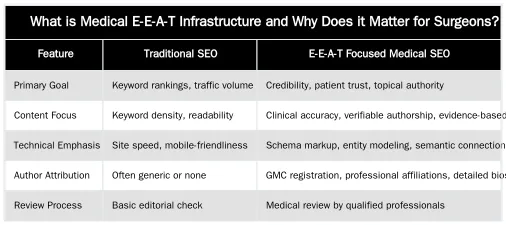
What is Medical E-E-A-T Infrastructure and Why Does it Matter for Surgeons?
A medical E-E-A-T infrastructure refers to the systematic technical and content framework designed to demonstrate Experience, Expertise, Authoritativeness, and Trust for medical websites. For surgeon websites, this is critical because their content falls under the YMYL (Your Money Your Life) category, where inaccurate or untrustworthy information can have severe consequences. Search engines prioritize highly credible sources for YMYL topics, making a robust E-E-A-T framework essential for ranking and building patient confidence. The most critical component of a medical E-E-A-T infrastructure is verifiable authorship, ensuring that all medical content is clearly attributed to a qualified, registered surgeon and supported by robust technical signals.
This framework extends beyond basic SEO, focusing on deep semantic connections and verifiable credentials. It helps search engines understand the true value and reliability of a surgeon’s online presence, directly influencing visibility in competitive markets like London’s Harley Street. Without a strong E-E-A-T foundation, even high-quality medical content may struggle to gain traction, as search algorithms are designed to protect users from potentially harmful misinformation.
The Core Pillars of Medical E-E-A-T: Beyond Basic SEO
Building a strong E-E-A-T foundation for medical websites involves several interconnected pillars that go beyond traditional keyword optimization. These include ensuring clinical accuracy, adhering to strict quality rater guidelines, and implementing structured data effectively. A comprehensive content review process is paramount, involving qualified medical professionals to verify information before publication. This meticulous approach signals to search engines that the content is reliable and produced by genuine experts.
Structured data, such as Schema.org markup, plays a vital role in explicitly communicating the nature of the content and the credentials of its authors to search engines. This technical layer helps algorithms understand the entities involved, their relationships, and their real-world authority. Integrating these elements creates a robust digital footprint that supports the overall credibility of the surgeon’s online presence.
Ensuring Clinical Accuracy and Quality Rater Compliance
Clinical accuracy is non-negotiable for medical content. Every piece of information, from procedural descriptions to patient advice, must be evidence-based and factually correct. This requires a rigorous content configuration workflow that includes multiple layers of review by GMC-registered surgeons or other qualified medical professionals. Adherence to Google’s Quality Rater Guidelines is crucial, as these guidelines outline the criteria human evaluators use to assess page quality, particularly for YMYL topics. Websites must demonstrate a high level of expertise, authoritativeness, and trustworthiness to satisfy these standards.
A structured content configuration process ensures that medical claims are supported by reputable sources, potential risks are clearly communicated, and patient safety is prioritized. This systematic approach minimizes errors and builds a foundation of trust with both patients and search engines. For more on optimizing this process, explore content configuration for clinical accuracy.
Achieving Topical Authority and Measurable Growth for Your Clinic
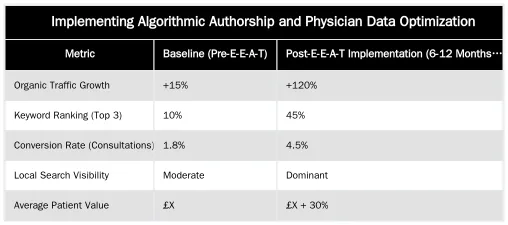
A robust medical E-E-A-T infrastructure directly translates into significant improvements in topical authority and organic search performance. By consistently demonstrating expertise and trustworthiness, surgeon websites can achieve higher rankings for critical medical queries, leading to increased organic traffic and patient inquiries. This long-term strategy is fundamental for any YMYL SEO framework, as it builds a sustainable foundation for digital growth. The benefits extend beyond mere visibility, enhancing brand reputation and positioning the surgeon as a leading expert in their field.
For plastic surgeons and aesthetic clinics in London, establishing this authority is crucial for attracting high-value patients. Measurable growth can be observed through metrics such as increased organic search impressions, higher click-through rates, improved conversion rates from website visitors to consultations, and a stronger presence in local search results for premium postcodes. This strategic investment in E-E-A-T ensures that the website not only ranks but also converts, driving tangible business outcomes.
From Infrastructure to Impact: Driving Organic Growth for Plastic Surgeons
Connecting the technical E-E-A-T framework to tangible business outcomes is essential for plastic surgery and aesthetic clinics. By meticulously building out a semantic content architecture and demonstrating verifiable expertise, these clinics can dominate local organic search across areas like Harley Street, Mayfair, and Knightsbridge. This comprehensive approach supports a topical authority strategy that covers all relevant procedures, patient concerns, and related medical entities. The result is a website that consistently appears at the top of search results for high-intent queries, attracting the right demographic of patients.
For example, a clinic specializing in rhinoplasty could see a substantial increase in organic traffic and inquiries by establishing deep topical authority around nasal aesthetics, surgical techniques, recovery processes, and patient education, all underpinned by a strong medical E-E-A-T infrastructure. This strategic alignment of technical SEO and content quality drives sustainable growth.
Partner with an Expert: Elevate Your Medical E-E-A-T Strategy
Navigating the complexities of medical E-E-A-T requires specialized expertise in semantic SEO, web development, and the unique demands of the healthcare sector. Building a high-authority semantic content network and optimizing for algorithmic authorship is a technical endeavor that yields significant returns. Abdurrahman Şimşek, a London-based Semantic SEO Strategist with over a decade of experience, specializes in crafting these advanced frameworks for medical clinics, skin clinics, and plastic surgeons. His approach leverages semantic engineering and physician data optimization to ensure your website not only meets but exceeds search engine expectations.
For plastic surgeons and aesthetic clinic owners in London seeking to dominate local organic search across Harley Street and premium postcodes, partnering with a specialist is paramount. Elevate your digital presence and attract high-value patients by implementing a robust medical E-E-A-T infrastructure. Contact Abdurrahman Şimşek today for a strategic consultation.
Conclusion
Establishing a strong medical E-E-A-T infrastructure is no longer optional for surgeon websites; it is a fundamental requirement for online success and patient trust. By focusing on verifiable authorship, clinical accuracy, robust technical signals, and a comprehensive semantic content network, medical practitioners can significantly enhance their search visibility and reputation. This strategic investment ensures that expertise is not only present but also effectively communicated to both search engines and prospective patients. For plastic surgeons and aesthetic clinics, a well-executed E-E-A-T strategy is the pathway to achieving topical authority and sustained organic growth in a highly competitive digital landscape.
To build a high-converting website and dominate local organic search, a specialized approach is essential. Partner with an expert who understands the nuances of medical SEO and semantic engineering. Discover how Abdurrahman Şimşek can transform your medical website’s E-E-A-T profile.
Frequently Asked Questions
What is the most critical component of a medical e-e-a-t infrastructure?
The most critical component for a robust medical e-e-a-t infrastructure is verifiable authorship. This involves clearly attributing all medical content to a qualified, registered surgeon (e.g., GMC-registered in the UK) and using appropriate schema markup to connect the author to their real-world credentials and expertise. This transparency builds immediate trust with both users and search engines.
How does a ‘content review process’ support E-E-A-T for medical sites?
A documented content review process, where medical information is verified for accuracy by a qualified expert before publication, is a powerful trust signal. Mentioning this process on your website demonstrates a commitment to providing reliable, authoritative information. This systematic approach enhances the perceived expertise and trustworthiness of your content.
Can a technically poor website undermine its medical e-e-a-t infrastructure?
Absolutely. A slow, insecure, or poorly structured website can signal a lack of professionalism and trustworthiness, negatively impacting user experience and perceived authority. A robust medical e-e-a-t infrastructure requires a technically superior platform to ensure content is accessible and reliable. Technical excellence is foundational to demonstrating credibility.
What role do external citations play in enhancing a surgeon’s online authority?
Mentions and links from authoritative medical directories, journals, and professional organizations are vital for building online authority. These external citations act as third-party validation of a surgeon’s expertise and trustworthiness. They reinforce the signals you build on your own site, demonstrating broader recognition within the medical community.
How can a surgeon’s website effectively showcase ‘Experience’?
Surgeons can showcase their experience through detailed case studies (with patient consent), comprehensive before-and-after galleries, and authentic patient testimonials. Publishing content that addresses complex, nuanced patient questions also demonstrates hands-on, real-world expertise. This approach goes beyond basic textbook information, highlighting practical skill and knowledge.
How can a surgeon get started with building a strong medical e-e-a-t infrastructure?
To begin building a strong medical e-e-a-t infrastructure, surgeons should first audit their existing online presence for E-E-A-T signals. This involves identifying areas for improvement in authorship, content accuracy, and technical website performance. Partnering with a specialized semantic SEO strategist can provide a tailored framework and expert guidance for effective implementation.
Ruxi Data brings together multi-model AI, automated website crawling, live indexation checks, topical authority mapping, E-E-A-T enrichment, schema generation, and full pipeline automation — from crawl to WordPress publish to social posting — all in one platform built for agencies and freelancers who run on results.