Semantic Architecture for Surgeons: Building Scalable Content Networks
Semantic architecture for surgeons provides a data-driven framework for plastic surgery clinics to build scalable content networks. This approach leverages Entity-Attribute-Value (EAV) modeling and topical maps to organize content around core entities like procedures and conditions. Readers will learn how this strategy enhances E-E-A-T, establishes topical authority, and optimizes for search engine understanding. By structuring information semantically, clinics reduce Google’s ‘Cost of Retrieval’ and improve visibility for high-value patient acquisition. This method moves beyond keyword-centric SEO to focus on comprehensive topic coverage and entity relationships.
Abdurrahman Şimşek, a London-based Semantic SEO Strategist with 10+ years of experience, specializes in building high-authority semantic content networks for medical clinics. His expertise in Semantic Engineering and EAV modeling helps plastic surgeons achieve algorithm-proof rankings and dominate local search.
To explore your options, contact us to schedule your consultation. You can also reach us via: Book a Semantic SEO Audit, Direct WhatsApp Strategy Line: +90 506 206 86 86
Plastic surgeons and aesthetic clinics in London need more than traditional SEO to achieve online visibility and attract high-value patients. This guide introduces semantic architecture for surgeons, a data-driven approach that builds a scalable content network using Entity-Attribute-Value (EAV) modeling and topical maps. This strategy helps clinics dominate search results and establish topical authority, ensuring their expertise is recognized by patients and search engines in 2026.
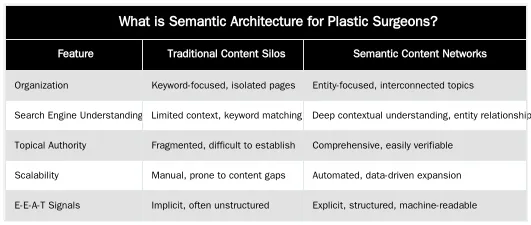
What is Semantic Architecture for Plastic Surgeons?
Semantic architecture for plastic surgery websites is a data-driven method for organizing content around entities like surgeons, procedures, and conditions to create a machine-readable content network. This structure helps search engines understand the relationships between information on a website. It differs from traditional keyword-centric SEO by focusing on topic coverage and entity relationships rather than isolated keyword density.
Beyond Keywords: Understanding Entity-Based SEO
Search engines have evolved beyond keyword matching to understand the meaning and context behind queries. Entity-based SEO recognizes that Google processes information as entities (people, places, things, concepts) and their attributes. For a plastic surgeon, this means defining “Rhinoplasty” as an entity with attributes like “recovery time,” “anesthesia type,” and “ideal candidate,” not just as a keyword. This allows for a more accurate interpretation of content and more relevant search results.
Implementing Entity-Attribute-Value (EAV) Modeling and Topical Maps
Semantic architecture has two core components: Entity-Attribute-Value (EAV) modeling and topical maps. EAV structures data, while topical maps ensure complete coverage of a medical specialty. This creates an organized, machine-readable content network. For example, ‘Rhinoplasty’ is an entity, ‘Recovery Time’ an attribute, and ‘2-4 weeks’ its value. This detail enhances search engine understanding and patient experience.
Structuring Surgical Procedures with EAV for Precision
The Entity-Attribute-Value (EAV) model for surgical procedures breaks down complex information into discrete, related data points. For a ‘Breast Augmentation’ Entity, Attributes might include ‘Implant Type’, ‘Incision Location’, ‘Anesthesia’, ‘Recovery Time’, ‘Cost Range’, and ‘Surgeon’. The Values would be specific details like ‘Saline or Silicone’, ‘Inframammary Fold’, ‘General Anesthesia’, ‘4-6 weeks’, ‘£6,000-£8,000’, and ‘Dr. Jane Smith’. This structured data helps search engines understand procedure nuances, improving relevance for detailed patient queries.
Building Comprehensive Topical Maps for Plastic Surgery
Topical maps for plastic surgery identify all core topics, sub-topics, and related entities within a specialty to ensure complete topical authority. For a clinic specializing in facial aesthetics, the core topic ‘Facial Rejuvenation’ would branch into sub-topics like ‘Facelift’, ‘Blepharoplasty’, ‘Rhinoplasty’, and ‘Dermal Fillers’. Each sub-topic links to related entities such as ‘Surgeon Qualifications’, ‘Patient Testimonials’, ‘Before & After Galleries’, and ‘Recovery Guidelines’. This interconnected content signals to search engines that the clinic is an exhaustive resource. This approach is central to a semantic content network blueprint.
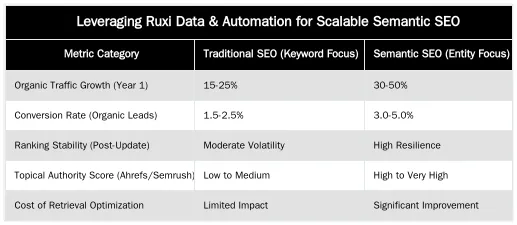
Leveraging Ruxi Data & Automation for Scalable Semantic SEO
Abdurrahman Şimşek, a Semantic SEO Strategist with over 10 years of experience, uses tools like Ruxi Data. Ruxi Data automates SERP analysis, identifies topical gaps, and generates data-driven content briefs. This allows plastic surgery clinics to scale content production efficiently without compromising quality or E-E-A-T. This automation provides a strategic advantage in London’s competitive medical market, helping clinics produce authoritative content that ranks.
Automating Topical Map Creation and Content Briefs with Ruxi Data
Ruxi Data streamlines content strategy and production for medical practices. It analyzes search data, identifying the entities, attributes, and relationships Google prioritizes for medical queries. This analysis uncovers topical gaps in existing content and generates detailed content briefs. These briefs guide writers to create relevant, semantically rich content. This automation ensures new content contributes to the clinic’s topical authority, as demonstrated in automating medical topical maps with Ruxi Data.
The Future of Medical SEO: Algorithmic Authorship and GEO
Semantic architecture prepares websites for Generative Engine Optimization (GEO). By structuring content around entities and attributes, clinics position themselves as authoritative sources for AI-generated answers. Generative AI models prioritize well-structured, factual, and attributable content. A semantic network with clear E-E-A-T signals ensures a clinic’s expertise is reflected and sourced by these systems, influencing patient interactions and search visibility. This future-proofs a clinic’s online presence.
Achieving Algorithm-Proof Rankings and High-Value Patient Acquisition
Semantic architecture provides long-term benefits for plastic surgery clinics. It leads to stable, algorithm-proof rankings because it aligns with how search engines understand information. Clinics gain organic visibility for high-value procedures, attracting more qualified patient inquiries. Semantic SEO builds a lasting digital asset, unlike short-term tactics, ensuring sustained growth and patient acquisition.
From Visibility to Consultations: The Patient Journey Enhanced by Semantic SEO
A semantic content network guides patients through their decision-making process. From initial research on a procedure (e.g., “breast augmentation London”) to understanding recovery times and surgeon qualifications, the structured content provides answers at every stage. This information builds confidence. Patients who see a clinic as an authoritative source are more likely to book a consultation. This converts organic visibility into patient leads.
Measuring ROI: Beyond Rankings to Patient Acquisition
Measuring semantic SEO success extends beyond keyword rankings. Key performance indicators (KPIs) include increased organic traffic to high-value procedure pages, higher conversion rates on consultation forms, and a measurable increase in qualified patient inquiries. A clinic might track new patient bookings attributed to organic search. This focus on business outcomes demonstrates the return on investment (ROI) of a semantic strategy.
Partner with a Semantic SEO Strategist for Your Clinic’s Growth
Plastic surgeons and aesthetic clinic owners in London can establish an online presence by partnering with a semantic SEO strategist. Abdurrahman Şimşek has over a decade of experience in semantic engineering and medical SEO, offering a data-driven approach to building a semantic content network. This methodology helps your clinic achieve algorithm-proof rankings, attract high-value patients, and future-proof its digital strategy. Increase your clinic’s online authority and patient acquisition in London’s market. Book a Semantic SEO Audit or connect directly via WhatsApp: +90 506 206 86 86.
Conclusion
Semantic architecture is a necessity for plastic surgery clinics seeking online success in 2026. By using entity-attribute-value modeling and topical maps instead of traditional keyword strategies, clinics can build a scalable content network that establishes topical authority and E-E-A-T. This approach reduces Google’s ‘Cost of Retrieval,’ ensures algorithm-proof rankings, and prepares for Generative Engine Optimization. For London medical practices, this framework translates to higher organic visibility and the acquisition of high-value patients. To transform your clinic’s digital presence, Book a Semantic SEO Audit with Abdurrahman Şimşek, or reach out via WhatsApp: +90 506 206 86 86.
Frequently Asked Questions
What is semantic architecture for surgeons?
This is a data-driven method for organizing a website’s content around key entities like surgeons, procedures, and conditions. It uses topical maps and an Entity-Attribute-Value (EAV) model to create a highly structured, machine-readable content network that Google can easily understand, establishing the site as an authority.
How does semantic architecture for surgeons help attract high-value patients?
By clearly defining every procedure, its attributes (e.g., cost, recovery time), and the surgeons who perform it, this architectural approach directly answers specific patient queries. This improves rankings for long-tail, high-intent searches and builds trust, which is crucial for attracting patients seeking high-value cosmetic procedures.
What is the main benefit of using an EAV model within a semantic architecture for surgeons?
An EAV model offers immense scalability and flexibility compared to standard website structures. Instead of rigid page templates, procedures are defined by their attributes, allowing easy addition of new treatments, dynamic comparisons, and consistent information updates across the entire site. This ensures your semantic architecture for surgeons remains consistent and authoritative.
How does this content strategy enhance E-E-A-T signals for medical practices?
A well-structured content network significantly improves E-E-A-T. It programmatically demonstrates expertise through deep, interconnected content hubs and builds authority by establishing your clinic and surgeons as central entities in the knowledge graph. This enhances trust by presenting clear, comprehensive information that satisfies both user and search engine requirements for YMYL topics.
Is implementing a robust content network complex for a clinic?
While building this advanced content strategy requires specialized expertise in semantic SEO and data modeling, the process can be streamlined. Frameworks like Ruxi Data are leveraged to automate much of the heavy lifting, making the initial strategic investment manageable for clinics.
How can plastic surgeons begin building a semantic content network?
To start, plastic surgeons can book a Semantic SEO Audit with an expert like Abdurrahman Şimşek. This initial step helps identify current content gaps and outlines a tailored strategy for building a scalable semantic content strategy, ensuring long-term online growth and patient acquisition. You can book an audit here.
Ruxi Data brings together multi-model AI, automated website crawling, live indexation checks, topical authority mapping, E-E-A-T enrichment, schema generation, and full pipeline automation — from crawl to WordPress publish to social posting — all in one platform built for agencies and freelancers who run on results.