
Pillar Page SEO Medical: Elevating Medical Clinic Visibility
Implementing a robust pillar page SEO medical strategy is essential for healthcare providers, especially plastic surgeons and aesthetic clinics, to achieve dominant organic search rankings. This guide explains how to leverage a content cluster approach, centered around comprehensive pillar pages, to build unparalleled topical authority and enhance user experience. Readers will learn to define high-value topics, structure content using the hub and spoke model, and apply semantic engineering principles. Mastering this strategy ensures medical websites establish strong E-E-A-T signals, satisfying both patient information needs and search engine algorithms.
Abdurrahman Şimşek, a Semantic SEO Strategist with over a decade of experience, specializes in crafting high-authority Semantic Content Networks for medical clinics. His expertise in holistic SEO strategy and semantic engineering ensures content architecture that drives significant organic growth and establishes definitive topical authority in competitive medical niches.
To explore your options, contact us to schedule your consultation.
In the highly competitive and trust-sensitive landscape of healthcare, a robust pillar page SEO medical strategy is no longer optional. This guide will demystify how medical clinics, particularly plastic surgeons and aesthetic practices, can leverage content hubs to build unparalleled topical authority, enhance user experience, and secure dominant organic search rankings. Understanding this approach is crucial for establishing a strong digital presence and attracting high-value patients in 2026 and beyond.
What is a Medical Pillar Page and Why Does it Matter for SEO?
A medical pillar page is a comprehensive, authoritative resource that broadly covers a core topic relevant to a medical specialty. It serves as the central hub for a network of more specific, interlinked articles, known as content clusters. This structure is vital for establishing topical authority and demonstrating Expertise, Experience, Authoritativeness, and Trustworthiness (E-E-A-T) in Your Money Your Life (YMYL) medical niches, signaling to search engines that your site is a definitive source of information.
Defining the Hub and Spoke Model for Medical Content
The ‘hub and spoke’ or ‘topic cluster’ model organizes website content around a central pillar page (the hub) that links to several supporting articles (the spokes). For a plastic surgeon, a pillar page might be “The Complete Guide to Breast Augmentation.” This hub would link to spokes covering specific aspects like “Types of Breast Implants,” “Breast Augmentation Recovery Timeline,” and “Understanding Breast Augmentation Risks.” This systematic approach helps search engines understand the depth and breadth of your expertise on a given subject, improving overall search visibility.
Crafting Your Medical Pillar Page: Strategy & Structure
Developing an effective content hub requires strategic planning, especially within the nuanced medical field. The goal is to create a comprehensive resource that addresses a broad user intent while maintaining medical accuracy and relevance. This foundational work sets the stage for a successful overall SEO strategy, ensuring your content resonates with both patients and search algorithms.
Selecting High-Value Topics for Medical Specialties
Choosing the right pillar page topic is paramount. It should be broad enough to encompass numerous subtopics but specific to your clinic’s high-value services and patient needs. For an aesthetic clinic, “Non-Surgical Facial Rejuvenation” could be an excellent topic, covering injectables, laser treatments, and skin tightening. This aligns with common user intent, addressing a wide range of patient queries while remaining focused on profitable procedures. Thorough keyword research is essential to identify topics with significant search volume and high topical relevance.
Structuring for Comprehensive Coverage and User Experience
A well-structured medical pillar page enhances both user experience and search engine crawlability. It should begin with a clear introduction, followed by a table of contents for easy navigation. Use descriptive H2 and H3 headings to break down complex information into digestible sections. A logical flow, from general concepts to specific details, ensures comprehensive coverage. This robust information architecture not only guides users through the content but also helps search engines understand the hierarchy and relationships between different topics, reinforcing the page’s authority.
Implementing a Robust Content Cluster Strategy for Medical SEO
Beyond the pillar page itself, the success of this content model hinges on the strategic development and interlinking of supporting cluster articles. This approach builds strong content silos, signaling deep topical authority to search engines. For medical practices, this means creating a network of highly accurate and informative content that addresses every facet of a patient’s potential questions.
Developing Supporting Cluster Content and ’10x Content’
Supporting cluster articles delve into specific subtopics introduced on the pillar page. These should be “10x content”—meaning they are ten times better than anything else currently ranking for that specific query. For a “Guide to Dermal Fillers” pillar, cluster content might include “Hyaluronic Acid Fillers: What to Expect,” “Comparing Different Types of Lip Fillers,” or “Aftercare for Dermal Filler Injections.” Each article must provide in-depth, medically accurate information, demonstrating E-E-A-T through clear sourcing and expert authorship. This detailed approach is critical for capturing long-tail search queries and reinforcing the overall topical map. For a deeper dive into this process, explore a comprehensive topic cluster strategy workflow.
Mastering Internal Linking and Content Silos for Authority
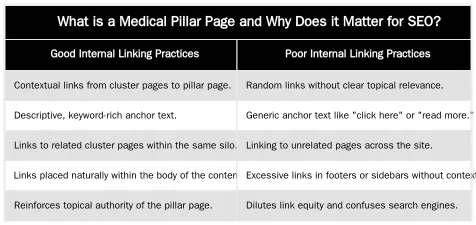
Strategic internal linking is the backbone of a successful content cluster strategy. Cluster pages should link back to the main pillar page using relevant anchor text, reinforcing the pillar’s authority on the broad topic. Additionally, related cluster pages should link to each other, creating a tightly knit content silo. This structure helps distribute link equity throughout your site and signals to search engines the semantic relationships between your content pieces. Effective content silos prevent keyword cannibalization and ensure that each page contributes to the overall topical authority of your medical website. Understanding content silo architecture is key to this process.
Leveraging Semantic Engineering for Algorithm-Proof Medical Pillar Pages
In the evolving landscape of search, merely optimizing for keywords is insufficient. Abdurrahman Şimşek, a London-based Semantic SEO Strategist, specializes in building high-authority Semantic Content Networks for medical clinics. This advanced approach, rooted in semantic engineering, ensures that medical pillar pages are not only relevant today but also resilient to future algorithm updates, reducing the ‘cost of retrieval’ for search engines.
Beyond Keywords: Entity-Based Optimization for Medical Content
Modern search engines understand content through entities—real-world objects, concepts, and people—and their attributes. For medical content, this means optimizing for entities like “Botox,” “dermatologist,” “rhinoplasty,” and their associated characteristics (e.g., “Botox side effects,” “rhinoplasty recovery time”). By structuring content around these entities and their relationships, medical websites can align with Google’s Knowledge Graph, building profound topical authority. This shift from keyword density to entity-attribute-value (EAV) modeling ensures content is understood in context, making it more valuable to both users and search engines.
Automating Topical Map Creation with Ruxi Data for Medical Clinics
Creating comprehensive topical maps for complex medical specialties can be resource-intensive. Leveraging advanced tools like Ruxi Data, Abdurrahman Şimşek streamlines this process. Ruxi Data analyzes vast amounts of search data and competitor landscapes to identify all relevant entities, subtopics, and user intents related to a medical pillar page. This automation assists in pinpointing topical gaps and opportunities, enabling the creation of a robust semantic content network. By precisely mapping out the entire topic, clinics can ensure exhaustive coverage, reduce content development time, and optimize for the lowest possible ‘cost of retrieval’ for search engines, leading to more efficient indexing and ranking.
Measuring Success and Sustaining Your Medical Pillar Page Strategy
Implementing a content hub strategy is an ongoing process. To ensure long-term success and a strong return on investment, medical clinics must continuously monitor performance, adapt to patient needs, and maintain the highest standards of medical accuracy and E-E-A-T. Neglecting these aspects can undermine even the most well-crafted content.
Key Metrics for Evaluating Pillar Page Performance
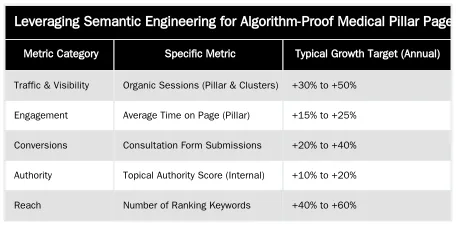
Measuring the effectiveness of your medical pillar pages goes beyond simple keyword rankings. Key performance indicators (KPIs) include organic traffic to both the pillar and its cluster pages, user engagement metrics (e.g., time on page, bounce rate), and conversion rates (e.g., consultation form submissions, phone calls). Tracking the growth of your overall topical authority and the number of referring domains also provides insight into the strategy’s impact. Regular analysis of these metrics, often through tools like Google Analytics, helps identify areas for improvement and demonstrates the tangible value of your content efforts. For more on analytics, refer to Google Analytics best practices.
Maintaining E-E-A-T and Freshness for Evergreen Medical Content
Medical information evolves, and search engines prioritize content that is current, accurate, and trustworthy. Regularly updating and expanding your pillar pages and their associated clusters is crucial for maintaining E-E-A-T signals. This involves reviewing content for medical accuracy, incorporating new research or treatment options, and updating statistics. Displaying “Last Reviewed By” dates and the credentials of medical professionals who have vetted the content further reinforces trust. Adhering to Google’s Quality Rater Guidelines, which emphasize expertise and trustworthiness, is paramount for sustained organic visibility in the YMYL space. Consult Google’s Quality Rater Guidelines for detailed insights.
Ready to Dominate Your Medical Niche with Pillar Page SEO?
Implementing a sophisticated content hub strategy for medical specialties requires deep expertise in both SEO and the unique demands of the healthcare sector. A well-executed pillar page SEO medical approach can transform your online presence, attracting more high-value patients and establishing your clinic as a leading authority. Don’t let your competitors capture the attention your expertise deserves. Partner with a specialist who understands the intricacies of medical content and semantic engineering.
Conclusion
A strategic content hub approach is indispensable for medical clinics aiming to achieve and sustain top organic search rankings. By meticulously crafting comprehensive pillar pages, developing robust content clusters, and leveraging advanced semantic engineering, medical practices can build unparalleled topical authority and E-E-A-T. This not only enhances search visibility but also provides immense value to prospective patients, fostering trust and driving conversions. To unlock the full potential of your medical website and dominate your niche, consider a partnership with an expert in semantic SEO. Discover how Abdurrahman Şimşek can elevate your digital strategy at abdurrahmansimsek.com.
Frequently Asked Questions
What is the best way to select a topic for a pillar page SEO medical strategy?
A pillar page topic should be broad enough to encompass many subtopics, yet specific to the clinic’s core services. For a dermatologist, ‘A Patient’s Guide to Acne Treatment’ is a strong example, as opposed to a generic ‘Skin Care’. It must align with a high-value service to attract the right patient demographic.
What is the ideal structure for an effective pillar page SEO medical content hub?
The ideal structure begins with a clear definition and summary, followed by a table of contents linking to distinct sections. Each section should cover a key subtopic, such as ‘Types of Acne’ or ‘Topical Treatments,’ with internal links to more detailed articles within the topic cluster. This hierarchical organization helps both users and search engines navigate the comprehensive content.
How does implementing a pillar page SEO medical strategy enhance a clinic’s search engine rankings?
This strategy organizes your content logically, making it easier for search engines to understand your expertise. By establishing a central, authoritative hub (the pillar) supported by detailed cluster pages, you signal comprehensive knowledge on a topic, which boosts the ranking potential of all related content. This approach builds topical authority and improves overall organic visibility.
How does a medical content pillar differ from a standard blog post?
No, while a pillar page is extensive, its core differentiator is its strategic structure and purpose. It serves as a foundational resource that broadly covers a topic and links out to many related, in-depth articles. A blog post, conversely, typically focuses on a single, narrow subtopic and links back to the central pillar. This distinction is crucial for content organization and SEO impact.
What role does Ruxi Data play in developing successful medical content hubs?
Ruxi Data streamlines the complex planning phase of content creation. It analyzes the core topic, identifies all essential subtopics for cluster content, and generates a complete structural blueprint for both the pillar page and its supporting articles. This ensures comprehensive coverage and eliminates content gaps, making the process highly efficient for medical specialists.
How can I get started with a specialized content strategy for my medical practice?
Abdurrahman Şimşek specializes in building high-authority Semantic Content Networks specifically for medical clinics, leveraging 10 years of experience and Ruxi Data. You can contact us for a strategic consultation to develop a tailored approach that enhances your digital presence and attracts high-value patients. Visit abdurrahmansimsek.com to learn more about our services and how we can help your practice dominate its niche.
Ruxi Data brings together multi-model AI, automated website crawling, live indexation checks, topical authority mapping, E-E-A-T enrichment, schema generation, and full pipeline automation — from crawl to WordPress publish to social posting — all in one platform built for agencies and freelancers who run on results.