
SEO Metrics for Revenue: Driving Clinic Profitability
For private medical clinics, understanding which seo metrics for revenue truly matter shifts focus from superficial rankings to tangible financial outcomes. This article details performance indicators crucial for patient acquisition and profitability, moving beyond vanity metrics. It explains how to track these metrics, including conversion rate optimization and marketing attribution, and connect them directly to business results. The goal is to ensure SEO efforts translate into measurable clinic revenue growth and attract high-value patients, optimizing overall SEO ROI.
Abdurrahman Şimşek, a Semantic SEO Strategist, specializes in building high-authority semantic content networks for medical clinics. His expertise focuses on leveraging advanced SEO strategies to drive patient acquisition and measurable revenue growth for private healthcare providers, particularly in the London market.
To explore your options, contact us to schedule your consultation.
For private medical clinics, understanding which seo metrics for revenue matter moves focus from superficial rankings to financial outcomes. This article covers the performance indicators that impact patient acquisition and profitability, how to track them, and how to connect them to business results so SEO efforts translate into measurable growth.
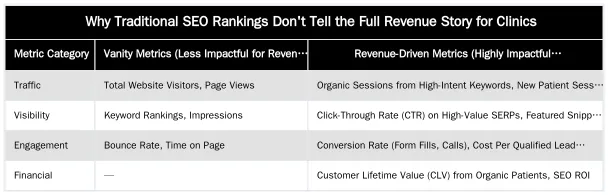
Why Traditional SEO Rankings Don’t Tell the Full Revenue Story for Clinics
Traditional SEO metrics like keyword rankings and website traffic volume provide an incomplete picture of a clinic’s online success. High rankings alone do not guarantee booked consultations or increased revenue. These are “vanity metrics” because they lack direct correlation to a clinic’s financial health. The value of SEO is measured by its contribution to patient acquisition and profitability. Focusing on setting realistic SEO goals and KPIs for your clinic’s growth means shifting to business metrics that reflect patient engagement and financial returns.
The goal is to attract visitors actively seeking specific procedures or consultations. A focus on revenue-driven metrics helps clinics understand the return on investment (ROI) from their digital marketing, ensuring resources are allocated effectively for growth.
Key SEO Metrics Directly Impacting Patient Acquisition and Clinic Revenue
For medical clinics, impactful SEO metrics extend beyond traffic counts to focus on the journey from search query to booked procedure. Metrics like Cost Per Qualified Lead (CPQL), conversion rate, and customer lifetime value (CLV) from organic patients show SEO’s financial contribution. Targeting high-value keywords is also crucial, as these terms attract patients further down the decision-making funnel, influencing patient acquisition and clinic revenue.
Understanding Cost Per Qualified Lead (CPQL) for High-Value Procedures
Cost Per Qualified Lead (CPQL) is a critical metric for private medical practices. Unlike Cost Per Click (CPC), which measures visit cost, CPQL quantifies the investment to generate a lead meeting specific criteria. For a plastic surgery clinic, a qualified lead might complete a detailed consultation request form for a specific procedure, indicating high intent and financial capability. CPQL is calculated by dividing total SEO spend by the number of qualified leads from organic channels. This metric links SEO expenditure to potential revenue, allowing clinics to assess the efficiency of their patient acquisition for high-value procedures.
Conversion Rate Optimization: Turning Organic Visitors into Consultations
Conversion rate optimization (CRO) increases the percentage of website visitors who complete a desired action, such as booking a consultation, filling out a contact form, or making a phone call. For organic traffic, this means guiding visitors from search engines toward conversion. Tracking conversion rates for key actions—like form submissions, phone number clicks, or live chat inquiries—is critical. Continuous testing and refinement of website elements, calls-to-action, and user flows improve these rates, translating organic visits into patient leads and clinic revenue.
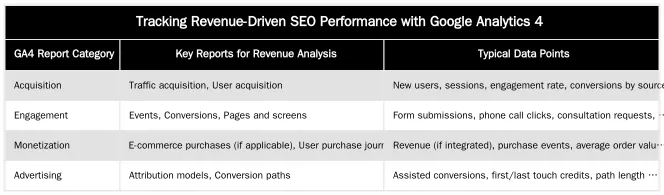
Tracking Revenue-Driven SEO Performance with Google Analytics 4
Google Analytics 4 (GA4) has an event-based data model for lead tracking and marketing attribution. Unlike its predecessor, GA4 focuses on user behavior across platforms, providing a unified view of the patient journey. Correctly configuring GA4 allows clinics to measure actions that lead to revenue, such as form submissions, phone calls, and virtual consultation bookings. This setup is crucial for understanding which organic channels and content contribute to patient acquisition and profitability.
Setting Up GA4 for Comprehensive Lead and Conversion Tracking
To track leads and conversions in GA4, clinics must define and implement custom events. A form submission on a “Book Consultation” page can be configured as an event, then marked as a conversion. Clicks on phone numbers, email addresses, or live chat widgets can be tracked as micro-conversions indicating user intent. This uses Google Tag Manager (GTM) to deploy event tags based on user interactions. Setting up these events provides granular data on how organic visitors interact with the website and which actions lead to patient inquiries. This detailed lead tracking is the foundation for accurate performance measurement.
Demystifying Marketing Attribution Models for Clinic Revenue
Marketing attribution models show how different touchpoints in the patient journey contribute to a conversion. GA4 offers models like last click, first click, linear, time decay, and data-driven attribution. For high-value medical procedures, the patient journey is complex, involving multiple interactions before a consultation is booked. Focusing on “assisted conversions” is insightful, as it reveals how organic content can initiate interest early in the funnel, even if another channel is the final touchpoint. Understanding these models allows clinics to credit SEO for its role in nurturing leads, providing a more accurate picture of its impact on clinic revenue.
Optimizing for High-Value Patients: An Expert’s Approach to SEO ROI
Shifting from attracting high traffic to acquiring high-value patients is fundamental for maximizing SEO ROI in private healthcare. Abdurrahman Şimşek, with over 10 years of experience in semantic SEO, emphasizes a strategy focused on topical authority and understanding patient intent. This approach moves beyond broad keyword targeting to entity-based content that addresses specific patient needs for complex procedures. By building a semantic content network, clinics can establish themselves as authoritative sources, attracting patients who are researching and ready to commit to high-value treatments.
This method ensures SEO efforts connect with the right audience at the right time, leading to higher conversion rates and a more profitable patient base. The focus is on quality over quantity, ensuring every organic lead has a higher potential for conversion into a booked consultation and procedure.
Beyond Generic Traffic: Identifying and Attracting High-Value Patient Segments
Attracting high-value patient segments requires specific keyword research and semantic analysis. Instead of targeting generic terms like “plastic surgery,” clinics should identify high-value keywords indicating intent for high-revenue procedures, such as “rhinoplasty specialist London” or “breast augmentation consultation Harley Street.” These terms have lower search volumes but higher conversion potential. Semantic analysis helps uncover entities and attributes associated with these procedures, allowing for the creation of authoritative content that addresses patient concerns and decision-making factors. This precision targeting ensures organic traffic consists of individuals further along their patient journey and more likely to convert.
The Role of E-E-A-T in Building Trust and Driving High-Quality Leads
For medical clinics, demonstrating Expertise, Experience, Authoritativeness, and Trustworthiness (E-E-A-T) is a prerequisite for attracting and converting patients. Google’s Quality Rater Guidelines emphasize E-E-A-T for Your Money Your Life (YMYL) topics like health. For a private clinic, this means showcasing surgeon qualifications and experience, publishing medically accurate content, and building an online reputation through patient testimonials. Abdurrahman Şimşek’s expertise in YMYL SEO ensures a clinic’s digital presence communicates its E-E-A-T, building the trust necessary to drive high-quality leads. For more on E-E-A-T, Google’s guidance on creating helpful, reliable, people-first content provides foundational understanding.
From Organic Traffic to Booked Consultations: Proving SEO’s Financial Impact
Connecting SEO data to clinic revenue requires tracking the entire patient journey. Clinics must understand how many organic leads become booked consultations and revenue-generating procedures. Methods for connecting SEO performance to revenue data include integrating web analytics with Customer Relationship Management (CRM) systems, using unique tracking numbers for phone calls, and implementing post-consultation feedback loops. This tracking allows clinic directors to see the return on their SEO investment.
Presenting this data demonstrates SEO’s financial impact, moving discussions beyond traffic numbers to patient acquisition costs and revenue generated. This transparency builds confidence in SEO as a business driver.
Integrating SEO Data with CRM for End-to-End Patient Journey Tracking
To prove SEO’s financial impact, organic lead data from GA4 must integrate with a clinic’s CRM system. This integration allows clinics to track a patient’s progression from initial organic inquiry to booked consultation, procedure, and revenue generation. By tagging organic leads in the CRM, clinics can monitor conversion rates at each funnel stage, identify bottlenecks, and attribute revenue to SEO. This end-to-end visibility provides a quantifiable measure of SEO’s contribution to the clinic’s bottom line, enabling data-driven decisions for marketing spend.
Quantifying the Value of Organic Patients: Beyond the First Consultation
The value of a patient acquired through SEO extends beyond their initial procedure. Quantifying the customer lifetime value (CLV) of organic patients involves considering repeat business, referrals, and potential for higher-value procedures over time. Organic patients, having conducted thorough research, may exhibit higher loyalty and propensity for future engagements. By analyzing CRM data, clinics can calculate the average CLV for patients from organic search. This metric demonstrates the long-term profitability of SEO, showing it generates valuable patient relationships, not just leads. The Wikipedia page on Customer Lifetime Value offers a good overview.
Setting Realistic Expectations and Continuous Optimization for Revenue Growth
Achieving revenue growth through SEO requires setting realistic, measurable goals tied to financial outcomes. SEO is a long-term investment, and its full impact unfolds over time. Continuous analysis of performance data and adaptation of strategies are crucial for maximizing return. Clinics must use an iterative approach, refining SEO efforts based on data about patient behavior and conversion pathways. This ongoing refinement ensures the SEO strategy remains aligned with market conditions and patient needs, driving revenue growth.
Partnering with an SEO expert who understands the medical sector is vital for this continuous optimization process. This collaboration ensures SEO efforts remain focused on the most impactful revenue-driven metrics.
Benchmarking and Iteration: Refining Your SEO Strategy for Maximum ROI
Benchmarking SEO performance against industry averages and competitors provides a baseline for setting goals. Once benchmarks are established, an iterative process of testing, analyzing, and refining the SEO strategy begins. This involves A/B testing content formats, calls-to-action, or landing page designs to identify what resonates with high-value patient segments. Regular performance reviews, focusing on revenue metrics like CPQL and conversion rates, allow clinics to identify areas for improvement and allocate resources to strategies that yield the highest SEO ROI. This continuous feedback loop is essential for adapting to algorithm updates and maintaining a competitive edge.
Partner with a Specialist to Drive Measurable Clinic Revenue Growth
Focusing on the right seo metrics for revenue is fundamental for a private medical clinic’s growth. Moving beyond vanity metrics ensures SEO investment contributes directly to patient acquisition and profitability. Abdurrahman Şimşek, a London-based Semantic SEO Strategist with a decade of experience, specializes in building high-authority Semantic Content Networks for medical clinics. His expertise in YMYL SEO and attracting high-value patients makes him a partner for Harley Street and premium London medical practices. Transform your online presence into a source of measurable revenue. Contact Abdurrahman Şimşek for a strategic consultation.
Frequently Asked Questions
What are the most important seo metrics for revenue for a medical clinic?
The most critical metric is ‘Cost Per Qualified Lead’ (CPQL) from organic search. This directly links your SEO investment to generating potential patients who are a good fit for your high-value procedures. Focusing on these seo metrics for revenue ensures your digital marketing efforts contribute directly to profitability.
Why should I focus on ‘assisted conversions’ in my reporting?
Patients often interact with your clinic’s website multiple times through various channels before booking a consultation. Assisted conversions highlight when SEO played a crucial role in the patient’s journey, even if it wasn’t the final click. This demonstrates SEO’s value in nurturing leads and contributing to overall conversion pathways.
How can I use seo metrics for revenue to identify high-value keywords?
By setting up robust conversion tracking for specific high-value actions, such as a ‘tummy tuck consultation request,’ you can analyze which landing pages and their associated keywords drive these conversions. These are your most valuable keywords, and optimizing their performance is key to improving your seo metrics for revenue.
Is a high volume of organic traffic always good for clinic revenue?
Not necessarily. A high volume of irrelevant traffic that doesn’t convert into patient inquiries is a waste of resources and can skew your performance analysis. It’s far more effective to attract less traffic that is highly targeted and converts into qualified leads, directly impacting your clinic’s profitability.
How do I track revenue from patients who call the clinic?
Implementing a sophisticated call tracking system is essential for this. This technology attributes phone calls to the specific marketing channel that drove them, allowing you to accurately see how many high-value patient calls originated from your SEO efforts. Integrating this data provides a comprehensive view of your revenue generation.
How can a semantic SEO strategist help improve my clinic’s seo metrics for revenue?
A semantic SEO strategist like Abdurrahman Şimşek specializes in building high-authority content networks that attract highly qualified patients. By focusing on YMYL and E-E-A-T optimization, they ensure your clinic ranks for high-intent queries, directly improving your seo metrics for revenue and patient acquisition. To discuss a tailored strategy for your London clinic, you can contact Abdurrahman Şimşek directly via his website.
Ruxi Data brings together multi-model AI, automated website crawling, live indexation checks, topical authority mapping, E-E-A-T enrichment, schema generation, and full pipeline automation — from crawl to WordPress publish to social posting — all in one platform built for agencies and freelancers who run on results.