
Patient Testimonials for SEO: Boosting Medical Clinic Trust & Rankings
Patient testimonials for SEO are crucial for medical clinics to enhance E-E-A-T signals and improve online visibility in the YMYL sector. This article details how authentic patient feedback, including medical reviews and Google Business Profile reviews, directly influences local search rankings and builds patient trust. Understanding the strategic implementation of review schema and effective online reputation management is key to leveraging patient testimonials for SEO to establish topical authority and drive patient acquisition.
Abdurrahman Şimşek, a Semantic SEO Strategist specializing in medical clinics, provides expert guidance on integrating these trust signals. His approach focuses on semantic engineering and E-E-A-T optimization to build high-authority content networks for healthcare providers.
To explore your options, contact us to schedule your consultation.
Patient testimonials for SEO help private healthcare clinics in London build trust and enhance online visibility in 2026. In the YMYL (Your Money Your Life) sector, authentic patient feedback strengthens a clinic’s E-E-A-T (Expertise, Experience, Authoritativeness, Trust) signals, which are critical for search engine rankings and patient acquisition.
Why Patient Testimonials Are Critical E-E-A-T Signals for Medical Clinics
Patient testimonials reflect a medical practice’s real-world performance and patient satisfaction, making them indispensable E-E-A-T signals. These accounts provide evidence of a surgeon’s Expertise, validate their Experience, contribute to their Authoritativeness, and build patient trust. For search engines, user-generated content like medical reviews offers context about a healthcare provider’s quality and reliability, influencing rankings in the YMYL sector. Leveraging these trust signals is foundational for establishing E-E-A-T for surgeons.
The Role of Social Proof in Healthcare Trust
In healthcare, social proof from existing patients is a powerful validator. Prospective patients often seek reassurance from others who have undergone similar procedures or treatments. Positive patient feedback serves as an independent endorsement, verifying a surgeon’s claims and the clinic’s standard of care. This affirmation mitigates patient anxieties and builds confidence, a critical step in the patient journey. It also signals to search engines that the medical entity is reputable and provides a positive user experience, aligning with Google’s emphasis on trustworthy content for YMYL topics, as detailed in E-E-A-T for YMYL in 2026.
How Do Patient Reviews Affect SEO & Local Search Rankings?
Patient reviews influence SEO and local search rankings through direct and indirect mechanisms. Search engines like Google consider the quantity, quality, and recency of online reviews as a factor in local search visibility. Positive patient feedback can elevate a clinic’s position in the local pack for geo-specific queries like “plastic surgeon London” or “dermatologist Harley Street.” Positive reviews also increase click-through rates (CTR) from search results, as users are more likely to choose clinics with higher ratings. This engagement signals relevance and authority to search engines.
Optimizing Google Business Profile with Patient Feedback
Google Business Profile (GBP) is a cornerstone of local SEO for medical clinics. Encouraging patients to leave reviews on your GBP listing is paramount. GBP reviews are heavily weighted in local search algorithms. Clinics should provide clear instructions and direct links to their GBP review page during the patient journey. Responding to every review demonstrates engagement and commitment to patient care, enhancing the clinic’s local search presence. GBP optimization for surgeons includes a review management strategy.
Implementing Review Schema & Displaying Testimonials Effectively
Review schema markup enhances the visibility of patient feedback in SERPs. Schema.org provides structured data types like `AggregateRating` and `Review` that allow search engines to understand ratings for a `MedicalClinic`, `Physician`, or `Procedure`. Correct implementation can enable rich snippets, displaying star ratings in search results and boosting click-through rates. The strategic display of testimonials on a clinic’s website is crucial for user experience and conversion.
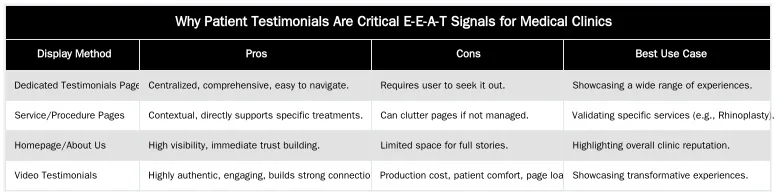
Best practices include a dedicated testimonials page, integrating feedback onto service pages, and featuring quotes on the ‘About Us’ section. Video testimonials require more effort but offer engaging and authentic social proof. Ensure testimonials are mobile-responsive and easily digestible.
Choosing the Right Schema for Medical Reviews
Selecting the appropriate schema type is critical for medical practices. `MedicalClinic` schema can include `AggregateRating` for the clinic. `Physician` profiles should also use `AggregateRating` to display their patient feedback. `Procedure` schema can incorporate reviews relevant to a specific service. Combining these schema types helps search engines attribute reviews to the correct entity, reinforcing the clinic’s semantic network. For detailed guidance on this, refer to implementing advanced medical schema and local business schema.
Building a Robust Patient Review Strategy for Topical Authority
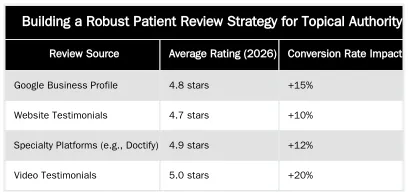
A systematic approach to managing patient reviews contributes to a clinic’s topical authority and semantic SEO beyond direct ranking benefits. When patients leave detailed reviews mentioning specific procedures or surgeons, this user-generated content reinforces the clinic’s relevance and expertise. This natural language data helps search engines understand the clinic’s core competencies and the entities it serves. Abdurrahman Şimşek’s expertise in semantic engineering emphasizes integrating these signals into a content strategy that aligns with patient search intent.
Strategies for soliciting reviews include asking satisfied patients at key touchpoints like post-procedure follow-ups or discharge. Providing multiple, easy-to-use channels for feedback (e.g., email links, QR codes in-clinic) increases participation. Integrating patient testimonials into content strategy means using snippets on service pages, creating case studies from feedback, and inspiring new content based on patient questions or experiences in reviews.
Ethical Collection & GDPR Compliance in Medical Reviews
Collecting medical reviews requires adherence to ethical guidelines and data privacy regulations like GDPR. Patient consent is paramount. Clinics must obtain explicit permission from patients before publishing their testimonials, especially if personal details or images are involved. Anonymization or using initials can be considered if full names are not consented to. Transparency about how reviews will be used is essential. Clinics need a clear privacy policy for user-generated content. The Information Commissioner’s Office (ICO) provides guidance on GDPR compliance in the UK, which medical practices should consult for legal and ethical review collection.
Managing Online Reputation: Responding to All Patient Feedback
Online reputation management requires responding professionally to all patient feedback. Timely responses show a clinic values its patients. For positive reviews, a personalized thank you reinforces patient loyalty and encourages recommendations. Acknowledging specific points in a positive review makes the response more impactful.
Responding to negative feedback is crucial. It is an opportunity to demonstrate empathy, professionalism, and a commitment to resolving issues. Public responses should remain calm and constructive, avoiding defensive language. Acknowledge the patient’s concern, apologize, and offer to take the conversation offline to address details confidentially. This approach mitigates damage and shows prospective patients how the clinic handles challenges.
Turning Negative Reviews into Positive Opportunities
Negative reviews can be valuable for improvement and trust-building. By responding and offering solutions, clinics can de-escalate situations and demonstrate dedication to patient satisfaction. For instance, a response might state, “We are truly sorry to hear about your experience and take your feedback seriously. Please contact our patient care coordinator at [phone number] so we can discuss this further and find a resolution.” This public accountability can reassure potential patients more than an unresponsive review profile. For further guidance on managing challenging feedback, resources like this online reputation management guide offer practical advice.
The Long-Term Impact of Patient Testimonials on Clinic Growth
A patient testimonial strategy fosters sustained clinic growth beyond immediate SEO gains. Positive patient feedback enhances brand reputation, positioning the clinic as a trusted provider in the London private healthcare market. This reputation increases patient acquisition, as clients are more likely to choose a clinic with positive experiences. The confidence from authentic reviews can lead to higher conversion rates from website visitors to consultations. Integrating patient voices drives organic growth and contributes to the clinic’s long-term success.
Testimonials as a Catalyst for Patient Acquisition
Positive patient reviews are a catalyst in the patient acquisition funnel. They shorten the decision-making process by providing validation and building confidence. When a potential patient sees positive accounts, their perceived risk decreases, making them more inclined to book a consultation. This social proof can be the decisive factor that moves a patient from consideration to booking, impacting patient volume and revenue.
Elevate Your Clinic’s E-E-A-T with Expert Semantic SEO
For London’s medical practices, using patient testimonials for SEO requires a semantic approach. Abdurrahman Şimşek specializes in building Semantic Content Networks for medical clinics, skin clinics, and plastic surgeons. By integrating patient feedback with E-E-A-T optimization and technical SEO, your clinic can achieve dominant online visibility. Partner with a London-based Semantic SEO Strategist who understands the nuances of the private healthcare market. Elevate your digital presence and attract patients by transforming your online reputation into a ranking asset.
Conclusion
Patient testimonials are indispensable assets for medical clinics in 2026. They are critical E-E-A-T signals, influencing search rankings, local visibility, and patient acquisition. By strategically collecting, managing, and displaying patient feedback, clinics can build trust with patients and reinforce their topical authority. A review strategy, coupled with semantic SEO, translates a clinic’s reputation into organic growth and a dominant online presence. To develop a tailored strategy for your London practice, explore advanced semantic SEO solutions at abdurrahmansimsek.com.
Frequently Asked Questions
How do patient testimonials for SEO enhance a clinic’s E-E-A-T?
Patient testimonials for SEO provide powerful social proof, directly bolstering the ‘Trust’ component of E-E-A-T for medical clinics. These authentic accounts validate a surgeon’s expertise, experience, and patient care from a real-world perspective, signaling credibility to both potential patients and search engines. They are crucial for YMYL sectors where trust is paramount for ranking success.
Why are both on-site reviews and Google Business Profile reviews important for patient testimonials for SEO?
Both on-site reviews and Google Business Profile reviews are vital for a comprehensive SEO strategy. Google Business Profile reviews are essential for local search rankings and appearing in the map pack, driving local patient inquiries. Meanwhile, displaying patient testimonials for SEO directly on your website, often with review schema, allows you to control the narrative, build trust with visitors, and reinforce your brand’s authority.
What are the most effective strategies for displaying patient testimonials for SEO on a website?
The most effective strategy involves a multi-format approach. Utilize concise, impactful quotes on relevant service pages, create a dedicated testimonials page featuring detailed stories and, with consent, before-and-after photos. Video testimonials are particularly powerful for building emotional connections and demonstrating genuine patient satisfaction, significantly boosting the impact of patient testimonials for SEO.
How do authentic patient reviews contribute to topical authority for medical clinics?
Authentic patient reviews demonstrate real-world experience and positive outcomes, which Google interprets as strong signals of a clinic’s practical expertise. By consistently showcasing positive patient experiences related to specific treatments or conditions, clinics can reinforce their authority on those topics. This user-generated content validates the clinic’s claims and helps establish it as a trusted resource within its medical niche.
How can a London clinic start leveraging patient feedback to improve its search visibility?
A London clinic can begin by actively soliciting feedback from satisfied patients and implementing a structured system for collecting and displaying reviews. For a holistic approach, consider consulting with a Semantic SEO Strategist like Abdurrahman Şimşek. They can help integrate patient feedback into a broader E-E-A-T and topical authority strategy, ensuring maximum impact on your clinic’s search visibility and patient acquisition.
Ruxi Data brings together multi-model AI, automated website crawling, live indexation checks, topical authority mapping, E-E-A-T enrichment, schema generation, and full pipeline automation — from crawl to WordPress publish to social posting — all in one platform built for agencies and freelancers who run on results.