Traditional SEO Fails: Why Medical Practices Need Holistic Strategies
Traditional SEO fails for medical practices because outdated tactics like keyword stuffing and generic link building no longer meet Google’s advanced algorithm requirements for YMYL content. This article explains why traditional SEO fails to build genuine authority, often leading to penalties and eroding online reputation. Modern search engines prioritize E-E-A-T compliance, semantic search, and topical authority. Adopting a holistic SEO approach is essential for medical clinics to genuinely serve user intent, build digital trust, and achieve sustainable online growth.
Abdurrahman Şimşek, a Semantic SEO Strategist, provides insights into navigating these complex algorithm updates. The content emphasizes the critical shift from manipulative tactics to building genuine online authority through E-E-A-T and advanced semantic strategies for medical practices.
To explore your options, contact us to schedule your consultation. You can also reach us via: Book a Semantic SEO Audit, Direct WhatsApp Strategy Line: +90 506 206 86 86
Traditional SEO, once the bedrock of online visibility, increasingly traditional seo fails medical practices in 2026. This article explores why outdated tactics like keyword stuffing and generic link building are detrimental for healthcare websites, especially in the highly regulated YMYL (Your Money Your Life) sector. We’ll uncover the fundamental shifts in Google’s algorithms and introduce Holistic SEO as the essential framework for medical clinics to build genuine authority and attract high-value patients. Understanding these changes is crucial for any medical practice aiming for sustainable online growth.
Why Traditional SEO Fails for Medical Practices in 2026
Traditional SEO, characterized by a narrow focus on exact keyword matching, high keyword density, and acquiring numerous backlinks without regard for quality, consistently fails medical practices today. Google’s sophisticated algorithms now prioritize genuine expertise, authoritativeness, and trustworthiness (E-E-A-T), especially for Your Money Your Life (YMYL) topics like health. Outdated tactics are not only ineffective but can also lead to penalties, eroding a clinic’s online reputation and visibility. The emphasis has shifted from manipulating search engines to genuinely serving user intent with high-quality, verifiable information.
Medical websites operate in a highly sensitive domain where accuracy and credibility are paramount. Search engines have evolved to detect and reward content that demonstrates deep knowledge and is authored by verifiable experts. Generic content or strategies that worked a decade ago no longer suffice. Instead, a comprehensive approach that builds a clinic’s digital authority and trust signals is essential for ranking and attracting patients.
The Shifting Landscape: Why Google Penalizes Outdated Tactics
The digital environment for medical practices has undergone a profound transformation. Google’s algorithm updates have progressively moved away from simple keyword matching to a nuanced understanding of content and user intent. This evolution makes many conventional search engine optimization strategies obsolete, particularly for healthcare websites facing unique YMYL SEO challenges.
E-E-A-T and YMYL: The Non-Negotiable Standards for Medical Sites
Google’s Quality Rater Guidelines explicitly define E-E-A-T (Experience, Expertise, Authoritativeness, Trustworthiness) as critical ranking factors, especially for YMYL content. Medical information directly impacts health and well-being, making it a prime YMYL category. For a medical practice, this means demonstrating verifiable credentials, publishing evidence-based content, and cultivating a strong online reputation. Websites that fail to meet these stringent e-e-a-t compliance standards, often relying on generic content or manipulative link building schemes, risk being demoted or excluded from search results. This shift underscores the need for genuine authority over superficial optimization.
For London’s private healthcare market, where patient trust is paramount, adhering to these guidelines is not merely an SEO tactic but a fundamental requirement for ethical practice and business success. Google’s algorithm updates are designed to protect users from misinformation, making it imperative for clinics to present themselves as reliable sources of medical information. Establishing E-E-A-T: Foundational Content and Signals for Surgeons is a core strategy for modern medical SEO.
Beyond Keywords: Understanding User Intent in Healthcare Searches
Modern search engines, powered by semantic search capabilities, no longer simply match keywords. They strive to understand the underlying user intent behind a query. For instance, a patient searching for “breast augmentation” might be looking for procedure details, recovery time, cost, or surgeon qualifications. A website that only stuffs the keyword “breast augmentation” will likely underperform compared to one that comprehensively addresses all potential aspects of that user’s journey.
This shift demands content quality that anticipates and fulfills diverse patient needs. Medical practices must move beyond a narrow keyword focus to create rich, informative content that answers questions, alleviates concerns, and guides patients through their decision-making process. Understanding user intent is crucial for attracting high-value patients who are actively seeking specific medical solutions.
Holistic SEO vs. Traditional: A Paradigm Shift for Clinics
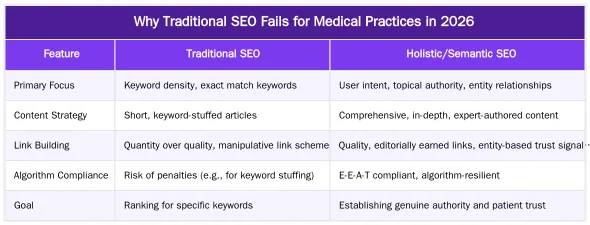
The distinction between conventional and modern search engine optimization is stark, particularly for medical practices. Holistic SEO represents a comprehensive, integrated approach that aligns with current algorithm updates and prioritizes genuine value for both users and search engines. It moves beyond isolated tactics to build a cohesive, authoritative online presence.
From Keyword Stuffing to Topical Authority
The era of keyword stuffing is over. Attempting to force keywords into content unnaturally degrades readability and signals low content quality to search engines. Modern SEO for medical practices focuses on establishing comprehensive building comprehensive topical authority. This involves creating a semantic content network that thoroughly covers all aspects of a medical specialty or procedure, demonstrating deep expertise. Instead of repeating a single keyword, a holistic strategy explores related concepts, patient questions, and associated conditions, positioning the clinic as the definitive resource on a given topic.
From Link Schemes to Entity-Based Trust Signals
Low-quality link building schemes, such as buying links or participating in link farms, are now actively penalized by Google. These tactics undermine trust and signal a lack of genuine authority. Holistic SEO emphasizes earning high-quality, editorially given links from reputable medical organizations, academic institutions, and authoritative news sources. Furthermore, it focuses on building entity-based trust signals, where Google recognizes the clinic and its practitioners as established entities within the medical field. This includes consistent online mentions, structured data, and a verifiable digital footprint that reinforces E-E-A-T.
Embracing Semantic SEO: The Future for Medical Practice Growth
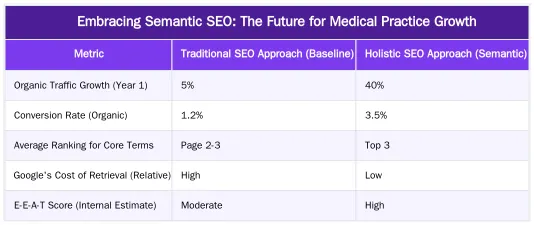
For medical practices, the future of online visibility lies in semantic SEO. This advanced approach moves beyond keywords to understand the meaning and context of content, building a robust digital presence that resonates with both search engines and prospective patients. Implementing a semantic strategy involves structuring information in a way that is easily digestible by machines, thereby enhancing discoverability and authority.
Building an Entity-Attribute-Value (EAV) Model for Medical Procedures
A cornerstone of semantic SEO is the Entity-Attribute-Value (EAV) model. For medical procedures, this means identifying core entities (e.g., “Rhinoplasty,” “Dr. Smith,” “Harley Street Clinic”) and systematically defining their attributes (e.g., “recovery time,” “anesthesia type,” “cost range,” “surgeon’s qualifications”). By structuring content around these entities and their specific attributes, medical practices provide comprehensive, machine-readable information. This clarity helps search engines accurately understand the content’s context and relevance, making it easier to match with complex patient queries. An effective Entity-Attribute-Value (EAV) model for surgical procedures is crucial for modern medical SEO.
Reducing Google’s Cost of Retrieval with Semantic Architecture
Google’s “Cost of Retrieval” (CoR) refers to the computational resources required for search engines to crawl, process, and understand a website’s content. A poorly structured, disorganized website increases CoR, making it less efficient for Google to index and rank. Conversely, a well-designed semantic architecture, utilizing structured data and a clear content hierarchy, significantly reduces CoR. Tools like Ruxi Data assist in automating the creation of topical maps and EAV modeling, ensuring that content is organized logically and semantically. This efficiency translates into better crawlability, faster indexing, and improved ranking potential, as search engines can more easily extract and present relevant information to users.
Why Specialist Semantic Engineering is Crucial for Medical SEO
The complexities of the YMYL sector, combined with the rapid evolution of search algorithms, mean that a generalist SEO approach is no longer sufficient for medical practices. Specialist semantic engineering offers a distinct advantage, providing the deep technical and strategic expertise required to navigate this challenging landscape. This specialized knowledge ensures that a clinic’s online presence is not only visible but also authoritative and resilient.
The Abdurrahman Şimşek Difference: 10+ Years in Semantic Search
Abdurrahman Şimşek brings over a decade of experience in search engineering, specializing in building high-authority Semantic Content Networks for medical clinics, skin clinics, and plastic surgeons. His methodology, rooted in a Semantic SEO Framework and Entity Architecture, goes beyond conventional keyword optimization. By leveraging Ruxi Data as a core infrastructure, he automates topical map creation and EAV modeling, significantly reducing Google’s Cost of Retrieval for complex medical websites. This expertise is particularly vital for London private healthcare, plastic surgery, and aesthetic skin clinic markets, where precision and trust are paramount. His work focuses on establishing medical E-E-A-T infrastructure for surgeons, ensuring content is not only comprehensive but also recognized as authoritative by search engines.
Future-Proofing Your Clinic with Algorithm-Resilient Strategies
A deep understanding of information retrieval and generative AI optimization (GEO) is essential for long-term stability in search rankings. Specialist semantic engineers design strategies that are inherently algorithm-resilient, meaning they are less susceptible to fluctuations from core updates. By focusing on fundamental principles of content quality, topical authority, and entity relationships, these strategies build a robust foundation. This approach ensures that medical practices can maintain and grow their organic visibility, even as search engines continue to evolve with advancements in artificial intelligence and natural language processing. Investing in a semantic SEO strategy is an investment in the future-proof growth of your medical practice.
For further insights into the evolving landscape of search, understanding the principles of information retrieval is key. Information retrieval is the science of searching for information within documents, databases, and the web, forming the backbone of modern search engines.
Ready to Transform Your Clinic’s Online Presence?
Understanding why traditional SEO fails is the first step toward building a robust, future-proof online presence for your medical practice. Embracing a holistic, semantic SEO strategy is no longer optional; it is essential for attracting high-value patients and establishing genuine authority in the competitive healthcare market. By focusing on E-E-A-T, user intent, and a meticulously structured content network, your clinic can achieve sustainable organic growth.
Take the next step towards dominating local organic search across Harley Street and premium London postcodes. Partner with a specialist who understands the unique demands of medical SEO. Book a Semantic SEO Audit today to discover how a tailored strategy can transform your clinic’s digital footprint. For immediate strategic discussions, you can also reach out via Direct WhatsApp Strategy Line: +90 506 206 86 86.
Frequently Asked Questions
Why does traditional SEO fail for medical practices in the current Google landscape?
The primary reason traditional seo fails is its reliance on outdated, manipulative tactics like keyword stuffing and low-quality link building. For YMYL (Your Money Your Life) topics such as healthcare, Google’s algorithms actively penalize these methods, prioritizing genuine E-E-A-T (Experience, Expertise, Authoritativeness, Trustworthiness) instead. This approach ultimately undermines a medical practice’s credibility and visibility.
How do Google’s algorithm updates specifically target why traditional SEO fails for healthcare sites?
Google’s algorithm updates, particularly those impacting YMYL sectors, are designed to identify and devalue websites employing manipulative or low-quality SEO tactics. This means that strategies where traditional SEO fails by focusing on keyword density over genuine value are increasingly penalized. Updates aim to ensure that only the most authoritative and trustworthy information reaches users, making outdated methods ineffective and risky.
What are the long-term consequences for a medical practice when traditional SEO fails to deliver sustainable results?
When traditional SEO fails, medical practices face diminishing returns, wasted marketing budgets, and a lack of sustainable online growth. It can lead to a cycle of continuous spending on ineffective tactics, preventing the clinic from building genuine topical authority and a resilient online presence. This ultimately hinders patient acquisition and brand reputation in the competitive healthcare market.
What is Holistic SEO, and how does it address the shortcomings of conventional methods?
Holistic SEO views a website as a complete ecosystem, integrating technical excellence, deep content authority, and verifiable E-E-A-T signals. It moves beyond individual keyword optimization to build a genuinely authoritative resource, directly addressing where conventional SEO often falls short. This comprehensive approach ensures long-term resilience and relevance for medical practices.
If traditional link building is risky, how does Abdurrahman Şimşek’s approach build authority for medical clinics?
Our methodology focuses on constructing a best-in-class information resource that naturally earns high-quality links from reputable sources. By building deep topical authority and semantic networks, your website becomes the definitive source in its niche. This organic approach attracts links as a byproduct of exceptional quality and expertise, rather than relying on manipulative tactics.
How can a medical practice begin transforming its online presence with a Holistic SEO strategy?
You can start by booking a Semantic SEO Audit with Abdurrahman Şimşek to assess your current online landscape and identify growth opportunities. Alternatively, for a direct discussion, reach out via our WhatsApp Strategy Line: +90 506 206 86 86. This initial step helps tailor a specialized strategy to build genuine authority and attract high-value patients.
Ruxi Data brings together multi-model AI, automated website crawling, live indexation checks, topical authority mapping, E-E-A-T enrichment, schema generation, and full pipeline automation — from crawl to WordPress publish to social posting — all in one platform built for agencies and freelancers who run on results.