
Medical Schema for Surgeons: Enhancing Digital Authority & Visibility
Medical schema for surgeons enhances online visibility and digital authority by explicitly defining practice details for search engines. This guide details how structured data, particularly Physician and MedicalProcedure schema, improves a surgeon’s online presence and E-E-A-T. Implementing JSON-LD markup helps secure rich snippets, build topical authority, and communicate specialized services effectively. Understanding these entity relationships within a knowledge graph is crucial for modern technical SEO, ensuring accurate representation of expertise and services to potential patients.
Abdurrahman Şimşek, a Semantic SEO Strategist, provides expert guidance on leveraging structured data for medical professionals. This content delivers actionable strategies for surgeons to optimize their digital footprint, ensuring search engines accurately interpret and rank their specialized services and credentials.
To explore your options, contact us to schedule your consultation.
Implementing medical schema for surgeons enhances online visibility and digital authority. This guide details how structured data like Physician and MedicalProcedure markup improves a surgeon’s online presence and E-E-A-T (Expertise, Experience, Authoritativeness, Trustworthiness). Implement JSON-LD to secure rich snippets, build topical authority, and communicate specialized services to search engines.
What is Medical Schema for Surgeons & Why is it Essential?
Medical schema markup, a form of structured data, explicitly defines a surgeon’s practice, specialties, qualifications, and services for search engines. It enhances a website’s E-E-A-T signals, helping search engines understand and trust medical content. The most important schema type for surgeons is Physician, which establishes their identity and expertise.
Structured data allows search engines to interpret complex medical information accurately. This clarity is vital in the YMYL (Your Money Your Life) sector, where accuracy and trust are paramount. By defining entities like a surgeon’s name, medical specialty, and board certifications, medical schema helps search engines confidently present a practice’s information to potential patients. This technical SEO foundation ensures a surgeon’s digital presence reflects their real-world authority and experience.
The Foundational Role of Physician Schema
The ‘Physician’ schema is the most critical structured data type for surgeons. It communicates a surgeon’s name, medical specialty (e.g., Plastic Surgeon, Orthopedic Surgeon), qualifications, and professional affiliations to search engines. This schema builds a surgeon’s E-E-A-T by linking their expertise to their online content. It also associates medical procedures and conditions with the physician, creating a comprehensive digital profile.
Key Medical Schema Types: Physician, MedicalProcedure & Beyond
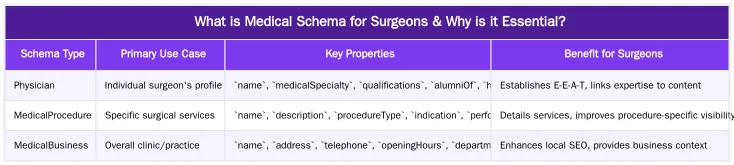
Several schema.org types are crucial for a surgeon’s digital representation. The Physician schema establishes the practitioner’s identity and credentials. The MedicalProcedure schema details the services offered, while MedicalBusiness provides context for the clinic or practice. Each type builds the semantic profile of a surgical practice.
Linking these schema types creates a network of interconnected entities, helping search engines understand a surgeon’s expertise and services. For instance, a MedicalProcedure schema should reference the Physician who performs it, and the Physician schema can link to the MedicalBusiness where they practice. This interconnectedness strengthens the website’s topical authority.
Mapping Surgical Services with MedicalProcedure Schema
Marking up surgical procedures informs search engines and potential patients. The ‘MedicalProcedure’ schema details a procedure’s name, a concise description, its indications (why it’s performed), potential risks, and expected outcomes. Link this schema to the physician using the `performer` property to reinforce the surgeon’s expertise for that intervention. This mapping helps present the surgeon’s profile when a patient searches for that procedure.
Comparing Core Medical Schema Types for Surgeons
Implementing JSON-LD: A Step-by-Step Guide for Surgeons
Implementing structured data on a surgeon’s website involves using JSON-LD (JavaScript Object Notation for Linked Data). This Google-recommended format is embedded in the page’s HTML. Generate the JSON-LD code and place it on relevant pages for search engines to process.
Manual JSON-LD creation offers maximum control, but tools can streamline the process. Precision in property values and adherence to schema.org guidelines are critical. Incorrect or incomplete implementation can cause errors and prevent rich snippets from appearing.
Generating & Embedding Schema Markup
Generate JSON-LD schema markup manually or with online generators. Manual creation provides granular control over properties. Place the generated JSON-LD script in the “ section of the HTML. For dynamic content or CMS platforms, plugins or custom code snippets can inject the schema on each page.
Validating Your Medical Schema Implementation
After implementing structured data, validation is critical. Use Google’s Rich Results Test to check if your JSON-LD is correctly parsed and eligible for rich snippets. The Schema.org Validator details your markup and highlights errors or warnings. Regular validation ensures your structured data remains error-free and effective.
Unlocking Rich Snippets & Dominating Local Search with Schema
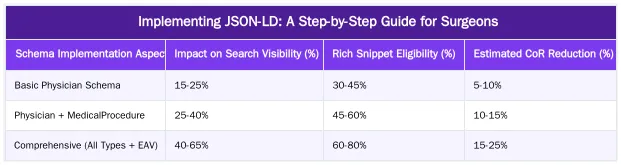
Implemented medical schema can generate rich snippets in search results. These listings, which can include star ratings, procedure details, or contact information, increase click-through rates. For surgeons in competitive markets, structured data improves local search visibility and attracts patients.
Rich snippets make a surgeon’s listing more prominent and informative on search results pages. This encourages clicks, driving qualified traffic to the website. Schema provides explicit signals for search engines to display a practice for relevant local queries.
Schema for Harley Street & London Private Healthcare Dominance
For surgeons in locations like Harley Street and central London, schema for local SEO is a necessity. `MedicalBusiness` schema with a precise address, phone number, and service area provides search engines details for local pack rankings. Combining this with `Physician` and `MedicalProcedure` schema linked to specific locations helps target patients searching for treatments in these areas. This approach is key to outranking competitors in the London private healthcare market.
Elevate Your Practice: Partner with a Semantic SEO Expert
Mastering medical schema for surgeons is a strategic advantage, requiring an understanding of technical SEO and the medical field. A semantic SEO strategist can help your practice use structured data to build topical authority and attract patients.
Abdurrahman Şimşek specializes in building high-authority semantic content networks for medical clinics and plastic surgeons. Book a Semantic SEO Audit to improve your practice’s local organic search.
Conclusion
Medical schema for surgeons is necessary for online visibility and E-E-A-T. Implementing Physician and MedicalProcedure schema guides search engines, secures rich snippets, and builds a semantic foundation. This technical precision is vital in competitive markets to reach the right patients. Partnering with an expert can help attract high-value patients. Book a Semantic SEO Audit to unlock your practice’s potential.
Frequently Asked Questions
What is the most important schema type for a surgeon’s website?
The ‘Physician’ schema is the most critical for medical schema for surgeons. It allows you to explicitly tell Google your name, specialty (e.g., Plastic Surgeon), qualifications, and affiliations. This is a foundational element for building your E-E-A-T and connecting your expertise to your content.
How should I use ‘MedicalProcedure’ schema on my service pages?
On each procedure page (e.g., for Rhinoplasty), you should use ‘MedicalProcedure’ schema to define the procedure type, its purpose, and expected outcomes. This helps Google understand your services at a granular level, improving your chances of ranking for specific, high-intent surgical queries.
Can I combine different schema types on one page?
Yes, and you absolutely should. A surgeon’s bio page, for example, should nest ‘Physician’ schema within the ‘WebPage’ schema and link to the ‘MedicalClinic’ where they work. This creates a rich, interconnected data structure that feeds Google’s Knowledge Graph.
Will implementing medical schema for surgeons guarantee rich snippets?
Implementing medical schema for surgeons does not guarantee them, but it is a prerequisite. Correctly implemented schema for reviews, FAQs, and procedures makes your site eligible for rich snippets like star ratings and dropdowns in the search results, which can significantly increase click-through rates.
How does medical schema for surgeons enhance E-E-A-T?
Medical schema for surgeons explicitly defines a surgeon’s practice, specialties, and qualifications for search engines. This structured data enhances E-E-A-T signals, helping search engines understand and trust the medical content provided. By clearly presenting expertise, it builds digital authority.
How can a semantic SEO strategist help with medical schema for surgeons?
A semantic SEO strategist, such as Abdurrahman Şimşek, specializes in optimizing YMYL and E-E-A-T for healthcare domains. They can implement advanced medical schema for surgeons to build topical authority, particularly for services like London Private Healthcare SEO. This ensures precise JSON-LD markup for every surgeon, clinic, and procedure, enhancing online visibility.
Ruxi Data brings together multi-model AI, automated website crawling, live indexation checks, topical authority mapping, E-E-A-T enrichment, schema generation, and full pipeline automation — from crawl to WordPress publish to social posting — all in one platform built for agencies and freelancers who run on results.