
Patient Acquisition Cost: Optimizing Clinic Profitability
Understanding patient acquisition cost (PAC) is crucial for aesthetic clinics to ensure sustainable growth and optimize marketing investments. This guide explains how to calculate patient acquisition cost by factoring in all marketing and sales expenses against new patients acquired. It details strategic methods to reduce PAC, including leveraging semantic SEO and topical authority to generate high-quality cosmetic surgery leads. Tracking PAC is essential for identifying high-ROI marketing channels, optimizing your marketing budget, and enhancing overall clinic profitability.
Abdurrahman Şimşek, a Semantic SEO Strategist, provides expert insights into data-driven marketing strategies for healthcare. This content offers practical guidance for aesthetic clinics seeking to improve their financial health through efficient patient acquisition.
To explore your options, contact us to schedule your consultation.
For aesthetic clinics and plastic surgeons, understanding patient acquisition cost (PAC) is essential for sustainable growth. This guide explains how to calculate and strategically reduce PAC, ensuring marketing investments yield maximum returns in the London private healthcare market. It covers practical methods, semantic SEO strategies, and the role of data in optimizing your clinic’s financial health.
What is Patient Acquisition Cost (PAC) and How Do You Calculate It?
Patient Acquisition Cost (PAC) is the total cost to acquire one new patient for your aesthetic clinic. The metric includes all marketing and sales expenses over a defined period, divided by the number of new patients acquired in that timeframe. PAC is fundamental for assessing marketing efficiency and ensuring the financial viability of your practice.
For aesthetic clinics, calculating PAC enables informed decisions on marketing budget allocation and strategy refinement. It shows the investment needed to acquire a new client for a cosmetic surgery procedure or a skin treatment.
The Essential PAC Formula for Aesthetic Practices
The formula for calculating PAC is:
Patient Acquisition Cost (PAC) = (Total Marketing & Sales Spend) ÷ (Number of New Patients Acquired)
Total Marketing & Sales Spend includes direct advertising costs (e.g., PPC campaigns for doctors, social media ads), agency fees, salaries for marketing staff, software subscriptions, content creation expenses, event sponsorships, and promotional materials. Accounting for all these elements is crucial for an accurate PAC.
Why Tracking Patient Acquisition Cost is Crucial for Clinic Profitability
Tracking patient acquisition cost offers insights into your clinic’s operational efficiency and financial health. Monitoring PAC helps aesthetic practices identify high-ROI marketing channels, optimize budgets, and make data-driven decisions for profitability. This determines if marketing spend is sustainable relative to the revenue generated by new patients.
Tracking pinpoints underperforming campaigns, allowing adjustments to prevent wasted resources, and highlights successful strategies for further investment. This optimization loop is vital for a competitive edge in the London private healthcare market, where budgets must be deployed with precision.
PAC vs. CPA: Understanding the Nuances for Medical Marketing
Cost Per Acquisition (CPA) and Patient Acquisition Cost (PAC) have distinct meanings in healthcare. CPA is the cost to acquire a lead or a specific action (like a form submission), which may not result in a paying patient. PAC measures the cost to acquire a *paying patient* who has received a service.
For aesthetic clinics, PAC is the more relevant metric as it correlates marketing spend with revenue-generating patients. CPA is a useful intermediate metric for optimizing campaign performance, but PAC measures overall marketing effectiveness for healthcare finance.

Strategic Methods to Reduce Your Patient Acquisition Cost
Reducing patient acquisition cost requires improving efficiency across all touchpoints. Strategies involve optimizing existing processes and leveraging channels that deliver high-quality cosmetic surgery leads at a lower expense, including refining targeting, improving online presence, and nurturing leads.
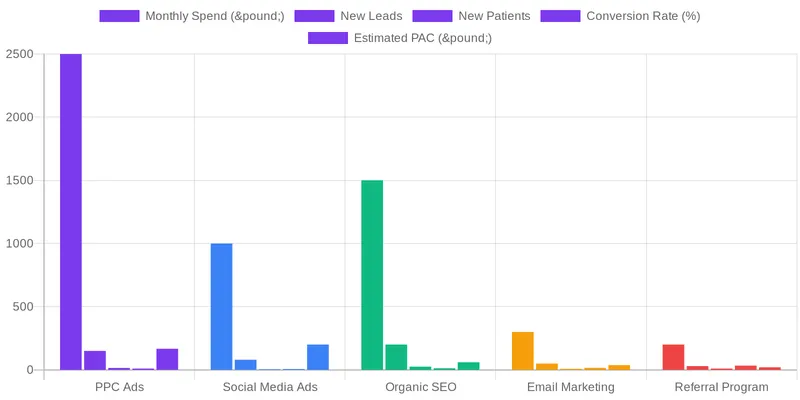
Continuously analyze your marketing budget. Identify channels with high costs and low conversion rates, and reallocate resources to those with better performance. For instance, PPC for doctors can yield immediate results but its cost per lead can be high. Balancing this with long-term organic strategies is crucial for a sustainable reduction in acquisition costs.
Optimizing Conversion Rates and Patient Lifetime Value (LTV)
Improving your conversion rate lowers PAC. Optimize your website’s user experience (UX) with clear calls-to-action, intuitive navigation, mobile responsiveness, and fast loading times. Streamlining the booking process, from inquiry to scheduling, minimizes friction and reduces drop-off rates.
Understanding patient lifetime value (LTV) is critical. LTV is the total revenue a patient generates over their relationship with your clinic. For aesthetic practices, where repeat treatments and referrals are common, a higher LTV can justify a higher initial PAC. Investing in patient retention and loyalty programs increases LTV, making the initial acquisition cost more profitable long-term. Focusing on high-value procedures and patients also lowers the effective acquisition cost per revenue unit.
Measuring Marketing ROI and Ensuring Long-Term Clinic Growth
Measuring marketing ROI is essential for an aesthetic clinic’s sustainable growth. It requires a view of all marketing efforts and their direct impact on revenue, beyond just patient acquisition cost. Clinics must establish key performance indicators (KPIs) for each marketing channel and track performance against these benchmarks. This data-driven approach enables continuous optimization, ensuring marketing spend contributes to profitability.
Reviewing your marketing budget against patient acquisition numbers and revenue helps identify strengths and weaknesses. This process of analysis and adjustment maximizes marketing spend efficiency. For instance, understanding the SEO ROI from organic channels compared to the higher cost of PPC campaigns informs strategic resource allocation.
Key Metrics Beyond PAC: From Leads to Loyal Patients
While PAC is a vital metric, understanding marketing performance requires tracking other indicators. Conversion rates by channel reveal the most effective platforms. Lead quality metrics assess if marketing attracts the right demographic. Patient retention rates are crucial for understanding the long-term value of acquired patients and the success of post-acquisition engagement.
A holistic view considers the entire patient journey, from awareness to repeat visits and referrals. Analyzing these interconnected metrics provides a deeper understanding of your marketing ecosystem to make informed decisions that foster new patient acquisition, loyalty, and sustained clinic growth.
Ready to Optimize Your Patient Acquisition Cost? Partner with an Expert
Reducing patient acquisition cost and maximizing marketing ROI requires specialized expertise in the London private healthcare market. As a Semantic SEO Strategist, Abdurrahman Şimşek offers strategies for aesthetic clinics and plastic surgeons, focusing on building online authority and driving patient acquisition. Leverage 10 years of experience in search engineering to transform your digital presence and secure sustainable growth.
Discover how a semantic content network can attract more qualified patients to your practice. Connect with Abdurrahman Şimşek today to discuss a strategy for your clinic’s needs.
Conclusion
Mastering patient acquisition cost is about making strategic investments in your clinic’s future. By understanding PAC and implementing semantic SEO strategies, aesthetic clinics and plastic surgeons can achieve sustainable growth and dominate their local market. A data-driven approach, focusing on building topical authority and optimizing for E-E-A-T, ensures marketing efforts contribute to long-term profitability. Ready to transform your patient acquisition strategy? Let’s connect.
Frequently Asked Questions
What is the formula to calculate patient acquisition cost (PAC)?
The basic formula for patient acquisition cost is: Total Marketing & Sales Spend ÷ Number of New Patients Acquired in a specific period. It’s crucial to include all relevant costs, from ad spend and agency fees to staff time spent on marketing and sales efforts.
Why is tracking patient acquisition cost crucial for an aesthetic clinic’s profitability?
Tracking this metric reveals which marketing channels are truly profitable and deliver high-value patients. Without this insight, clinics risk overspending on ineffective campaigns, directly impacting their financial health and growth potential and making their patient acquisition cost unsustainable.
What is the most effective way to reduce patient acquisition cost for aesthetic clinics?
Investing in organic channels like Semantic SEO is the most sustainable way to lower your average patient acquisition cost. While it requires an upfront investment, a high-ranking website generates a consistent flow of qualified leads at a marginal cost of zero over time.
How does Conversion Rate Optimization (CRO) help lower the expense of acquiring new patients?
CRO directly impacts your efficiency by optimizing your website’s consultation forms, call-to-action buttons, and procedure pages. This allows you to convert more existing website visitors into booked consultations for the same marketing spend. Ultimately, this means you acquire more patients for the same investment, effectively reducing your per-patient expense.
Should clinics prioritize reducing new patient acquisition expenses or increasing Patient Lifetime Value (LTV)?
Both are vital, but understanding the ratio between LTV and the expense of acquiring a patient is key for sustainable growth. A successful clinic ensures that the value a patient brings over their lifetime is significantly higher (ideally 3x or more) than the initial investment to attract them.
How can Abdurrahman Şimşek help London aesthetic clinics optimize their patient acquisition strategies?
Abdurrahman Şimşek specializes in YMYL & E-E-A-T Optimization for surgeons, focusing on building topical authority for healthcare domains. By implementing advanced Semantic SEO strategies, he helps Harley Street and Central London aesthetic clinics attract highly qualified patients organically, significantly lowering their long-term patient acquisition expenses and ensuring sustainable growth.
Ruxi Data brings together multi-model AI, automated website crawling, live indexation checks, topical authority mapping, E-E-A-T enrichment, schema generation, and full pipeline automation — from crawl to WordPress publish to social posting — all in one platform built for agencies and freelancers who run on results.