
Javascript SEO for Healthcare: Optimizing Dynamic Content Visibility
Effective javascript seo for healthcare is essential for medical websites utilizing dynamic content to ensure search engine crawlability and indexation. This guide details critical rendering strategies—Client-Side Rendering (CSR), Server-Side Rendering (SSR), and dynamic rendering—to optimize YMYL content for Googlebot. Understanding these approaches helps medical platforms improve Core Web Vitals, manage crawl budget, and enhance E-E-A-T signals. Proper implementation ensures interactive patient resources and service offerings are visible in search results, directly impacting patient acquisition and online authority.
Abdurrahman Şimşek, a Semantic SEO Strategist, emphasizes the importance of technical SEO precision for healthcare entities. This content provides actionable insights for medical websites to navigate JavaScript rendering complexities, ensuring their vital information reaches patients effectively and maintains search engine performance.
To explore your options, Book a Semantic SEO Audit. You can also reach us via: Direct WhatsApp Strategy Line: +90 506 206 86 86
Effective javascript seo for healthcare is critical for medical websites using dynamic content to engage patients. Search engines must be able to crawl, render, and index this YMYL (Your Money Your Life) content for online visibility and patient acquisition. This guide covers rendering strategies and best practices for medical websites to maintain search performance.
What is JavaScript SEO for Healthcare Websites?
JavaScript SEO for healthcare websites optimizes sites using JavaScript to ensure search engines can discover, render, and index all content. Many medical platforms, like appointment schedulers and interactive symptom checkers, are built with JavaScript frameworks. Proper implementation makes patient information and service offerings visible in search results, impacting a clinic’s ability to attract new patients.
Unlike HTML-based sites, JavaScript-driven pages require search crawlers to execute JavaScript to see the full content. If not optimized, parts of a medical website may be invisible to search engines, causing lost organic traffic and reduced authority.
The Imperative of Crawlability for YMYL Medical Content
Search engines process JavaScript in a two-phase approach: first, they crawl the initial HTML, then they queue JavaScript for rendering using a headless browser (like Googlebot’s Web Rendering Service, which is based on Chromium). For YMYL (Your Money Your Life) content like medical advice, procedure descriptions, or surgeon profiles, ensuring all information is crawlable is critical. Content missed due to rendering issues can impact a site’s E-E-A-T (Experience, Expertise, Authoritativeness, Trustworthiness) signals, which are critical for ranking in the healthcare sector. Unindexed content means potential patients cannot find accurate, authoritative medical information.
Understanding Rendering Strategies: SSR, CSR, and Dynamic Rendering
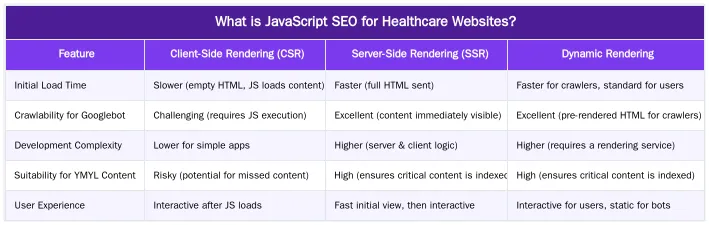
Rendering strategies for JavaScript content have distinct SEO implications. Client-Side Rendering (CSR) relies on the user’s browser to execute JavaScript and build the page content. Server-Side Rendering (SSR) generates the full HTML on the server before sending it to the browser, making content immediately available. Dynamic rendering serves a pre-rendered, static HTML version to search engine crawlers while delivering the full JavaScript experience to human users.
Hydration is a related concept, often used with SSR or Static Site Generation (SSG). It involves attaching JavaScript event listeners and making the server-rendered HTML interactive on the client side. This combines the benefits of fast initial load and crawlability with a rich user experience.
Comparing Rendering Approaches for Medical Websites
Choosing a rendering strategy for a medical website requires balancing load times, crawlability, development complexity, and YMYL content visibility. The table below compares Client-Side Rendering (CSR), Server-Side Rendering (SSR), and Dynamic Rendering.
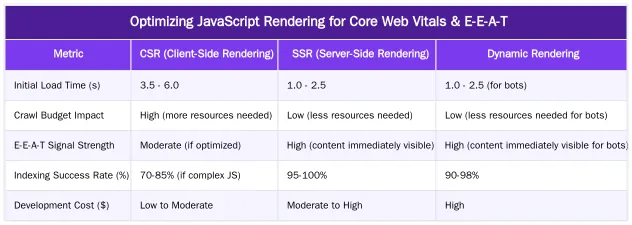
Optimizing JavaScript Rendering for Core Web Vitals & E-E-A-T
The JavaScript rendering strategy impacts a medical website’s Core Web Vitals, which are ranking factors. Metrics like Largest Contentful Paint (LCP), First Input Delay (FID), and Cumulative Layout Shift (CLS) are directly affected by how and when content is rendered. Poor performance can undermine E-E-A-T signals, as slow or unstable pages erode user trust and Google’s perception of quality. Optimizing rendering for frameworks like React (React SEO) and Vue.js (Vue.js SEO) involves techniques like code splitting, lazy loading, and efficient data fetching to minimize JavaScript payload and execution time.
For instance, a React-based patient portal should prioritize SSR for critical initial content to ensure a fast LCP, while interactive elements can be client-rendered. This hybrid approach balances performance with dynamic functionality for user experience and search engine visibility.
Reducing ‘Cost of Retrieval’ with Efficient JS Execution
Optimized JavaScript rendering reduces the ‘Cost of Retrieval’ for search engines. This refers to the computational resources Googlebot expends to crawl, render, and index a page. An inefficient, JavaScript-heavy site forces Googlebot to spend more resources, potentially impacting crawl budget and how frequently medical content is indexed. Minimizing JavaScript execution time and payload improves site efficiency, allowing Googlebot to process more pages with fewer resources. This technical SEO concept is vital for large medical content hubs.
Explore strategies for reducing ‘Cost of Retrieval’ for efficient medical website performance.
Advanced JavaScript SEO Best Practices for Healthcare Clinics
For London-based medical clinics, javascript seo for healthcare extends beyond rendering choices. It involves technical and semantic SEO to ensure dynamic content is visible, understood, and authoritative. With over a decade of experience in search engineering, Abdurrahman Şimşek specializes in building high-authority Semantic Content Networks for medical practices. This expertise informs best practices for JavaScript-driven sites, focusing on structured data, internal linking, and content architecture.
Adhering to the E-E-A-T framework is critical. This involves technical optimization, clear authorship, robust content, and transparent clinic information, all of which can be affected by JavaScript implementation.
Integrating Medical Schema with Dynamic Content
Implementing medical schema correctly is crucial for entity recognition and E-E-A-T on JavaScript-driven pages. Schema types like Physician, MedicalClinic, and MedicalProcedure must be in the initial HTML or injected via JavaScript so Googlebot can parse them. For dynamic content, this often means using SSR or dynamic rendering to ensure the JSON-LD is available in the server-rendered response. Verify schema implementation with Google’s Rich Results Test to confirm search engines can interpret your medical entities and procedures.
Leveraging Dynamic Rendering for Complex Patient Portals
Dynamic rendering is a solution for highly interactive or personalized sections like patient portals, appointment booking systems, or symptom checkers. These features rely on client-side JavaScript, which can be challenging for search crawlers. Serving a pre-rendered HTML version to Googlebot ensures core content (e.g., service descriptions, FAQs) is accessible, while users receive the full JavaScript experience. This strategy balances user experience with search engine visibility for medical information.
Ensuring Googlebot Can Effectively Crawl Your Dynamic Medical Content
Continuously verify how Googlebot perceives your JavaScript-driven medical content. Google Search Console’s URL Inspection tool shows a page as Googlebot renders it, including JavaScript-generated content. This helps identify missed YMYL information. Tools like Lighthouse provide insights into Core Web Vitals performance, which is influenced by JavaScript execution. Analyzing server log files can also reveal Googlebot’s crawl patterns, indicating if it’s struggling to access certain JavaScript-heavy sections.
Regular monitoring and troubleshooting are essential to maintain crawlability and indexability for dynamic medical websites. This ensures patient-facing content, from procedure details to contact information, remains discoverable.
Monitoring and Troubleshooting Common JS SEO Issues
Common JavaScript SEO pitfalls for medical websites include unindexed content, broken internal links generated by JavaScript without HTML fallbacks, and slow load times that impact Core Web Vitals. To diagnose these, regularly check Google Search Console for “Indexed, though blocked by robots.txt” or “Discovered – currently not indexed” statuses, which often point to rendering issues. Use browser developer tools to audit network requests and JavaScript execution times. For complex issues, consider a dedicated rendering service or consulting a specialist on rendering JavaScript-heavy clinic sites.
Partner with a Specialist for Robust Healthcare JavaScript SEO
JavaScript SEO for YMYL healthcare sites demands specialized expertise. Navigating rendering strategies, Core Web Vitals, and medical schema requires understanding technical SEO and the medical industry’s regulatory and trust requirements. Partnering with a specialist like Abdurrahman Şimşek provides your London-based medical practice with technical and semantic SEO strategies to compete in organic search and attract patients.
Secure Your Clinic’s Digital Future with Semantic SEO
A semantic approach to technical SEO, including optimized JavaScript rendering, builds algorithm-proof topical authority. This strategy makes your clinic’s digital presence resilient and drives patient acquisition. For London clinics, a strategic partnership is an investment in long-term organic growth. Book a Semantic SEO Audit today to secure your clinic’s digital future. Direct WhatsApp Strategy Line: +90 506 206 86 86.
Conclusion
JavaScript SEO is necessary for healthcare websites seeking organic visibility. By implementing rendering techniques, optimizing for Core Web Vitals, and integrating medical schema, clinics can make their dynamic content accessible to search engines. Partnering with a specialist like Abdurrahman Şimşek helps your London-based medical practice use technical and semantic SEO to compete and attract patients. For an overview of technical SEO for medical websites, explore An Advanced Technical SEO Framework for London’s Elite Medical Websites. Take the next step: Book a Semantic SEO Audit or reach out via Direct WhatsApp Strategy Line: +90 506 206 86 86.
Frequently Asked Questions
Why is JavaScript SEO for healthcare websites a critical consideration?
JavaScript SEO for healthcare is critical because many modern medical websites use JS frameworks for dynamic features like appointment booking and interactive patient information. If not implemented correctly, search engines may struggle to crawl, render, and index this vital YMYL content. This severely impacts visibility, E-E-A-T signals, and ultimately, patient acquisition for medical practices.
How can rendering strategies improve javascript seo for healthcare?
Optimizing rendering strategies is fundamental for effective javascript seo for healthcare. Approaches like Server-Side Rendering (SSR) or Dynamic Rendering ensure search engines receive a fully formed HTML page, making content immediately discoverable. This improves crawlability, indexing, and overall search performance for dynamic medical websites.
Can client-side rendering (CSR) harm search visibility for medical content?
Yes, relying solely on client-side rendering can significantly harm search visibility. Googlebot has to execute the JavaScript to see the content, a process that consumes more resources and can lead to delays or incomplete indexing. For critical patient-facing information, this presents a substantial risk to patient acquisition and trust.
How does JavaScript impact E-E-A-T for a medical professional’s site?
If important E-E-A-T signals—like author bios, medical credentials, or patient testimonials—are loaded exclusively via JavaScript, there’s a risk Google might miss them during the initial crawl. Ensuring this content is present in the initial HTML payload through strategies like SSR or dynamic rendering is crucial. This reinforces expertise, authoritativeness, and trustworthiness, which are vital for YMYL content.
What are common challenges in implementing javascript seo for healthcare?
Common challenges in implementing javascript seo for healthcare include ensuring all dynamic content is crawlable, managing rendering budgets, and optimizing for Core Web Vitals. Addressing these requires a deep understanding of both SEO and web development best practices. Proper implementation ensures vital patient information and service offerings are visible in search results.
How can Abdurrahman Şimşek assist with my clinic’s JavaScript SEO?
Abdurrahman Şimşek, a Semantic SEO Strategist with over 10 years of experience, specializes in Medical & Plastic Surgery SEO for London clinics. He can conduct a comprehensive Semantic SEO Audit to identify and resolve complex JavaScript rendering issues, ensuring your dynamic medical content is fully discoverable by search engines. You can book a Semantic SEO Audit or contact him directly via WhatsApp at +90 506 206 86 86 for strategic guidance.
Ruxi Data brings together multi-model AI, automated website crawling, live indexation checks, topical authority mapping, E-E-A-T enrichment, schema generation, and full pipeline automation — from crawl to WordPress publish to social posting — all in one platform built for agencies and freelancers who run on results.