AI Overviews Medical Search: Optimizing for AI Visibility
AI overviews medical search is fundamentally changing how patients find health information, increasing zero-click searches and demanding new SEO strategies. This article explains how generative AI summaries impact medical visibility and outlines methods for adapting. It details optimizing content through semantic SEO, E-E-A-T principles, and entity-attribute-value modeling. Implementing these strategies ensures your medical practice appears in AI Overviews and maintains authority in an AI-first search environment, crucial for attracting high-value patients.
Abdurrahman Şimşek, a Semantic SEO Strategist, provides expert guidance on navigating these changes. This content focuses on actionable strategies for medical entities to enhance their digital presence and information retrieval in the evolving search landscape.
To explore your options, contact us to schedule your consultation.
In 2026, Google’s AI Overviews are reshaping how patients find medical information, making ai overviews medical search a critical focus for healthcare providers. These generative AI summaries impact medical SEO and increase zero-click searches. Semantic strategies help clinics maintain visibility and attract high-value patients in an AI-first search environment.
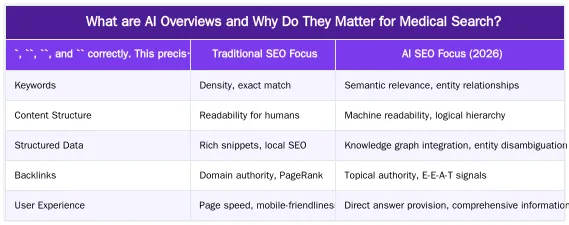
What are AI Overviews and Why Do They Matter for Medical Search?
AI Overviews, formerly Search Generative Experience (SGE), are AI-generated summaries at the top of Google search results. They synthesize information from multiple sources to provide direct answers to queries, particularly for complex topics like medical conditions. This alters information retrieval by offering immediate responses, often leading to zero-click searches where users get answers without visiting a website.
Generative AI summaries impact how patients access health information. For medical practices, appearing in these sections is crucial for visibility. The system prioritizes factual, unambiguous, and highly authoritative content. Medical entities must adapt to this model to maintain their digital presence and attract patients in 2026.
Understanding Generative Engine Optimization (GEO) for Healthcare
Generative Engine Optimization (GEO) is the evolution of SEO for AI-driven search environments. Unlike traditional SEO’s focus on keyword density and backlinks, GEO emphasizes semantic understanding and entity relationships. It involves structuring content for AI models to comprehend, process, and synthesize into answers. For healthcare, this means presenting medical information so AI can interpret and validate expertise, ensuring accurate data appears in AI Overviews.
How Do AI Overviews Impact Medical SEO & Zero-Click Searches?
AI Overviews, powered by large language models, have profound implications for medical SEO. A primary effect is the increase in zero-click searches, where users get a direct answer on the results page. This can reduce website traffic from informational queries for medical clinics. However, clinics can establish authority by being cited in these AI-generated summaries.
Medical content strategies must evolve beyond ranking for keywords. Content must be comprehensive, entity-rich, and structured to provide answers AI can extract. The goal shifts from attracting clicks to establishing a clinic’s expertise on medical topics. This way, even without a click, the clinic’s brand is associated with the information, fostering trust and recognition.
Navigating the Zero-Click Landscape for Patient Acquisition
Medical practices can still acquire high-value patients by focusing on brand authority and direct engagement. Consistent appearance in AI Overviews builds credibility, leading to direct searches for the clinic’s name or services. Strategies include optimizing for local search intent, presenting clear contact information, and using calls to action that encourage inquiries or bookings. High-value medical leads seek trust and direct interaction with a provider.
Optimizing Your Medical Website for AI Overviews: A Strategic Guide
To gain visibility in AI Overviews, medical clinics need technical and content strategies, including structured data, semantic HTML, and content architecture. These elements signal AI models, helping them understand, categorize, and retrieve medical information. These strategies reduce search engine processing effort, making content more likely to be featured.
Using specific JSON-LD schema types like `MedicalBusiness`, `Physician`, and `MedicalProcedure` helps AI understand your services and expertise. A logical content structure with clear headings allows AI to parse information effectively. This foundational work is critical for medical practices in the generative search era. For more on structuring content, explore optimizing for AI Overviews with semantic HTML structure.
Leveraging Structured Data and Semantic HTML for AI SEO
Structured data like JSON-LD gives search engines explicit clues about content meaning. For medical clinics, this includes marking up physician details, procedures, conditions treated, and clinic locations. Semantic HTML uses tags (like `
` through `
`, `
`, `
- `, `
- `, `
E-E-A-T and YMYL: The Foundation for Medical AI Overview Success
For medical content, E-E-A-T (Experience, Expertise, Authoritativeness, Trustworthiness) and YMYL (Your Money Your Life) are paramount for visibility in AI Overviews. Google applies stringent quality standards to YMYL topics like health information to ensure accuracy. Content with clear E-E-A-T signals is more likely to be trusted and featured by generative AI models.
This means showcasing medical professionals’ credentials, citing reputable sources, and maintaining a transparent, secure online presence. Abdurrahman Şimşek specializes in building high-authority semantic content networks for medical clinics, understanding these requirements. His methodology ensures medical content establishes the trust signals for AI to present it to users. This is vital for plastic surgeons and aesthetic clinics in competitive markets like Harley Street, London.
Building Topical Authority for London Aesthetic Clinics with Ruxi Data
Topical authority is essential for YMYL content, particularly for London aesthetic clinics. It signifies a website’s deep coverage of a subject, positioning it as a definitive resource. Tools like Ruxi Data automate creating topical maps and entity-attribute-value (EAV) models. This helps clinics demonstrate knowledge across their services, from procedures to patient care and recovery.
Abdurrahman Şimşek uses Ruxi Data to construct semantic content networks where each piece of content contributes to the clinic’s authority. This approach, combined with a focus on E-E-A-T, makes medical websites more credible and discoverable in AI-driven search. For more on technical aspects, refer to AI Overviews technical SEO in 2026. This framework is crucial for clinics aiming to dominate local organic search and attract high-value patients.
Google’s emphasis on E-E-A-T for YMYL content means medical websites must be informative and demonstrably credible. AI Overviews amplify this need, prioritizing sources with clear expertise and trustworthiness.
Beyond Keywords: Entity-Attribute-Value (EAV) Modeling for Medical Content
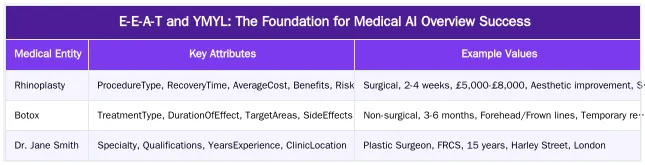
Keyword-centric SEO is insufficient for AI Overviews. Entity-Attribute-Value (EAV) modeling is a more advanced approach. This method breaks down medical procedures, conditions, and treatments into entities (e.g., “Rhinoplasty”), their attributes (e.g., “recovery time,” “cost,” “benefits”), and values (e.g., “2 weeks,” “£5000-£8000,” “improved facial symmetry”). This structured representation allows AI to build a knowledge graph, facilitating precise information retrieval.
Defining these relationships makes medical content highly machine-readable. For example, an AI can understand that “Rhinoplasty” is a “MedicalProcedure” with “AverageCost” and “PotentialRisks.” This organization reduces the ‘Cost of Retrieval’ for search engines, making it easier for AI to process and present accurate answers. This semantic engineering approach is a key part of Abdurrahman Şimşek’s medical SEO strategy.
Reducing Search Engine Cost of Retrieval (CoR) with Semantic Engineering
Cost of Retrieval (CoR) is the computational resources and time search engines use to find, process, and synthesize information for a query. For AI-driven search, reducing CoR is paramount. Semantic engineering, using methods like EAV modeling and knowledge graphs, addresses this. When medical content is semantically rich and structured, AI systems can identify entities and their attributes without extensive inferencing.
This efficiency makes content more likely to be understood and chosen by AI for Overviews. A knowledge graph for a medical clinic detailing its services, practitioners, and specializations is an efficient and reliable source for AI. This optimization ensures medical information is presented effectively, benefiting patients and providers.
Partner with a Semantic SEO Strategist for AI Overview Dominance
AI-driven search demands a specialized approach for medical clinics. Navigating AI Overviews and zero-click searches requires more than traditional SEO. Abdurrahman Şimşek offers expertise in semantic SEO and web development for the private healthcare sector, including plastic surgeons and aesthetic clinics.
His strategies focus on building semantic content networks, establishing topical authority, and optimizing for E-E-A-T signals. Partnering with a specialist in generative engine optimization ensures your clinic remains visible, trusted, and attracts high-value patients. Secure your clinic’s future in the AI-first search era.
Conclusion
AI Overviews redefine how medical information is discovered online. Healthcare providers must adapt for sustained visibility and patient acquisition. By prioritizing E-E-A-T, implementing structured data, using semantic HTML, and adopting Entity-Attribute-Value modeling, medical clinics can optimize their digital presence for AI-driven search. These strategies ensure your expertise is accurately represented and featured, even in a zero-click environment. To navigate this landscape and secure your clinic’s position, book a Semantic SEO Audit with Abdurrahman Şimşek to transform your online strategy. Visit abdurrahmansimsek.com for more information.
Frequently Asked Questions
How can my clinic’s website be optimized to appear in ai overviews medical search results?
To be featured in these generative AI summaries, your content must be highly authoritative, factual, and unambiguous. This requires a deep focus on E-E-A-T signals, extensive use of structured data, and a well-organized site architecture that AI can easily process. Optimizing for ai overviews medical search means providing clear, trustworthy information.
Will AI Overviews reduce website clicks for medical practices, particularly in an ai overviews medical search environment?
AI Overviews may reduce clicks for simple, informational queries answered directly in the SERP. However, for complex, high-consideration YMYL topics like plastic surgery, patients will still click through to authoritative websites. They seek to verify information and vet a surgeon’s credentials, making direct engagement still vital.
What is the role of Semantic HTML in optimizing for an effective ai overviews medical search strategy?
Semantic HTML, using tags like <article> and <section>, provides a clear structure that AI models can easily parse and understand. It helps AI differentiate between main content, supplementary information, and author details. This clear structuring is critical for your content to be cited as a reliable source within AI Overviews.
How does an Entity-Attribute-Value (EAV) model enhance visibility in generative AI summaries?
The EAV model structures data in a way that AI systems favor. By defining entities like ‘Rhinoplasty’ and their specific attributes such as ‘Anesthesia: General’, you feed Google’s Knowledge Graph with precise, machine-readable facts. This significantly increases your content’s chances of being utilized in an AI Overview.
Why will brand reputation be even more critical for medical practices with the rise of AI-powered search?
Brand reputation will matter immensely. AI models are designed to synthesize information from sources Google already trusts and deems credible. A strong brand, positive patient reviews, and mentions in authoritative medical publications are crucial signals that tell AI your clinic is a reliable source of health information.
How can Abdurrahman Şimşek’s London Private Healthcare SEO Service help my clinic prepare for AI-driven search?
Our London Private Healthcare SEO Service specializes in YMYL & E-E-A-T optimization for surgeons, focusing on building topical authority for healthcare domains. We help Harley Street & Central London Aesthetic Clinics develop semantic strategies to maintain visibility and attract high-value patients in this evolving search landscape.
Ruxi Data brings together multi-model AI, automated website crawling, live indexation checks, topical authority mapping, E-E-A-T enrichment, schema generation, and full pipeline automation — from crawl to WordPress publish to social posting — all in one platform built for agencies and freelancers who run on results.