
Website Migration SEO Checklist: Preserving Medical Practice Rankings
The website migration seo checklist provides a critical roadmap for medical practices to preserve organic visibility and patient leads during a site transition. It details essential steps from pre-migration technical SEO audits, comprehensive URL mapping, and implementing 301 redirects, to safeguarding E-E-A-T signals and crawl budget. Following this checklist helps mitigate risks associated with platform changes, domain moves, or redesigns, ensuring a seamless transition and maintaining search engine authority for healthcare websites.
As a Semantic SEO Strategist, Abdurrahman Şimşek provides strategic guidance to navigate complex website migrations. This content delivers actionable insights to protect search rankings and maintain patient acquisition channels, focusing on technical accuracy and E-E-A-T compliance for medical practices.
To explore your options, contact us to schedule your consultation. You can also reach us via: Book a Semantic SEO Audit, Direct WhatsApp Strategy Line: +90 506 206 86 86
A website migration for a medical practice has SEO pitfalls that can jeopardize rankings and patient leads. This website migration seo checklist is a roadmap to preserve organic visibility and authority in the London private healthcare market, covering planning, execution, and post-migration monitoring for medical websites.
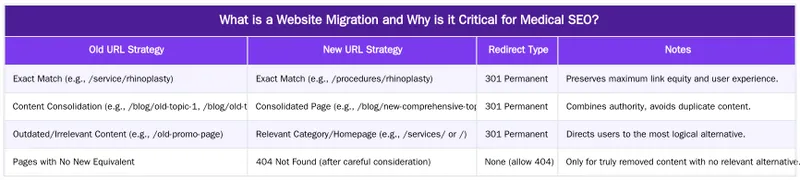
What is a Website Migration and Why is it Critical for Medical SEO?
A website migration involves changes to a site’s location, platform, structure, or content that impact how search engines crawl, index, and rank pages. This includes moving to a new domain, changing content management systems (CMS), redesigning the site, or restructuring URL paths. For medical practices, site moves are high-stakes because of the “Your Money or Your Life” (YMYL) nature of healthcare content, where Google requires Expertise, Experience, Authoritativeness, and Trustworthiness (E-E-A-T).
The Biggest Risk: Losing Organic Traffic and Patient Leads
A poorly executed site transition can cause a loss of organic search visibility, impacting patient acquisition and revenue. Google’s algorithms trust established, authoritative YMYL sites. Disrupting a site’s technical foundation or content signals during a migration can cause a loss of trust, dropping rankings and patient inquiries. Rebuilding this trust and recovering visibility is a long, costly process.
Pre-Migration SEO Audit
A pre-migration SEO audit is non-negotiable. It establishes a baseline by collecting and analyzing data to identify high-value assets and mitigate risks, ensuring all critical elements are planned for the new environment.
Comprehensive URL Mapping and Content Inventory
A full inventory of all existing URLs is required to identify high-value pages (service pages, surgeon profiles, educational content) and retain their search equity. Each old URL needs a corresponding new URL or a redirect plan if content is consolidated or removed. Audit content for relevance, accuracy, and E-E-A-T signals before the move to optimize or remove underperforming assets. Automated redirect management is crucial.
Baseline Performance Metrics and Technical Health Check
Capture current organic rankings, traffic volumes, crawl statistics, and index status as a benchmark for post-migration comparison. A pre-migration technical SEO audit assesses site speed, mobile-friendliness, existing schema markup (e.g., MedicalBusiness, Physician), and current crawl errors. Fixing existing technical issues prevents their inheritance by the new site.
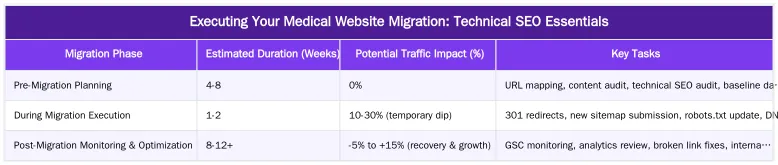
Executing Your Medical Website Migration: Technical SEO Essentials
A site move’s technical execution dictates its SEO success. Precision is required when implementing redirects, updating site configuration files, and communicating changes to search engines to preserve search engine signals.
Implementing a 301 Redirect Strategy
The most critical component of a site migration is 301 redirects. Every old URL must permanently redirect to its new, relevant counterpart. Failing to implement a 1:1 redirect map results in broken links, lost link equity, and a drop in organic visibility. Common mistakes include redirecting all old pages to the homepage or using temporary 302 redirects. Redirect management tools can map thousands of URLs accurately, ensuring search engines understand the permanent move and transfer link authority.
Updating XML Sitemaps, Robots.txt, and Canonical Tags
After launch, create and submit a new XML sitemap to Google Search Console with all new, indexable URLs. Update the robots.txt file to reflect the new site structure or disallowed paths, allowing search engines to access critical content while blocking irrelevant sections. Review all canonical tags to confirm they point to the preferred versions of pages, preventing duplicate content issues. These steps guide search engines through the new site’s architecture.
Beyond Redirects: Safeguarding E-E-A-T and Crawl Budget During Your Move
For medical websites, a migration extends beyond technical redirects to maintaining trust signals and optimizing for search engine efficiency. Preserving the semantic integrity and entity architecture of a medical site is crucial for long-term authority and patient acquisition in the YMYL space.
Preserving E-E-A-T Signals and Medical Schema
Medical practices rely on E-E-A-T to rank. During a site move, ensure author profiles, medical qualifications, patient testimonials, and professional memberships are correctly transferred and displayed. Implement relevant schema markup, such as Physician, MedicalClinic, and MedicalProcedure JSON-LD, accurately. This structured data helps search engines understand the entities on your site and their relationships, reinforcing your expertise and trustworthiness. Neglecting these elements can impact how Google perceives your authority. Google’s guidelines emphasize accurate medical structured data.
Optimizing Crawl Budget and Reducing Cost of Retrieval
Site architecture changes and redirect chains can negatively impact crawl budget, slowing the indexing of new content. A migration should optimize the new site’s structure for efficient crawling, ensuring medical content is discovered and indexed promptly. This reduces Google’s ‘Cost of Retrieval’ (CoR)—the resources Google expends to process your site. Minimizing CoR signals an efficient site, which can positively influence indexing and ranking. Strategies include flattening site architecture, eliminating unnecessary redirects, and ensuring fast page load times. Learn more about reducing Cost of Retrieval for medical content.
Post-Migration Monitoring: Ensuring Ranking Recovery and Patient Flow
After the new site goes live, continuous monitoring is essential to identify and fix issues, ensuring ranking recovery and maintaining patient flow.
Using Google Search Console for Issue Detection
Google Search Console (GSC) is essential for post-migration monitoring. Check GSC’s ‘Crawl Stats’ to ensure Googlebot is crawling the new site. The ‘Index Coverage’ report highlights pages with indexing errors. Use the ‘Removals’ tool to expedite the de-indexing of old, un-redirected URLs. Monitor ‘Sitemaps’ to confirm the new XML sitemap has been processed. Addressing crawl errors or indexing problems promptly is critical for recovery. Google’s Search Console documentation provides guidance on these reports.
Analyzing Traffic, Rankings, and Conversion Data
Use Google Analytics and other tracking tools to monitor organic traffic, keyword rankings, and patient lead conversions. Compare post-migration data to pre-migration baselines. Set up alerts for drops in traffic or conversions. Monitor high-value procedure pages and surgeon profiles. Analyzing user behavior metrics like bounce rate and time on page can reveal if the new site meets user expectations.
Common Website Migration Mistakes Medical Practices Must Avoid
Certain pitfalls can derail a medical website migration. Awareness of these common errors allows practices to avoid them, safeguarding their online presence and patient trust.
Overlooking Local SEO and Google Business Profile Updates
For medical practices, local SEO is a primary driver of patient acquisition. A site migration, especially a domain change, requires immediate updates to your Google Business Profile (GBP) and all local citations. Failing to update your website URL on GBP, Yelp, Doctify, and other directories leads to inconsistent Name, Address, Phone (NAP) information. This inconsistency can impact your local search rankings and visibility in the local pack.
Inadequate Testing and Staging Environment Review
Launching a new website without thorough testing is a risk. The new site should be tested in a staging environment for functionality, speed, mobile responsiveness, and all SEO elements before going live. This includes checking internal links, forms, and schema markup, and ensuring content renders correctly across devices. Fixing issues in a staging environment prevents them from impacting live users and search engine crawlers.
Medical Website Migration Expertise
A medical website migration requires specialized expertise to protect rankings, E-E-A-T, and patient acquisition channels. Abdurrahman Şimşek, a London-based Semantic SEO Strategist, specializes in healthcare SEO, focusing on semantic SEO for surgeons and using a technical SEO framework.
Conclusion
A well-executed website migration for a medical practice can enhance performance and online presence. Following a checklist covering pre-migration audits, technical execution, and post-migration monitoring safeguards organic rankings and patient acquisition. Prioritizing E-E-A-T signals, optimizing for crawl efficiency, and using semantic SEO principles are crucial for success in the healthcare landscape. For guidance on your medical website migration, contact us. You can also Book a Semantic SEO Audit or reach out via Direct WhatsApp Strategy Line: +90 506 206 86 86.
Frequently Asked Questions
What is the single biggest risk for a medical practice following a website migration seo checklist?
The biggest risk is a significant loss of organic traffic and patient leads due to improperly implemented 301 redirects. Failing to meticulously map every old URL to its new equivalent can result in broken backlinks, lost search engine authority, and ultimately, a drop in rankings for high-value procedure pages. A comprehensive website migration seo checklist helps mitigate these critical issues.
Why is a pre-migration content and SEO audit essential for a successful website migration seo checklist?
A pre-migration audit establishes a benchmark of your current performance, identifying your most valuable pages, the keywords they rank for, and any existing technical issues. This data-driven approach, a key component of any effective migration strategy, ensures you protect your key assets and avoid transferring old problems to the new site. It sets the foundation for a seamless transition.
How soon should I submit my new XML sitemap to Google after migration?
You should submit the new XML sitemap via Google Search Console immediately after your new site goes live and all 301 redirects are fully in place. This crucial step, often highlighted in a thorough website migration seo checklist, encourages Google to quickly crawl the new URLs and accurately understand your site’s updated structure. Prompt submission aids in faster re-indexing.
What is a URL mapping file and why is it critical for a medical website migration?
A URL mapping file is a spreadsheet that meticulously lists every URL on your old site in one column and its corresponding new URL in a second column. This document serves as the absolute blueprint for your 301 redirects, ensuring no page is lost in the move. It is arguably the most critical component of any successful website migration seo checklist.
How long should I monitor my site’s performance after completing a website migration seo checklist?
You should monitor your site’s performance closely for at least 3-6 months post-migration. Continuously check Google Search Console for crawl errors and indexing issues, track organic traffic and keyword rankings using analytics tools, and perform regular spot-checks to confirm all redirects are functioning correctly. This sustained vigilance helps ensure ranking recovery and patient flow.
How can
Ruxi Data brings together multi-model AI, automated website crawling, live indexation checks, topical authority mapping, E-E-A-T enrichment, schema generation, and full pipeline automation — from crawl to WordPress publish to social posting — all in one platform built for agencies and freelancers who run on results.