
Medical E-e-a-t: Technical Framework for Surgeon Websites
Building a robust medical e-e-a-t framework is crucial for surgeons aiming to establish digital authority and attract high-value patients. This article details semantic SEO strategies essential for YMYL (Your Money Your Life) topics, ensuring compliance with Google’s Quality Rater Guidelines. It outlines how technical implementations like author schema and structured data contribute to algorithmic authorship and entity reconciliation, signaling expertise and trustworthiness to search engines. Mastering medical e-e-a-t enhances information retrieval, solidifying a surgeon’s topical authority and improving search visibility for critical medical content.
Abdurrahman Şimşek, a Semantic SEO Strategist, provides actionable insights into developing these technical foundations. The content offers a strategic roadmap for medical professionals to navigate complex search algorithms and build a credible online presence.
To explore your options, contact us to schedule your consultation.
For surgeons and medical practitioners, an online presence requires a technical framework built on medical e-e-a-t (Experience, Expertise, Authoritativeness, Trustworthiness). This article outlines semantic SEO strategies to meet Google’s YMYL (Your Money Your Life) guidelines, dominate organic search, attract high-value patients, and solidify digital authority.
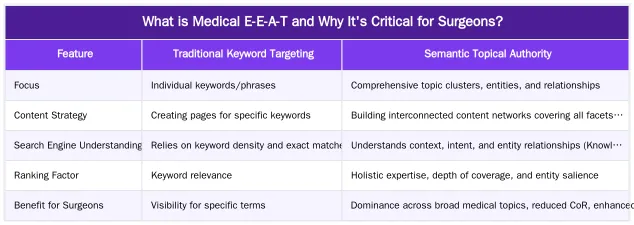
What is Medical E-E-A-T and Why It’s Critical for Surgeons?
Medical E-E-A-T is Google’s framework for evaluating health-related content quality and trustworthiness. It encompasses Experience, Expertise, Authoritativeness, and Trustworthiness. For surgeons, these components directly influence search rankings and patient confidence. Google’s Quality Rater Guidelines emphasize these signals for YMYL (Your Money Your Life) topics, where inaccurate information can have severe consequences.
Demonstrating E-E-A-T signals that a surgeon’s website provides reliable, accurate, and safe medical information. This is vital in fields like plastic surgery and aesthetic medicine, where patient decisions are life-altering. Search engines prioritize content from verifiable experts to provide users with credible guidance. Websites exhibiting these attributes rank higher and attract informed patients.
The YMYL Imperative: Why E-E-A-T is Non-Negotiable
YMYL pages, including medical advice, are subject to Google’s highest quality standards. The potential for harm from misinformation requires strong digital credibility. E-E-A-T ensures that only content from qualified sources is prominently displayed. Google’s Quality Rater Guidelines instruct evaluators to scrutinize the credentials and reputation of authors and websites publishing health content. This evaluation directly impacts search visibility, making an E-E-A-T for YMYL strategy indispensable for surgeons.
Building Topical Authority: A Semantic Framework for Medical Content
Medical search prominence requires building ‘topical authority’ around surgical procedures and medical conditions, not just optimizing for keywords. This involves demonstrating interconnected knowledge across a subject area. Semantic Content Networks structure information to show search engines a complete understanding of a topic. This approach uses Entity-Attribute-Value (EAV) modeling to organize complex medical information and prove expertise.
Mapping entities and their relationships establishes a surgeon’s website as a definitive resource. This view signals to search engines that the site offers authoritative information, reducing ambiguity and improving information retrieval for users.
Leveraging EAV Modeling and Semantic Content Networks
Entity-Attribute-Value (EAV) modeling organizes complex medical data like surgical procedures, patient outcomes, and specific conditions. For example, a “Rhinoplasty” entity might have attributes like “ProcedureType,” “RecoveryTime,” “PotentialRisks,” and “SurgeonSpecialty.” This structured data helps search engines understand the nuances of medical information. Ruxi Data’s approach automates the creation of topical maps and EAV models, reducing the Search Engine ‘Cost of Retrieval (CoR)’. This optimization enhances information retrieval for surgeon websites.
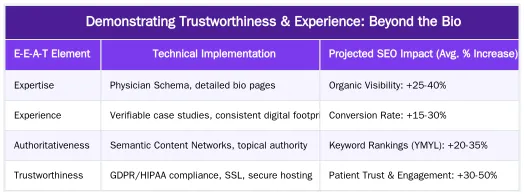
Demonstrating Trustworthiness & Experience: Beyond the Bio
Proving trustworthiness and experience extends beyond a surgeon’s biography, involving digital infrastructure and transparent operational practices. Data privacy, specifically adherence to GDPR and HIPAA standards, is a critical technical signal of trust. Secure website infrastructure, including SSL certificates and reliable hosting, signals integrity to users and search engines. Verifiable patient testimonials and case studies, ethically presented, build confidence. A consistent digital presence across professional directories and medical platforms reinforces a surgeon’s reputation and experience.
Technical Signals for Trust and Data Security
Technical trust signals are fundamental for medical websites. An SSL certificate (HTTPS) encrypts data, protecting patient information and signaling security. Reliable hosting ensures site availability and speed. Adherence to data privacy regulations like GDPR in the UK and HIPAA in the US is non-negotiable. Clear privacy policies detailing data collection, storage, and usage build patient confidence. These technical safeguards, combined with verifiable credentials and transparent patient experiences, establish trust with users and search engines. For more information on data privacy, refer to official guidelines from the Information Commissioner’s Office (ICO) on UK GDPR. Implementing automated E-E-A-T signals reinforces this trust.
The Impact of a Strong Medical E-E-A-T Framework
Implementing a medical e-e-a-t framework improves organic visibility, positioning a site higher in search results for YMYL queries. This enhanced ranking increases patient trust and conversion rates for consultations and procedures. An E-E-A-T framework also enhances a surgeon’s brand reputation, establishing them as an authority in their specialty.
Measuring Success: E-E-A-T’s Influence on Search Performance
Key SEO metrics track the impact of E-E-A-T improvements. These include organic traffic growth for high-value medical terms, higher keyword rankings for surgical procedures, and increased conversion rates for consultations. Reduced bounce rates and longer time-on-page metrics also indicate success. Establishing a ‘Topical Authority State’ for healthcare domains ensures sustained performance and positions the website as a definitive resource. Google’s Search Quality Rater Guidelines detail the criteria for evaluating content quality.
Partnering for E-E-A-T Excellence in London Private Healthcare
Building a medical e-e-a-t framework for surgeon websites demands specialized expertise. London-based private healthcare providers, plastic surgeons, and aesthetic clinics require a strategic partner to navigate Google’s YMYL requirements. Abdurrahman Şimşek offers semantic SEO strategies and web development services to build high-authority semantic content networks. This approach ensures dominance in local organic search across Harley Street and premium London postcodes, attracting high-value patients.
Conclusion
An online presence for surgeons in 2026 requires a technical framework embodying E-E-A-T. Implementing structured data, building topical authority, and ensuring data security contribute to digital credibility. This approach satisfies Google’s YMYL guidelines and cultivates patient trust. For medical practices in the London private healthcare sector, a partnership with a semantic SEO and web development expert is essential. Book a Semantic SEO Audit to build an authoritative online presence.
Frequently Asked Questions
What is the core importance of medical e-e-a-t for surgeons?
For surgeons, establishing a strong online presence relies heavily on Google’s framework for evaluating health-related content quality and trustworthiness. This framework directly influences search rankings and patient confidence, especially for YMYL (Your Money Your Life) topics. A robust E-E-A-T strategy ensures your expertise is recognized, attracting high-value patients and solidifying your digital authority.
How can surgeons technically demonstrate their ‘Experience’ for better search visibility?
Surgeons can prove first-hand experience through detailed case studies, before-and-after galleries (with patient consent), and content discussing the nuances of procedures. Using ‘Article’ schema with an ‘author’ property that links to your comprehensive bio page is a key technical signal. This structured data helps search engines understand and verify your practical expertise.
How does website design contribute to a strong medical E-E-A-T profile?
Yes, indirectly, a professional and user-friendly website significantly contributes to trustworthiness. A secure (HTTPS), mobile-friendly site with clear contact information, privacy policies, and patient testimonials builds confidence. Poor design and usability can be perceived as untrustworthy by both users and search engines, undermining your overall authority.
What role does topical authority play in building a robust framework for medical expertise online?
Topical authority involves creating comprehensive, interconnected content that covers a subject area in depth, demonstrating mastery. This semantic approach signals to search engines that you are a definitive source of information, significantly boosting your overall digital authority. It helps establish you as the go-to expert for specific medical topics.
Beyond just a name, what technical elements are essential for establishing authorship in medical e-e-a-t?
Establishing verifiable authorship is crucial for strong medical e-e-a-t. This requires a complete author profile page detailing your qualifications, publications, and experience, linked from every article you write. Using schema markup to programmatically define yourself as the author, connected to external authoritative profiles like the GMC register, is vital.
How can London private healthcare clinics begin optimizing their online presence for enhanced medical E-E-A-T?
To enhance your online authority and attract high-value patients, focus on implementing a robust semantic SEO strategy tailored to YMYL guidelines. Abdurrahman Şimşek specializes in E-E-A-T optimization for surgeons in Harley Street and Central London, helping clinics achieve a dominant topical authority state. Contact us to develop a bespoke strategy for your practice.
Ruxi Data brings together multi-model AI, automated website crawling, live indexation checks, topical authority mapping, E-E-A-T enrichment, schema generation, and full pipeline automation — from crawl to WordPress publish to social posting — all in one platform built for agencies and freelancers who run on results.