
Competing Clinic Ranking Higher: a Diagnostic SEO Audit
Understanding why a competing clinic ranking higher requires a structured diagnostic SEO audit, moving beyond superficial aesthetics. This 5-step process reveals underlying factors like technical SEO health, content authority, and semantic clarity. It involves competitor analysis, evaluating E-E-A-T signals, conducting a backlink gap analysis, and comparing schema markup. By identifying these critical gaps, clinics can develop targeted strategies to improve their search engine visibility and outperform competitors, addressing the true drivers of online presence.
Abdurrahman Şimşek, a Semantic SEO Strategist, provides expert guidance on dissecting complex ranking factors. This approach focuses on actionable insights derived from deep analysis of search engine algorithms and user intent, crucial for medical and aesthetic clinics.
To explore your options, contact us to schedule your consultation.
Understanding why a competing clinic ranks higher on Google despite perceived aesthetic shortcomings requires analyzing foundational SEO principles. This article outlines a 5-step diagnostic SEO audit to uncover the factors driving competitor visibility by analyzing technical infrastructure, content authority, and semantic clarity—elements Google prioritizes for medical and aesthetic clinics. This analysis helps clinics develop targeted strategies to improve their search performance.
Why Your Competitor Ranks Higher: Beyond Website Aesthetics
A competitor’s higher ranking stems from factors beyond visual appeal. Google’s algorithms prioritize relevance, authority, and user experience. A competitor’s site may seem “worse” due to outdated aesthetics yet possess a stronger technical foundation, content network, or off-page authority signals.
Common Misconceptions About Google Rankings
- Website Design: A modern design enhances user experience but is not a direct ranking factor. Google evaluates technical performance, content quality, and semantic relevance.
- Domain Age: An older domain does not automatically confer higher authority. Recent, high-quality content and consistent technical maintenance are more influential.
- Keyword Density: Repeating keywords does not improve rankings. Google understands context and semantic relationships, penalizing keyword stuffing.
- Traffic Volume: High traffic is often a result of good rankings, not a cause.
Search engine visibility drivers include technical health, comprehensive topical coverage, strong backlink profiles, and clear semantic signaling.
Step 1 & 2: Unpacking Technical SEO & SERP Intent
Technical SEO is foundational to online presence. For medical clinics in the YMYL (Your Money Your Life) category, a technically sound website is paramount for trust and crawlability. Understanding Search Engine Results Page (SERP) intent reveals what Google deems most relevant for specific queries.
Diagnosing Core Web Vitals & Site Architecture
A technical SEO audit begins with evaluating Core Web Vitals (CWV): Largest Contentful Paint (LCP), Interaction to Next Paint (INP), and Cumulative Layout Shift (CLS). These metrics impact user experience and are ranking signals. Mobile-friendliness, site speed, crawlability, and indexability are also critical. A well-structured site architecture with logical internal linking helps search engines understand content hierarchy and distribute authority.
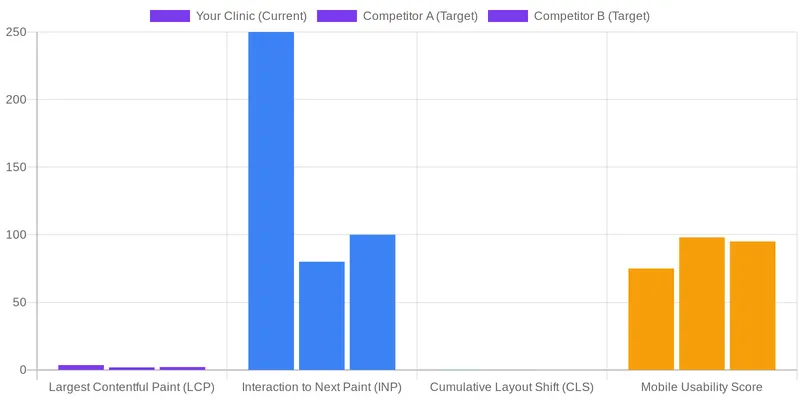
Comparing your clinic’s CWV to a competitor’s reveals performance gaps. Google’s guidance on Core Web Vitals serves as a benchmark for optimization.
Deconstructing SERP Intent: What Google Truly Wants
Analyzing the SERP for target keywords reveals the user intent Google aims to satisfy: informational (e.g., “what is liposuction”), transactional (e.g., “book liposuction consultation London”), or navigational (e.g., “Harley Street Clinic contact”). A high-ranking competitor meets this intent effectively through their content type, format, and depth. A detailed SERP analysis guides content strategy to match user expectations.
Step 4: Backlink & Semantic Markup Comparison
A website’s authority is influenced by its backlink profile. These external endorsements from reputable sites act as votes of confidence. Structured data is also important, providing search engines with explicit information about your content to enhance its visibility and understanding.
Performing a Backlink Gap Analysis
A backlink gap analysis identifies high-quality backlinks your competitors have that your clinic lacks. This involves analyzing their referring domains, anchor text distribution, and link velocity. High-quality backlinks from authoritative, relevant websites signal trust to Google. For medical clinics, links from medical associations, health publications, or local news outlets carry significant weight. Identifying these gaps provides a roadmap for targeted link-building to elevate your domain’s authority.
Schema Markup: The Language Google Understands
Schema markup (structured data) is code added to a website to help search engines better understand its content. For medical clinics, schema types like `MedicalBusiness`, `Physician`, and `MedicalProcedure` JSON-LD are crucial. This markup tells Google about your services, doctors, and location, enabling rich results in SERPs (e.g., star ratings, FAQs, contact information). A schema markup comparison reveals how competitors use this to enhance visibility and provide clearer signals to search engines.
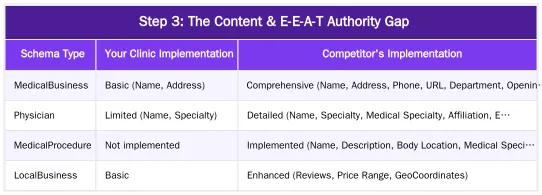
Properly implemented schema improves how your clinic appears in search results, helping patients find relevant information.
Step 5: Local SEO & Entity-Attribute-Value Modeling
For London-based clinics, especially in competitive areas like Harley Street, local SEO is a primary driver of patient acquisition. Advanced semantic engineering offers an advantage by optimizing how search engines perceive and connect your clinic’s entities.
Dominating Local Search: Google Maps & Citations
Optimizing your Google Business Profile (GBP) is fundamental for local search. This includes accurate business information, high-quality photos, consistent business hours, and active engagement with patient reviews. Local citations, consistent Name, Address, Phone (NAP) information, and geo-targeted content are also crucial. Competitors often leverage more positive reviews, local backlinks, and precise GBP categorization to secure top positions in the local pack and Google Maps. For clinics targeting premium London postcodes, a hyper-local strategy is essential.
Leveraging Semantic Engineering & Ruxi Data for Advantage
Abdurrahman Şimşek’s approach uses Entity-Attribute-Value (EAV) modeling and the Ruxi Data semantic engine. This method maps relevant entities (e.g., medical procedures, conditions, doctors, locations) and their attributes (e.g., benefits, risks, qualifications, testimonials). By structuring content around these interconnected entities, Ruxi Data automates the creation of high-authority Semantic Content Networks (SCN).
This semantic engineering reduces Google’s Cost of Retrieval (CoR) for complex medical topics. When search engines understand the relationships between entities on your site, they process information more efficiently, improving rankings and topical authority. This approach is a differentiator for medical SEO, helping clinics establish an online presence that attracts patients.
Transform Your Rankings: The Next Steps for Your Clinic
This 5-step audit provides a framework to identify competitor strengths and areas for improvement, from technical foundations and content authority to backlink profiles and semantic markup. Each element plays a role in search visibility.
From Diagnosis to Dominance: Your Strategic Partner
Implementing these insights requires specialized expertise. A semantic SEO audit provides an actionable roadmap for growth. Partnering with a specialist in the London private healthcare market and semantic engineering helps clinics move from identifying ranking gaps to establishing online dominance in organic search.
To uncover why competitors are outranking you and develop a strategy for market leadership, Book a Semantic SEO Audit to transform your clinic’s online presence.
Frequently Asked Questions
Why is a competing clinic ranking higher even with an older-looking website?
Often, a competing clinic ranking higher has superior ‘off-page’ authority, a more coherent internal linking structure, or better structured data that Google understands more easily. Our diagnostic audit looks beyond aesthetics to analyze over 200 technical and semantic signals to identify the precise reasons for their superior visibility.
What is the initial step in diagnosing why a competing clinic ranking higher?
The first step is a ‘Cost of Retrieval’ (CoR) analysis, combined with understanding SERP intent. We assess how much effort Google expends to crawl, render, and understand your site versus a competitor’s, identifying technical advantages that explain why a competing clinic ranking higher. A lower CoR, achieved through clean code and semantic structure, is a significant competitive advantage.
How do you evaluate E-E-A-T signals when a competing clinic ranking higher?
We systematically evaluate their on-page and off-page signals, including expert authorship, backlink quality, content depth, and medical directory reviews. This helps us understand the authority gap that explains why a competing clinic ranking higher, even if their website appears less modern. Proper medical-specific schema markup is also crucial for healthcare domains.
Can your audit pinpoint specific content gaps that explain why a competitor ranks higher?
Yes, absolutely. Using advanced data tools, we map your competitor’s entire topical authority against yours. This reveals specific subtopics, patient questions, and entities they cover that you don’t, providing a clear roadmap for content development to close the gap and improve your rankings.
Is a single diagnostic audit sufficient to surpass a competitor’s rankings?
An audit provides the strategic blueprint and identifies the precise reasons for a competitor’s higher ranking. Outranking them requires consistent execution of the audit’s recommendations, including technical fixes, content creation, and authority building. The audit is the critical first step to stop guessing and start implementing a data-driven strategy.
How can I start a diagnostic SEO audit for my London private healthcare clinic?
To begin, simply contact us through our website or schedule a consultation. We specialize in YMYL & E-E-A-T optimization for surgeons and aesthetic clinics in Harley Street and Central London, providing a tailored strategy to improve your search performance. Our team will guide you through the process and explain how we can help your clinic achieve topical authority.
Ruxi Data brings together multi-model AI, automated website crawling, live indexation checks, topical authority mapping, E-E-A-T enrichment, schema generation, and full pipeline automation — from crawl to WordPress publish to social posting — all in one platform built for agencies and freelancers who run on results.