
Attract Rhinoplasty Patients: Semantic Strategy for High-value Leads
To attract rhinoplasty patients, a semantic content strategy is essential for plastic surgeons. This approach transcends basic keywords by deeply understanding patient search intent, building topical authority, and enhancing E-E-A-T. It focuses on comprehensively addressing patient concerns regarding procedures, recovery, and surgeon qualifications. By becoming a definitive information resource, clinics effectively acquire high-value patients who are further along in their decision-making process and more likely to convert. This strategy ensures content resonates deeply, helping to attract rhinoplasty patients seeking trusted information.
Abdurrahman Şimşek, a Semantic SEO Strategist, specializes in developing advanced content strategies. His expertise helps medical practices establish digital authority and connect with qualified patient leads through comprehensive topic coverage.
To explore your options, contact us to schedule your consultation.
To attract rhinoplasty patients, plastic surgeons need a semantic content strategy beyond basic search engine optimization. This strategy focuses on understanding the needs and concerns of high-value patients to address their search intent. Semantic SEO builds topical authority, enhances E-E-A-T (Experience, Expertise, Authoritativeness, Trustworthiness), and draws qualified candidates to your practice.
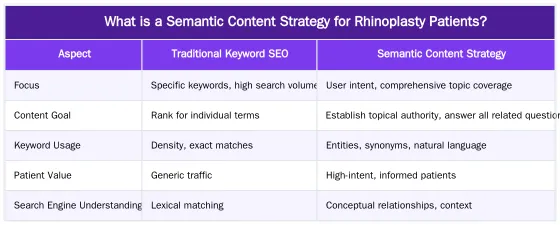
What is a Semantic Content Strategy for Rhinoplasty Patients?
A semantic content strategy for rhinoplasty patients creates content that comprehensively covers a topic, anticipating user questions and related concepts, instead of targeting individual keywords. It focuses on the meaning and context behind patient queries, helping search engines recognize your site as a definitive resource. This helps clinics connect with people seeking trustworthy information, attracting high-value patients who are further in their decision-making process and more likely to convert.
High-value patients have conducted extensive research, understand the procedure’s complexities, and seek a qualified surgeon. They are attracted to content demonstrating expertise, offering transparent information, and addressing concerns about results, recovery, and safety. This includes detailed procedural guides, surgeon philosophies, and answers to common and uncommon questions.
Beyond Keywords: Understanding Patient Search Intent
Semantic SEO moves beyond keyword matching to decipher the intent behind a patient’s search query. For instance, a patient searching for “nose job cost” might also be interested in “rhinoplasty financing options,” “recovery time,” or “surgeon qualifications.” A semantic approach ensures your content addresses this cluster of related intents. This coverage signals to search engines that your site is an authoritative source, leading to higher rankings for related queries, including long-tail keywords.
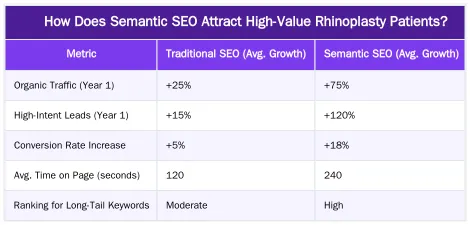
How Does Semantic SEO Attract High-Value Rhinoplasty Patients?
Semantic SEO uses topical authority and entity recognition to help clinics rank for complex queries, helping to attract rhinoplasty patients with higher intent. By building an interconnected content network around the “rhinoplasty” entity, your website demonstrates understanding of the subject. Search engines prioritize sites with comprehensive, structured information, reducing their “Cost of Retrieval” (CoR). This efficiency improves visibility and organic rankings.
When a clinic provides detailed, accurate information on all aspects of nasal surgery—from techniques to recovery protocols and outcomes—it establishes itself as an expert. Search algorithms recognize this expertise and favor the site for related searches. The result is traffic from individuals seeking specific surgical solutions, leading to better patient acquisition rates.
Mapping the Patient Journey with Topical Authority
Topic clusters around rhinoplasty-related entities guide patients through their decision-making process. This involves creating a central “pillar page” on rhinoplasty, supported by “cluster content” articles addressing sub-topics like “septorhinoplasty benefits,” “ethnic rhinoplasty considerations,” or “revisional rhinoplasty risks.” This structure ensures every stage of a patient’s research is met with relevant, authoritative content. This content architecture solidifies your clinic’s position as an authority in cosmetic nasal surgery.
Building E-E-A-T: The Foundation for Trust in Cosmetic Surgery SEO
E-E-A-T (Experience, Expertise, Authoritativeness, Trustworthiness) is critical for YMYL (Your Money Your Life) medical content like cosmetic surgery marketing. Search engines evaluate the E-E-A-T of medical websites to ensure users receive accurate, safe, and reliable information. For plastic surgeons, demonstrating E-E-A-T involves showcasing surgical experience, specialized rhinoplasty knowledge, medical community recognition, and a commitment to patient safety and ethics. Abdurrahman Şimşek, a London-based Semantic SEO Strategist, builds high-authority Semantic Content Networks for medical clinics, using Ruxi Data to establish E-E-A-T signals for plastic surgeons.
Strong E-E-A-T signals build patient trust, not just rankings. This trust is critical for procedures like rhinoplasty, where patients are making significant health and aesthetic decisions. Transparent communication about qualifications, procedure details, and patient care protocols reinforces a clinic’s credibility. Learn more about automating E-E-A-T content for YMYL topics by visiting E-E-A-T content automation for YMYL.
Showcasing Surgeon Expertise and Patient Testimonials
Demonstrating a surgeon’s qualifications, experience, and patient satisfaction requires multiple strategies. This includes detailed surgeon bios highlighting board certifications, fellowships, years of practice, and specific expertise in rhinoplasty. Publishing peer-reviewed articles, speaking at medical conferences, and maintaining memberships in professional organizations like the British Association of Aesthetic Plastic Surgeons (BAAPS) solidify authority. Patient testimonials, particularly video and detailed written reviews, provide social proof and build confidence. Transparent communication about risks, realistic outcomes, and aftercare protocols is vital for establishing trustworthiness. The British Association of Aesthetic Plastic Surgeons offers guidelines on ethical patient communication.
Optimizing Rhinoplasty Service Pages for Conversion & CoR
High-converting rhinoplasty service pages require specific content and technical elements. Detailed procedure information, including surgical techniques, anesthesia options, and recovery timelines, is essential. Before-and-after galleries showing diverse patient results build confidence and manage expectations. An FAQ section addresses common concerns, reducing direct inquiries and streamlining the patient journey. Clear calls to action (CTAs), such as “Book a Consultation” or “Request a Virtual Assessment,” should be strategically placed.
Optimized pages also reduce the “Cost of Retrieval” (CoR) for search engines. CoR refers to the computational resources search engines expend to find, process, and rank information. A structured, semantically rich page with clear entities and relationships helps search engines understand and serve content, improving visibility and reducing their operational cost. This efficiency is rewarded with higher rankings and better patient acquisition.
Leveraging Medical Schema for Enhanced Visibility
Implementing JSON-LD schema markup (`MedicalBusiness`, `Physician`, and `MedicalProcedure`) helps search engines understand and display information about your rhinoplasty services. This structured data can lead to rich snippets in search results, showing details like procedure duration, recovery time, and surgeon credentials on the SERP. This visibility can improve click-through rates and patient engagement. For more on structured data, explore medical schema for surgeons.
Implementing Your Semantic Content Network for London Clinics
London plastic surgeons, especially in Harley Street, can use a semantic content network to improve local organic search rankings. This involves creating pillar pages for core services like “Rhinoplasty in London,” linked to a cluster of supporting articles. These cluster articles might cover topics such as “Rhinoplasty Recovery Timeline,” “Choosing a Harley Street Rhinoplasty Surgeon,” or “Non-Surgical Rhinoplasty Options.”
Strategic internal linking funnels authority from supporting articles to pillar pages, strengthening their relevance and ranking potential. This architecture enhances search engine understanding and provides an informative journey for patients. A local SEO component, including an optimized Google Business Profile and location-specific content, is crucial for attracting patients in the London private healthcare market.
Strategic Internal Linking for Topical Authority
Effective internal linking is vital for strengthening topical authority and directing relevance to core service pages. Each supporting article should link back to its relevant pillar page using descriptive anchor text. For example, an article on “Rhinoplasty Techniques” might link to your main “London Rhinoplasty Services” page with the anchor text “explore advanced rhinoplasty procedures.” This linking strategy helps search engines understand the content’s hierarchical relationship, consolidating your expertise around key surgical procedures. For guidance on building a semantic content architecture, consider specialized semantic SEO for plastic surgeons.
Partner with an Expert: Elevate Your Rhinoplasty Patient Acquisition
A semantic SEO strategy is essential for plastic surgeons to attract high-value patients and establish market leadership. Abdurrahman Şimşek, a London-based Semantic SEO Strategist with 10 years of experience, builds high-authority Semantic Content Networks for medical clinics. Partnering with an expert who understands the London private healthcare market and semantic engineering can improve your clinic’s online visibility and patient acquisition. Book a Semantic SEO Audit to improve your online strategy.
Contact Abdurrahman Şimşek for a personalized strategy. Visit AbdurrahmanSimsek.com to learn more or reach out directly via WhatsApp at +90 506 206 86 86.
Frequently Asked Questions
What kind of content best helps attract rhinoplasty patients?
High-value individuals seeking rhinoplasty are drawn to expert, in-depth content that addresses their specific concerns. This includes comprehensive guides on the procedure, detailed FAQ sections, and case studies. Such content helps to attract rhinoplasty patients who are well-informed and serious about their decision.
How does a semantic strategy specifically help to attract rhinoplasty patients?
A semantic strategy comprehensively covers the entire ‘rhinoplasty’ topic, anticipating user questions and related concepts. By creating a network of content around entities like ‘ethnic rhinoplasty’ or ‘revision surgery’, you signal definitive authority to search engines. This comprehensive approach is crucial to attract rhinoplasty patients who are highly qualified and ready for consultation.
What is the role of E-E-A-T in helping to attract rhinoplasty patients?
<
Ruxi Data brings together multi-model AI, automated website crawling, live indexation checks, topical authority mapping, E-E-A-T enrichment, schema generation, and full pipeline automation — from crawl to WordPress publish to social posting — all in one platform built for agencies and freelancers who run on results.