
Core Web Vitals Medical: Enhancing Patient Trust and SEO
Optimizing core web vitals medical websites is crucial for patient trust and search engine visibility in 2026. This guide details practical strategies to enhance Largest Contentful Paint (LCP), First Input Delay (FID), and Cumulative Layout Shift (CLS), directly impacting user experience and E-E-A-T signals. Readers will learn how to diagnose performance issues, implement technical SEO improvements like image optimization and mobile-first design, and ensure their medical site provides a fast, stable, and responsive experience. Mastering these core web vitals medical metrics reinforces professionalism and reliability for healthcare providers.
Abdurrahman Şimşek, a Semantic SEO Strategist, provides expert guidance on technical SEO for healthcare websites. This content delivers actionable insights for improving website performance and patient engagement. The strategies presented aim to align medical site speed with critical E-E-A-T standards.
To explore your options, contact us to schedule your consultation. You can also reach us via: Book a Semantic SEO Audit, Direct WhatsApp Strategy Line: +90 506 206 86 86
This 2026 optimization guide explores core web vitals medical websites must master to ensure patient trust, search engine visibility, and overall clinic success. These crucial metrics directly influence how prospective patients perceive a healthcare provider’s professionalism and reliability. We will detail practical strategies to enhance your site’s performance and user experience, ensuring your online presence effectively serves your patients and business objectives.
Understanding Core Web Vitals for Healthcare Sites
Core Web Vitals are a set of specific metrics that measure real-world user experience for loading performance, interactivity, and visual stability of a webpage. For medical websites, these metrics are paramount because they directly influence patient perception, trust, and a site’s E-E-A-T (Experience, Expertise, Authoritativeness, and Trustworthiness) signals. A fast, stable, and responsive website reassures potential patients of a clinic’s professionalism and reliability, which is critical in the sensitive You Money Or Your Life (YMYL) healthcare sector.
What Are Core Web Vitals and Why Do They Matter for Patient Trust?
The three primary Core Web Vitals are Largest Contentful Paint (LCP), First Input Delay (FID), and Cumulative Layout Shift (CLS). LCP measures loading performance, specifically the time it takes for the largest content element on the screen to become visible. FID quantifies interactivity, reflecting the time from when a user first interacts with a page (e.g., clicking a button) to when the browser responds. CLS assesses visual stability, measuring unexpected layout shifts of visual page content. Each metric directly impacts a prospective patient’s first impression. A slow-loading site or one with shifting elements can create frustration and erode confidence in a medical practice, suggesting a lack of attention to detail or outdated infrastructure.
The Unique Impact of Page Speed on Medical E-E-A-T
Slow loading times on a medical website can significantly diminish E-E-A-T signals. Patients seeking healthcare information or services require immediate access to critical details such as surgeon qualifications, contact information, and emergency procedures. Delays in accessing this information can be perceived as a lack of expertise or authority. A high-performing website, conversely, reinforces the clinic’s credibility and trustworthiness. It signals that the practice values patient experience and maintains a modern, efficient operation, aligning with the high standards expected in healthcare.
Diagnosing & Optimizing LCP, FID, and CLS for Medical Content
Optimizing Core Web Vitals for medical websites requires addressing specific challenges, particularly with high-resolution imagery, video testimonials, and third-party scripts. Implementing targeted strategies for LCP, FID, and CLS can significantly enhance user experience and search engine performance.
Accelerating Largest Contentful Paint (LCP) for Critical Patient Information
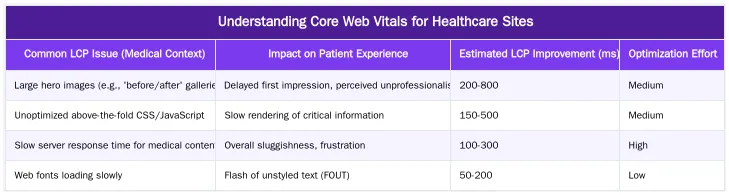
LCP is often impacted by large hero images, especially before-and-after galleries, and unoptimized above-the-fold content. To improve LCP, prioritize image compression using modern formats like WebP, implement lazy loading for images below the fold, and preload critical resources such as essential CSS and fonts. Ensuring these elements load quickly provides patients with immediate access to vital visual and textual information.
Minimizing Cumulative Layout Shift (CLS) on Dynamic Medical Pages
CLS issues frequently arise from embedded videos (e.g., patient testimonials), dynamic content like appointment booking widgets, and asynchronous font loading. To reduce CLS, always reserve space for dynamically injected content using CSS aspect ratio boxes or explicit width/height attributes. Preload fonts with font-display: swap to prevent invisible text during loading. A clean semantic HTML structure also contributes to layout stability by providing clear boundaries and predictable rendering for all page elements.
Beyond the Metrics: Enhancing User Experience for Medical Patients
Core Web Vitals are not merely technical scores; they are foundational to a superior overall user experience for medical patients. A fast, smooth, and accessible site journey directly translates into higher conversion rates and improved patient acquisition. Performance directly influences patient decision-making, as a seamless online experience reflects positively on the clinic’s real-world service quality.
Mobile-First Indexing and the Patient Journey: A Seamless Experience
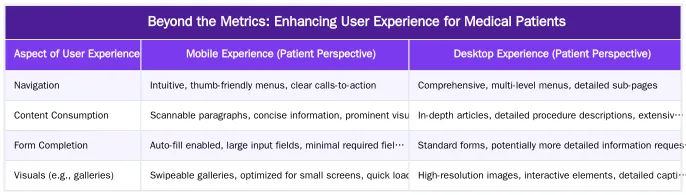
Mobile performance is paramount for medical websites, especially in 2026, given that a significant portion of patients search for clinics and information on their mobile devices. Optimizing for mobile-first indexing ensures that your site is evaluated by Google based on its mobile version, which is often the primary interface for patients. A flawless mobile booking experience and quick access to “near me” search results are crucial for capturing patients on the go. Ensuring a responsive design and optimized touch targets allows patients to easily navigate, read testimonials, and book consultations from any device.
The Role of Performance in Building Trust and Reducing Bounce Rates
A slow or visually unstable website can deter potential patients, leading to high bounce rates and lost opportunities. In the healthcare sector, where trust is paramount, a janky or unresponsive site can inadvertently signal a lack of professionalism or care. Conversely, fast loading times and a smooth interactive experience contribute to a perception of reliability and efficiency. This positive impression can significantly influence a patient’s decision to choose a particular healthcare provider, reinforcing the importance of a robust technical foundation.
Strategic Performance: Abdurrahman Şimşek’s Approach to Medical Site Speed
Abdurrahman Şimşek, a London-based Semantic SEO Strategist with over 10 years of experience, specializes in optimizing medical websites for both performance and semantic understanding. His methodology integrates advanced technical SEO with semantic engineering, creating performant, algorithm-proof sites tailored for the competitive London private healthcare sector. This holistic approach ensures that medical clinics not only rank well but also provide an exceptional user experience that builds patient trust.
Reducing Cost of Retrieval (CoR) Through Semantic Optimization
A core tenet of Abdurrahman Şimşek’s strategy is reducing the “Cost of Retrieval” (CoR) for search engines. This concept refers to the computational resources Google expends to crawl, process, and understand a website’s content. By implementing a well-structured, semantically rich website using Entity-Attribute-Value (EAV) models and leveraging Ruxi Data, clinics can make their content highly intelligible to search algorithms. This semantic clarity reduces the effort search engines need to understand and rank content, indirectly improving crawl budget and overall site performance. A site that is easy for algorithms to process is often faster for users too, as it implies efficient data organization.
Future-Proofing with Advanced Technical SEO for Healthcare
Abdurrahman’s approach to technical SEO for healthcare extends beyond basic speed optimizations. It encompasses a holistic framework that includes clean semantic HTML, efficient server infrastructure, and proactive monitoring. This ensures long-term performance and adaptability to evolving algorithm updates, including those related to Generative Engine Optimization (GEO). Addressing crawl budget issues is particularly important for large medical content hubs, where efficient indexing is critical for visibility. This strategic foundation helps medical practices maintain a competitive edge in the dynamic digital landscape.
Achieving and Maintaining Optimal Core Web Vitals in 2026
Achieving and maintaining optimal Core Web Vitals is an ongoing process that requires consistent monitoring and integration into a broader technical SEO strategy. As web technologies and user expectations evolve, regular audits and proactive improvements are essential to ensure your medical website continues to deliver a superior patient experience and strong search performance.
Essential Tools for Monitoring Your Clinic’s Page Performance
Several tools are indispensable for monitoring your clinic’s page performance. Google PageSpeed Insights provides detailed reports on both lab and field data, offering actionable recommendations for improvement. Lighthouse, integrated into Chrome DevTools, offers a comprehensive audit of performance, accessibility, and best practices. Google Search Console’s Core Web Vitals report highlights specific URLs that need attention based on real-user (CrUX) data. Regularly interpreting these reports allows you to prioritize fixes and track progress effectively. Understanding these metrics is crucial for any WordPress speed optimization efforts.
Integrating CWV Optimization into Your Overall Technical SEO Strategy
Core Web Vitals are not isolated metrics; they are integral components of a comprehensive technical SEO framework. Optimizing these signals should be part of a larger strategy that includes regular technical audits, efficient server management, and a robust content delivery network (CDN). This integrated approach ensures that improvements in page speed and visual stability contribute to overall website performance and search engine ranking. Continuous improvement, driven by data from monitoring tools, is key to staying competitive and providing an excellent user experience for patients.
Elevate Your Clinic’s Online Presence with Expert Technical SEO
Mastering Core Web Vitals and overall technical SEO is crucial for medical clinics aiming to dominate local organic search and attract high-value patients. The complexities of medical content, patient privacy (GDPR/HIPAA), and the competitive London private healthcare market demand specialized expertise. Partnering with a dedicated specialist ensures your website is not only fast and user-friendly but also semantically optimized for long-term success.
Partner with a Specialist in Medical & Plastic Surgery SEO
For clinic directors seeking to elevate their online presence, Abdurrahman Şimşek offers specialized expertise in medical and plastic surgery SEO. His strategic consulting, delivered through a transparent fixed-price model, focuses on building high-performing, patient-centric websites. To discuss tailored strategies for your London-based medical practice and ensure your site meets the highest standards of performance and trust, you can Book a Semantic SEO Audit or reach out directly via WhatsApp Strategy Line: +90 506 206 86 86.
Conclusion
Optimizing Core Web Vitals is a fundamental requirement for medical websites in 2026, directly impacting patient trust, E-E-A-T, and search engine visibility. By focusing on LCP, FID, and CLS, clinics can provide a superior user experience that converts prospective patients into loyal clients. A strategic approach, integrating technical SEO with semantic engineering, ensures long-term performance and adaptability. For London’s private healthcare sector, this means building an online presence that is not only fast and stable but also deeply understood by search engines. To ensure your clinic’s website is performing optimally and attracting the right patients, consider a specialized approach. Book a Semantic SEO Audit today or connect via Direct WhatsApp Strategy Line: +90 506 206 86 86.
Frequently Asked Questions
Why is a low LCP score particularly important for a medical website?
A low Largest Contentful Paint (LCP) score is crucial because it ensures prospective patients can see key information, like your clinic’s phone number or a reassuring image, almost instantly. A slow-loading site can create frustration and erode the trust that is vital in healthcare, directly impacting patient acquisition.
What are the most common causes of poor page experience metrics on clinic websites?
The most common causes include large, unoptimized images of procedures or facilities, and bloated WordPress themes or page builders. These elements significantly delay rendering, increase page load times, and negatively impact all three critical user experience metrics. Addressing these issues is fundamental for a high-performing healthcare site.
How does Abdurrahman Şimşek’s web development service guarantee excellent site performance for medical practices?
We build on a lightweight, semantic HTML foundation and employ advanced optimization techniques, including server-side caching, modern image formats (WebP), and deferred script loading. Our approach targets an LCP of under 2.0 seconds as a standard performance metric, ensuring a superior user experience for your patients. This holistic strategy is key to maintaining optimal site speed.
Does improving website performance metrics directly improve Google ranking for healthcare providers?
Yes, these performance metrics are a confirmed, albeit lightweight, ranking signal. More importantly, they are part of the overall page experience signals that heavily influence user behavior, which indirectly affects rankings and, crucially, patient conversion rates. A fast, stable site builds trust and encourages engagement.
Can you fix core web vitals medical issues on an existing website without a full rebuild?
In many cases, yes. We can perform a detailed performance audit to identify the primary bottlenecks affecting your core web vitals medical site. We then implement targeted optimizations like image compression, script deferral, and server enhancements. However, for sites built on fundamentally slow or outdated platforms, a rebuild is often the most effective long-term solution to achieve optimal patient experience.
How can I get started with optimizing my medical website’s performance with Abdurrahman Şimşek?
You can begin by booking a Semantic SEO Audit with Abdurrahman Şimşek to assess your current site performance and identify specific areas for improvement. Alternatively, you can reach out directly via our WhatsApp Strategy Line for immediate consultation on enhancing your online presence and patient engagement.
Ruxi Data brings together multi-model AI, automated website crawling, live indexation checks, topical authority mapping, E-E-A-T enrichment, schema generation, and full pipeline automation — from crawl to WordPress publish to social posting — all in one platform built for agencies and freelancers who run on results.