
Linking to Surgeon Profiles: Reinforcing Expertise and Trust Signals
Linking to surgeon profiles from medical procedure pages is crucial for enhancing a website’s E-E-A-T signals and search engine visibility. This practice establishes a direct semantic connection between medical content and qualified experts, a fundamental requirement for Your Money or Your Life (YMYL) content. Properly implementing linking to surgeon profiles reinforces entity recognition, strengthens knowledge panel presence, and builds topical relevance, ultimately boosting trust signals for private healthcare providers in competitive markets.
Abdurrahman Şimşek, a Semantic SEO Strategist, specializes in developing high-authority semantic content networks for medical clinics. His expertise ensures robust digital strategies that align with Google’s E-E-A-T guidelines for healthcare content.
To explore your options, contact us to schedule your consultation. You can also reach us via: Book a Semantic SEO Audit, Direct WhatsApp Strategy Line: +90 506 206 86 86
Linking to surgeon profiles from medical procedure pages reinforces your website’s E-E-A-T signals, boosting credibility and search engine rankings. This practice connects medical content to qualified experts, a requirement for Your Money or Your Life (YMYL) content. This semantic relationship is important for private healthcare providers seeking online visibility in competitive markets like London.
Why Linking to Surgeon Profiles is Essential for Medical E-E-A-T
Connecting medical content to expert authors addresses Google’s Quality Rater Guidelines for YMYL (Your Money or Your Life) content, where E-E-A-T (Experience, Expertise, Authoritativeness, Trustworthiness) is a critical ranking factor. Linking from procedure pages to surgeon profiles signals that the information is backed by verifiable medical professionals, enhancing trustworthiness and authority.
For medical websites, particularly in competitive fields like plastic surgery in London, demonstrating E-E-A-T is non-negotiable. Search engines prioritize credible sources for reliable health information. Attributing content to qualified surgeons through internal links directly conveys this expertise. This helps search algorithms understand the knowledge supporting your content, improving visibility and rankings.
The Direct Link Between Expertise and Trust Signals
Search engines evaluate medical content credibility by assessing author qualifications and reputation. When a procedure page, like one for rhinoplasty, links to the performing surgeon’s profile, it creates a clear chain of expertise. This connection is a strong trust signal, showing users and search engines the information comes from a qualified, experienced medical professional. This transparency builds confidence, which is vital for patient acquisition in private healthcare.
These connections help Google understand the “Experience” aspect of E-E-A-T. A surgeon’s profile, detailing years of practice and procedural history, directly supports the procedure page content. This reinforces that the content is expert-written, expert-performed, and informed by clinical experience. For more on establishing E-E-A-T, explore E-E-A-T for YMYL in 2026.
How Internal Links Reinforce Surgeon Entity Recognition & Knowledge Panels
Beyond E-E-A-T signals, internal linking helps search engines recognize surgeons as distinct entities within the medical knowledge graph. This process, entity reconciliation, is crucial for developing an online presence and can lead to a richer Knowledge Panel for surgeons and their clinics.
In competitive markets like London’s private healthcare sector, differentiating your experts is key. Clear, semantically rich connections between procedure pages and surgeon profiles provide Google with explicit data points. This aids the algorithm in disambiguating entities, ensuring the correct surgeon is associated with specific procedures, qualifications, and locations.
Connecting Content to the ‘Who’: Entity Reconciliation in Medical SEO
Google’s algorithms understand the world as a network of interconnected entities. In medical SEO, a surgeon is an entity with attributes: name, qualifications, specializations, affiliations, and procedures performed. When a procedure page links to a surgeon’s profile, it helps Google reconcile these attributes, building a digital identity for that surgeon. This is a core principle of semantic internal linking strategy.
This process establishes semantic relationships, not just keyword matching. For instance, if a “breast augmentation” page links to “Dr. Jane Smith’s profile,” and her profile lists that as a specialization, Google strengthens its understanding of her expertise in that area. This connection is vital for accurate entity recognition, especially with multiple surgeons in one clinic.
Strengthening Your Clinic’s Knowledge Graph Presence
A well-defined surgeon entity, reinforced by internal links, contributes to the clinic’s authority and visibility in Google’s Knowledge Graph. When surgeons are recognized as experts, this positive attribution extends to their associated clinic. This can lead to better local search visibility, richer snippets, and a more comprehensive clinic Knowledge Panel.
For private clinics in premium London postcodes, a strong Knowledge Graph presence is a valuable asset, providing credibility and information to patients on the search results page. By linking and defining each surgeon’s expertise, clinics elevate their digital footprint, signaling a network of qualified professionals to search engines and patients.
Best Practices for Implementing Surgeon Profile Links on Procedure Pages
Effective implementation requires strategic anchor text, placement, and structured data. These elements maximize SEO impact and enhance user experience. The goal is to create clear, contextual connections for search engines and patients.
After reading about a procedure, a patient often seeks information about the surgeon. A direct, well-labeled link fulfills this intent, reducing friction and building trust. This is important for high-value procedures at clinics in areas like Harley Street, where patient expectations are high.
Strategic Anchor Text and Placement for Maximum Impact
Anchor text should be descriptive and natural, indicating the link’s destination. Avoid generic phrases like “click here.” Use variations such as “Learn more about Dr. [Surgeon’s Name],” “Procedure performed by our lead surgeon, Dr. [Surgeon’s Name],” or “Meet the expert behind [Procedure Name], Dr. [Surgeon’s Name].” This provides context to users and search engines.
Optimal placement is in the introduction, conclusion, or a dedicated “Meet Your Surgeon” section. For instance, “This advanced technique is often performed by Dr. Jane Doe, our specialist in facial aesthetics” integrates the link naturally. Consistent placement across procedure pages reinforces the semantic connection.
Integrating Physician Schema for Enhanced Authoritativeness
Structured data, specifically Physician schema, is vital for semantically enhancing internal links. Marking up surgeon profiles with `Physician` schema provides explicit, machine-readable details about qualifications, specialties, and affiliations. This solidifies the connection between the surgeon entity and their expertise, making it easier for search engines to process.
When internal links point to a page with Physician schema, the link’s semantic weight increases. It becomes a link to a clearly defined expert entity. Other schema types, like `MedicalProcedure` and `MedicalClinic`, further strengthen this network. This approach to schema and internal linking creates a semantic framework crucial for medical SEO.
Optimizing Surgeon Profiles: What Information Builds the Strongest E-E-A-T?
A surgeon’s profile page is a cornerstone of E-E-A-T strategy, demonstrating expertise, experience, and trustworthiness. Optimizing these pages means presenting comprehensive, verifiable information that confirms the surgeon’s credibility to patients and search engines.
Every element on a surgeon’s bio page should build authority. Each piece of information, from credentials to testimonials, builds a complete picture of a qualified professional. This detail is important for private practices in London, where patients seek top-tier expertise.
Key Elements of a High-Authority Surgeon Bio Page
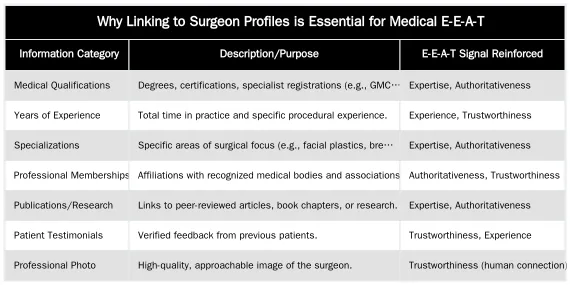
A high-authority surgeon bio page should feature medical qualifications (degrees, certifications, GMC registration), years of experience in specific procedures (addressing the “Experience” in E-E-A-T), detailed specializations, professional memberships (e.g., British Association of Plastic, Reconstructive and Aesthetic Surgeons), and academic or teaching roles to demonstrate expertise.
Publications in peer-reviewed journals or conference presentations show thought leadership. Ethically collected patient testimonials build trust. A professional photograph humanizes the profile. Verifiable information, with links to official registries or publications, strengthens the E-E-A-T signal.
Table: Essential Information for a High-E-E-A-T Surgeon Profile
Measuring the Impact: How Linking to Profiles Boosts Your Medical SEO
An internal linking strategy connecting procedure pages with surgeon profiles yields measurable medical SEO outcomes. This approach builds a semantic content network, contributing to a clinic’s topical authority and search visibility. Abdurrahman Şimşek, a London-based Semantic SEO Strategist, emphasizes that data-driven strategies are crucial for organic growth in healthcare.
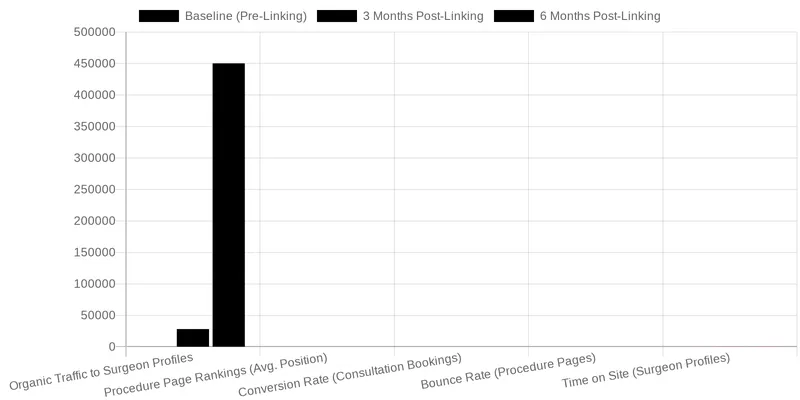
Structuring these internal connections improves key performance indicators, including higher rankings for procedure keywords, increased organic traffic to procedure and surgeon pages, and better engagement metrics. Strategic internal links distribute link equity, signaling the most important content and entities to search engines.
Improved Topical Authority and Search Visibility
Connecting medical procedures to the experts who perform them contributes to the clinic’s topical authority. When Google sees content on “rhinoplasty” linked to a qualified “rhinoplasty surgeon” on your site, it reinforces your clinic’s authority on that topic. This leads to better rankings for relevant queries, especially those with high commercial intent.
This semantic clustering helps search engines understand your clinic’s expertise. Your website becomes a more authoritative source, increasing organic search visibility across related keywords. This is a foundational aspect of an algorithm-proof content strategy, as discussed in E-E-A-T for YMYL in 2026.
Enhanced User Experience and Patient Trust Signals
Beyond SEO benefits, easy access to surgeon credentials improves patient confidence and engagement. When a patient can navigate from a procedure description to the surgeon’s profile, it fosters transparency and trust. This user experience can lead to lower bounce rates, increased time on site, and higher conversion rates.
Patients seeking medical treatments, particularly elective procedures, prioritize trust. Providing clear pathways to verify a surgeon’s qualifications addresses these concerns. This user-centric approach aligns with search engine goals, as Google rewards websites that offer a trustworthy experience. The synergy between technical SEO and user experience is critical for medical digital marketing.
Future-Proof Your Medical Website with Semantic Internal Linking
Linking to surgeon profiles is a component of a semantic content network, essential for long-term SEO success. This practice reinforces E-E-A-T, aids entity recognition, and contributes to a stronger Knowledge Panel and topical authority. For London’s private healthcare clinics, this type of internal linking is a key differentiator.
Adopting these semantic engineering principles makes your website more resilient to algorithm updates and better positioned to capture patient inquiries. To assess your internal linking structure and develop a strategy, Book a Semantic SEO Audit. For direct strategic advice, contact Abdurrahman Şimşek via Direct WhatsApp Strategy Line: +90 506 206 86 86. A semantic approach can secure your clinic’s future online visibility.
Frequently Asked Questions
What is the primary SEO benefit of linking to surgeon profiles from medical procedure pages?
The primary benefit of linking to surgeon profiles is to create a strong, explicit connection between medical content and the expert who authored or performs it. This practice sends powerful E-E-A-T signals to search engines, helping Google attribute expertise and trust to your valuable procedure pages. This is crucial for establishing authority in the highly competitive medical niche.
How does the practice of linking to surgeon profiles enhance E-E-A-T for YMYL content?
For Your Money or Your Life (YMYL) queries, Google’s algorithms place immense weight on demonstrated expertise, experience, authoritativeness, and trustworthiness. Consistently linking to surgeon profiles that detail credentials, experience, and publications shows that your high-stakes medical information is backed by a qualified professional, thereby significantly boosting your E-E-A-T signals.
What are the best practices for anchor text when linking to surgeon profiles?
When implementing linking to surgeon profiles, it’s crucial to use clear and authoritative anchor text that explicitly names the expert. Examples include “Performed by Dr. Jane Smith,” “About the Surgeon: Dr. Jane Smith,” or simply the surgeon’s full name. This approach reinforces the entity relationship for search engines and improves user experience.
Should surgeon profile pages also include links back to the procedures they perform?
Absolutely, creating a reciprocal linking structure is highly beneficial for semantic SEO. A well-optimized surgeon profile should feature a dedicated section listing their specializations and linking back to relevant procedure pages. This bidirectional linking establishes a robust semantic network, strengthening the authority of both the surgeon’s profile and the procedure content.
Beyond direct links, what other elements on a procedure page reinforce a surgeon’s expertise?
To further reinforce expertise, procedure pages should include a clear author byline near the top, often with a small photo and a direct link to the full surgeon profile. Additionally, incorporating a “Medically Reviewed By” line, potentially with another expert’s credentials, adds an extra layer of authority and trust to the content.
How can I learn more about implementing semantic SEO strategies for my medical practice?
To explore how semantic SEO, including effective internal linking strategies, can benefit your medical clinic, you can book a Semantic SEO Audit with Abdurrahman Şimşek. Alternatively, for direct strategic advice, you can reach out via WhatsApp at +90 506 206 86 86.
Ruxi Data brings together multi-model AI, automated website crawling, live indexation checks, topical authority mapping, E-E-A-T enrichment, schema generation, and full pipeline automation — from crawl to WordPress publish to social posting — all in one platform built for agencies and freelancers who run on results.