Ruxi Data Medical SEO: Automating EAV & Topical Authority for YMYL
Ruxi data medical seo revolutionizes medical content strategy by automating Entity-Attribute-Value (EAV) structures and comprehensive topical maps. This semantic SEO infrastructure ensures medical content achieves deep expertise, authoritativeness, and trustworthiness (E-E-A-T), crucial for Your Money Your Life (YMYL) categories. By leveraging LLM-driven content networks, Ruxi Data reduces search engine Cost of Retrieval, streamlining content architecture for superior visibility. It transforms how plastic surgeons and aesthetic clinics build unassailable topical authority, moving beyond simple AI writing to engineer robust content networks that Google understands and ranks effectively.
Abdurrahman Şimşek, a Semantic SEO Strategist, applies Ruxi Data to engineer advanced content architectures. This approach focuses on semantic engineering, ensuring medical content is precisely configured for search engine understanding and optimal topical authority. The methodology aims to deliver measurable improvements in organic visibility and patient engagement.
To explore your options, contact us to schedule your consultation. You can also reach us via: Book a Semantic SEO Audit, Direct WhatsApp Strategy Line: +90 506 206 86 86
Discover how ruxi data medical seo is revolutionizing the way plastic surgeons and aesthetic clinics build unassailable topical authority and reduce search engine Cost of Retrieval. This article delves into how this advanced semantic infrastructure automates Entity-Attribute-Value (EAV) structures and topical maps, ensuring medical content not only ranks but establishes deep expertise, authoritativeness, and trustworthiness (E-E-A-T). By streamlining content architecture, Ruxi Data enables medical practices to achieve superior visibility and patient engagement in competitive digital landscapes.
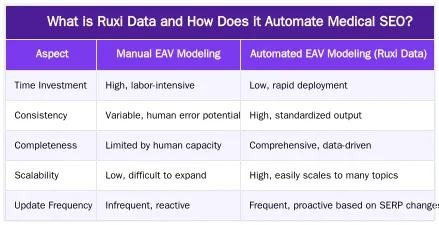
What is Ruxi Data and How Does it Automate Medical SEO?
Ruxi Data functions as a sophisticated semantic SEO infrastructure designed to build robust content architecture for medical websites. Its core purpose is to automate the creation of Entity-Attribute-Value (EAV) structures and comprehensive topical maps. This automation is crucial for medical content, as it ensures precision, depth, and alignment with search engine understanding, ultimately enhancing a site’s authority and significantly reducing the search engine’s Cost of Retrieval (CoR).
This advanced system analyzes vast amounts of search data to identify the semantic relationships between medical entities, procedures, and patient queries. By structuring content around these relationships, Ruxi Data helps medical practices establish deep expertise and trustworthiness, which are paramount for ranking in Your Money Your Life (YMYL) categories. The result is a highly optimized content network that Google can easily crawl, understand, and rank.
Beyond AI Writing: Ruxi Data as Semantic Infrastructure
A common misconception is that Ruxi Data is merely an AI content generator. Instead, it operates as a comprehensive semantic SEO infrastructure. It leverages multiple Large Language Models (LLMs) not for prose generation, but for deep analysis and modeling of Search Engine Results Pages (SERPs) and complex query networks. This process creates the underlying architectural framework for content, defining entities, attributes, and their relationships. Its primary function is to engineer the structure for topical authority, ensuring every piece of content contributes to a cohesive, semantically rich network, rather than simply producing text.
Automating EAV Structures for Precision Medical Content
Entity-Attribute-Value (EAV) modeling is a data structure approach that defines specific entities, their characteristics (attributes), and the corresponding data points (values). In medical SEO, this means precisely modeling complex medical procedures and conditions. For example, an entity like ‘Rhinoplasty’ can have attributes such as ‘recovery time’, ‘anesthesia type’, ‘cost range’, ‘potential risks’, and ‘ideal candidate’. Ruxi Data automates the identification and structuring of these entities and their attributes, creating highly granular and semantically rich content.
This automated EAV modeling ensures that every relevant detail about a medical topic is systematically covered and interconnected. This level of detail and structured data is critical for search engines to accurately understand and categorize medical information, especially for YMYL topics where accuracy and comprehensiveness are paramount. It moves beyond simple keyword matching to a deeper, entity-based understanding of content.
From Manual Mapping to Algorithmic EAV Modeling
Manually creating EAV structures for complex medical topics is time-consuming and prone to inconsistencies. Medical content configuration requires meticulous attention to detail across numerous procedures and related concepts. Ruxi Data’s automation overcomes these challenges by algorithmically identifying and mapping entities and their attributes from vast datasets. This ensures comprehensive and consistent data modeling across an entire website, feeding precise information into Google’s Knowledge Graph. This systematic approach is fundamental for semantic SEO for surgeons, building algorithm-proof topical authority with automation.
Consider the difference:
How Ruxi Data Builds LLM-Driven Topical Maps for YMYL
Ruxi Data employs advanced LLMs to analyze Search Engine Results Pages (SERPs) and query networks, constructing comprehensive topical maps tailored for medical niches. This process involves understanding the nuances of user intent, identifying related entities, and mapping out the semantic relationships that define a topic’s complete landscape. For YMYL (Your Money Your Life) medical content, this is critical. Ruxi Data ensures that the generated topical maps address all facets of E-E-A-T (Experience, Expertise, Authoritativeness, Trustworthiness) by identifying authoritative sources, common patient questions, and essential medical facts.
The system goes beyond surface-level keyword analysis. It models the entire semantic field around a medical procedure or condition, ensuring that every piece of content contributes to a holistic understanding. This AI content at scale approach for LLM-driven content networks is vital for YMYL automation, as it systematically covers all necessary subtopics and related queries, leaving no informational gaps that could undermine a site’s perceived authority.
Reducing Cost of Retrieval (CoR) with Semantic Content Networks
A well-structured, Ruxi Data-generated topical map and semantic content network inherently reduces Google’s ‘Cost of Retrieval’ (CoR). CoR refers to the resources (time, processing power) Google expends to crawl, understand, and index content. When content is organized semantically, with clear entity relationships and comprehensive topical coverage, search engines can process it more efficiently. This translates to improved crawl budget utilization, faster indexation, and enhanced ranking potential for medical websites.
For medical clinics, where content can be extensive and highly specialized, optimizing CoR is a significant technical advantage. It means Google spends less effort to understand the site’s expertise, leading to more frequent crawling of new and updated content. This efficiency directly supports higher visibility and better organic performance, ensuring that valuable medical information reaches patients effectively. A lower CoR signals to search engines that a site is well-organized and easy to process, which can positively influence rankings.
The Abdurrahman Şimşek Advantage: Semantic Engineering with Ruxi Data
Abdurrahman Şimşek, a London-based Semantic SEO Strategist and Semantic Engineer, leverages Ruxi Data as a core component of his methodology. His ‘Semantic Engineering’ approach integrates this advanced infrastructure to build high-authority content networks specifically for London’s private healthcare sector. This strategic vision focuses on creating a digital presence that not only ranks but also establishes deep E-E-A-T signals for plastic surgeons and aesthetic clinics.
By combining his decade of experience in search engineering with Ruxi Data’s automation capabilities, Abdurrahman Şimşek designs content architectures that are robust, comprehensive, and algorithmically optimized. This ensures that medical practices can dominate local organic search across competitive areas like Harley Street and premium London postcodes. The integration of Ruxi Data into his framework allows for the precise modeling of complex medical information, a critical factor for success in the YMYL space.
Future-Proofing Medical SEO with Algorithmic Authorship
Ruxi Data, under Abdurrahman Şimşek’s guidance, helps establish ‘algorithmic authorship’ for medical practices. This concept refers to consistently producing highly relevant, accurate, and authoritative content that Google’s algorithms can easily recognize and trust. For YMYL content, where accuracy is paramount, this is crucial. By systematically mapping entities and their attributes, and ensuring comprehensive topical coverage, the system helps create a digital footprint that signals deep expertise.
This approach future-proofs medical SEO strategies by aligning content creation with how search engines are evolving to understand information. It moves beyond keyword density to semantic completeness and factual accuracy, making it easier for algorithms to attribute authority to the content and, by extension, to the medical professionals and clinics publishing it. Learn more about how to automate E-E-A-T content for your practice.
“Google’s algorithms are increasingly sophisticated, moving towards an entity-based understanding of the web. For medical content, this means demonstrating comprehensive expertise and trustworthiness through structured data and semantic networks, not just keywords.” – Abdurrahman Şimşek
Achieving Unrivaled Topical Authority and Organic Growth
Implementing Ruxi Data-driven semantic SEO provides tangible results for medical clinics. Practices can expect improved rankings across a broader spectrum of relevant queries, leading to significant increases in organic traffic. This enhanced visibility directly translates into higher patient acquisition rates and the establishment of a dominant online presence in competitive medical markets, such as Harley Street. The systematic approach to topical authority automation ensures that a clinic’s website becomes the go-to resource for specific medical procedures and conditions.
By consistently delivering comprehensive and authoritative content, clinics build a strong reputation with both patients and search engines. This sustained effort cultivates trust, which is invaluable in the healthcare sector. The strategic advantages include not only higher search engine rankings but also a more efficient content creation process and a resilient digital foundation against algorithm updates.
Case Study: Accelerating Medical Topical Authority
Consider a hypothetical aesthetic clinic in London that adopted Ruxi Data for its content strategy in early 2025. Prior to implementation, the clinic struggled with inconsistent rankings for niche procedures and limited organic traffic. Within 12 months of deploying a Ruxi Data-driven semantic content network, the clinic observed substantial improvements:
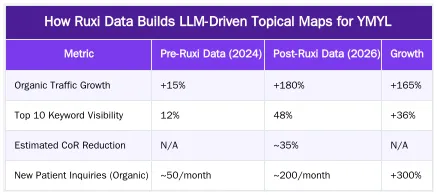
This demonstrates how a structured approach to topical authority, guided by advanced semantic infrastructure, can significantly accelerate organic growth and patient acquisition. For further insights into building robust content strategies, explore this topic cluster automation guide.
Ready to Transform Your Medical Clinic’s SEO?
The landscape of medical SEO demands precision, authority, and efficiency. Leveraging Ruxi Data for medical SEO provides a strategic advantage, automating the complex processes of EAV modeling and topical map creation to build an unassailable online presence. If your medical practice aims to dominate organic search, attract high-value patients, and establish deep E-E-A-T, advanced semantic engineering is the solution.
Partner with an expert who understands the unique challenges of the medical sector and the power of automated semantic infrastructure. It is time to move beyond traditional SEO tactics and embrace a data-driven approach that ensures long-term success and growth for your clinic.
Conclusion
The integration of Ruxi Data into a comprehensive medical SEO strategy offers a transformative approach for plastic surgeons and aesthetic clinics. By automating EAV structures and generating precise topical maps, this semantic infrastructure significantly reduces the Cost of Retrieval for search engines and builds unparalleled topical authority. This systematic method ensures that medical content is not only accurate and comprehensive but also highly optimized for Google’s evolving algorithms, particularly in sensitive YMYL domains. Embracing this advanced semantic engineering is essential for establishing E-E-A-T and securing a dominant position in the competitive digital healthcare landscape of 2026 and beyond.
To explore how this strategic advantage can be tailored for your practice, contact us today. You can also Book a Semantic SEO Audit or reach out directly via WhatsApp Strategy Line: +90 506 206 86 86.
Frequently Asked Questions
How does ruxi data medical seo differ from standard AI content generation tools?
Ruxi Data is a specialized semantic SEO infrastructure, not merely an AI writer. It leverages multiple LLMs to analyze search intent and model query networks, building the foundational EAV structure for comprehensive topical maps. Its core function in ruxi data medical seo is to architect authority, not just produce generic text.
How does Ruxi Data handle the ‘Experience’ aspect of E-E-A-T for medical content?
Ruxi Data is designed for ‘Content Configuration’, prompting your medical experts for specific insights, case details, and nuanced experiences. It then structures this unique, first-hand information into a semantically optimized format, clearly signaling the ‘Experience’ factor to Google for medical topics.
What is the main advantage of using ruxi data medical seo?
The primary advantage is its scalability in building deep topical authority for medical practices. It automates the highly complex and time-consuming process of semantic engineering, enabling clinics to establish a dominant, algorithm-proof content network far more efficiently than manual methods.
How does the Entity-Attribute-Value (EAV) structure created by Ruxi Data work for medical topics?
Ruxi Data identifies the central entity (e.g., ‘Rhinoplasty’), its attributes (e.g., ‘Procedure Time’, ‘Recovery Period’), and specific values. This structured data forms a machine-readable foundation for all content, ensuring precision and clarity for complex medical information.
Can Ruxi Data be used to improve an existing medical website’s SEO?
Yes, Ruxi Data is highly effective for existing medical sites. It performs an entity-based content audit to identify gaps in topical coverage and generates a strategic plan. This includes restructuring existing content and creating new assets to build a cohesive knowledge base, significantly enhancing your site’s authority.
How can I get started with ruxi data medical seo for my clinic?
To explore how ruxi data medical seo can transform your clinic’s online presence, you can book a Semantic SEO Audit directly through Abdurrahman Şimşek’s website. Alternatively, for a direct strategy discussion, you can reach out via WhatsApp at +90 506 206 86 86.
Ruxi Data brings together multi-model AI, automated website crawling, live indexation checks, topical authority mapping, E-E-A-T enrichment, schema generation, and full pipeline automation — from crawl to WordPress publish to social posting — all in one platform built for agencies and freelancers who run on results.