
Server Response Time TTFB: Boosting Patient Trust & Rankings
Server response time TTFB measures the initial delay before a server delivers the first byte of data, critically impacting medical website performance and patient trust. For healthcare providers, a swift Time to First Byte signals professionalism, directly influencing user experience and Google ranking factors like Core Web Vitals. This article details how optimizing server response time TTFB enhances patient perception, reduces bounce rates, and improves search engine visibility, crucial for Your Money Your Life (YMYL) sites. Understanding and improving this foundational page speed metric is essential for both SEO and building patient confidence.
Abdurrahman Şimşek, a Semantic SEO Strategist, emphasizes that technical optimization, including TTFB, is integral to a comprehensive semantic SEO strategy. His approach focuses on engineering websites for optimal performance, E-E-A-T, and superior user experience, aligning with search engine priorities for authoritative content.
To explore your options, contact us to schedule your consultation. You can also reach us via: Book a Semantic SEO Audit, Direct WhatsApp Strategy Line: +90 506 206 86 86
For private healthcare websites, speed is a cornerstone of patient trust and search engine visibility. This article explains server response time ttfb, its impact on medical website performance and Google rankings, and strategies for optimization. A low time to first byte reduces Cost of Retrieval for search engines and improves patient experience.
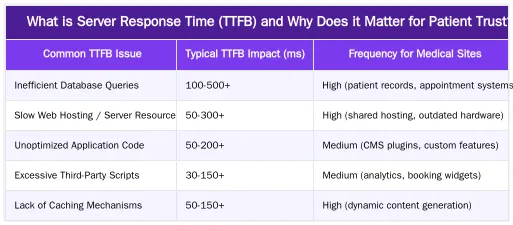
What is Server Response Time (TTFB) and Why Does it Matter for Patient Trust?
Time to First Byte (TTFB) measures the duration from when a user’s browser sends a request to your server until it receives the first byte of data in response. It indicates server responsiveness and is the initial bottleneck for page speed. For medical websites, a swift initial response signals professionalism and reliability, influencing patient perception.
Decoding Time to First Byte: The Initial Handshake of Your Website
Time to First Byte is a server-side metric, distinct from the full page load time. It includes DNS lookup, connection establishment, and server processing time before data is sent. A low TTFB indicates an efficient server and backend, allowing the browser to start rendering content quickly.
The Psychological Impact of Delays on Medical Website Visitors
A slow initial response on a medical website can be perceived as unreliability and unprofessionalism. Patients seeking critical health information or services expect immediate access. Delays can cause frustration, abandonment, and a negative impression of the clinic. This impacts patient trust, a crucial factor for Your Money Your Life (YMYL) websites. A fast initial load is foundational for good Core Web Vitals, which are essential for user satisfaction and search performance.
How Slow TTFB Undermines Your Medical Website’s SEO and User Experience
A slow server response time impacts SEO and user experience. For medical websites, these impacts are critical as every interaction affects trust. Google prioritizes fast sites because speed correlates with user satisfaction. A slow TTFB can lead to higher bounce rates, reduced time on site, and fewer patient conversions.
TTFB as a Core Web Vital Contributor and Ranking Factor
TTFB is a foundational element of page speed, which Google uses as a ranking factor. It significantly influences Largest Contentful Paint (LCP), one of the three Core Web Vitals. A high LCP score, often caused by slow server response, signals a poor user experience to search engines. Websites with optimal Core Web Vitals rank higher, especially in competitive markets like London’s private healthcare sector. Optimizing this metric is about securing search visibility.
Reducing Google’s Cost of Retrieval for Enhanced Visibility
Abdurrahman Şimşek’s methodology emphasizes reducing Google’s ‘Cost of Retrieval’ (CoR). A faster server response time reduces the resources Google’s crawlers expend to access and index a site. When a server responds quickly, Googlebot can crawl more pages in less time, leading to more efficient crawl budget allocation and improved indexing. This efficiency signals a well-maintained, authoritative website, which can enhance visibility and rankings. Learn more about this concept in our article on reducing Cost of Retrieval for SEO.
What Causes a Slow Time to First Byte and How to Diagnose It?
Identifying the root causes of a high TTFB is the first step to optimization. Server latency can be caused by factors from infrastructure to code efficiency. Understanding these bottlenecks is crucial for medical practices handling large image galleries, secure patient forms, and complex database interactions.
Common Bottlenecks: From Server Configuration to Database Queries
Contributors to slow server response include inadequate server hardware, poor web hosting for doctors, and inefficient database queries. Unoptimized application code, especially in content management systems, can cause delays. Excessive third-party scripts, like tracking pixels or advertising tags, can burden the server. For medical websites, large image galleries or complex booking systems can strain unoptimized server resources. Geographical distance from the server adds latency, making UK-based servers important for London clinics.
Tools and Techniques for Measuring Your Website’s TTFB
Measuring server response time is essential for diagnosis. Tools like Google PageSpeed Insights, GTmetrix, and WebPageTest provide TTFB reports. Browser developer tools (like Chrome DevTools Network tab) also monitor this metric. Interpretation involves looking for high values (ideally under 200ms) and correlating them with other performance indicators to pinpoint issues.
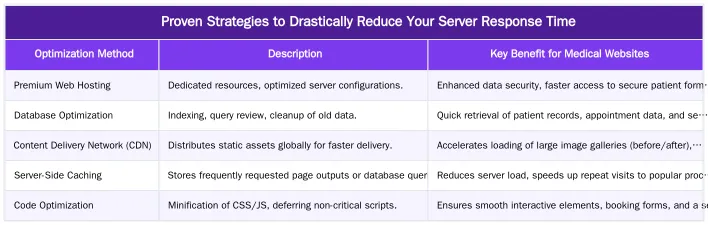
Proven Strategies to Drastically Reduce Your Server Response Time
Reducing TTFB requires addressing website infrastructure and code. These strategies improve medical website performance, user experience, and search visibility.
Optimizing Your Hosting Environment and Database Performance
Choosing high-performance web hosting for doctors is fundamental. Choose dedicated or VPS hosting over shared plans for sufficient server resources (CPU, RAM). Upgrading server hardware or migrating providers can yield immediate improvements. For London clinics, a host with UK-based servers minimizes geographical latency. Database optimization is also critical: review and optimize queries, add indexing, and clean up data. This ensures swift information retrieval for dynamic content like patient portals or service listings.
Leveraging Caching, CDNs, and Efficient Code for Speed
Caching reduces server load and improves TTFB. This includes browser caching for static assets, server-side caching (object caching, full-page caching) for dynamic content, and database caching. A Content Delivery Network (CDN) distributes static assets (images, CSS, JavaScript) across global servers, serving content from the user’s closest location to reduce latency. For medical sites with large image galleries or video content, a CDN is invaluable. Optimizing application code by deferring non-critical CSS and JavaScript, minifying files, and streamlining server-side logic ensures efficient request processing.
Abdurrahman Şimşek’s Approach: Semantic Engineering for Optimal TTFB and E-E-A-T
Optimizing technical metrics like server response time is one component of a digital strategy for medical clinics. Abdurrahman Şimşek’s approach integrates technical foundations with a semantic SEO framework. This methodology ensures a website’s speed and content architecture build topical authority and E-E-A-T (Experience, Expertise, Authoritativeness, Trustworthiness), critical for YMYL medical sites.
Beyond Speed: Integrating TTFB with Semantic Architecture for Trust
Abdurrahman’s methodology views a fast server response time as an enabler for a semantic content network. Reducing TTFB helps search engines efficiently crawl and understand entity-based content that establishes a clinic’s expertise. Technical efficiency and a clear semantic architecture reinforce expertise with structured data and build trust. A secure HTTPS connection is a trust signal for patients entering sensitive data, linking technical performance to E-E-A-T.
Ruxi Data and AI-Driven Performance for London’s Elite Clinics
Leveraging Ruxi Data, Abdurrahman Şimşek automates the creation of topical maps and Entity-Attribute-Value (EAV) modeling. This semantic engine contributes to a faster website by reducing data retrieval complexity for users and search engines. A semantic content network powered by Ruxi Data requires less server-side processing to deliver relevant information. This approach benefits Harley Street and premium London clinics, where establishing local trust with patient reviews and a sophisticated online presence is paramount. Optimizing the data structure enhances website performance, making it easier for search engines to understand and rank content.
Achieve Sub-2.0s LCP and Boost Patient Conversions with Expert Technical SEO
Optimizing server response time is a critical step towards a sub-2.0s Largest Contentful Paint (LCP) and improving page speed. This technical foundation enhances Google rankings, builds patient trust, and drives higher conversion rates. A fast, reliable website signals professionalism and care, impacting a patient’s decision-making.
Conclusion
A fast server response time (TTFB) is critical for medical websites. It influences patient trust, user experience, and search visibility. By implementing optimization strategies—from hosting and database management to caching and CDN usage—medical clinics can improve their online performance. Abdurrahman Şimşek’s approach integrates technical excellence with semantic engineering and E-E-A-T principles to ensure a website loads quickly and establishes authority and credibility. Contact us today to discuss how we can transform your medical website’s performance. You can also Book a Semantic SEO Audit or reach out directly via our Direct WhatsApp Strategy Line: +90 506 206 86 86.
Frequently Asked Questions
What exactly is server response time ttfb?
Time to First Byte (TTFB) measures the time it takes for a user’s browser to receive the very first byte of data from your website’s server after making a request. It’s a fundamental measure of your server’s health and responsiveness. A high server response time TTFB is a bottleneck for overall page speed, directly impacting user perception and search engine efficiency.
How does a slow server response time ttfb erode patient trust?
The initial delay caused by a slow server response time TTFB creates a perception of an unprofessional or unreliable website. For a patient seeking medical information, this first impression is critical; a sluggish site can subconsciously signal a lack of care or modernity, eroding trust before they even see your content. This directly impacts their willingness to engage with your clinic.
Is server response time ttfb a direct Google ranking factor?
While not a direct Core Web Vital, TTFB is a foundational speed metric that directly impacts LCP and the overall user experience, which are ranking factors. Google has confirmed that a faster server response time TTFB is correlated with better search performance and improved crawl rates. Optimizing this metric is crucial for overall SEO health.
What is the most common cause of high TTFB on a clinic’s website?
Common causes include inadequate shared hosting, inefficient database queries, and a lack of proper server-side caching. For dynamic sites built on platforms like WordPress, unoptimized plugins and themes are also frequent culprits that contribute to a slow time to first byte. Identifying these issues is the first step toward improvement.
Can a Content Delivery Network (CDN) fix a high TTFB?
A CDN can significantly help by caching content closer to the user, which reduces network latency and can lower TTFB. However, it cannot fix a fundamentally slow server; if the origin server itself is the problem, a CDN will only provide a partial improvement to your server response time. It’s a valuable tool but not a complete solution for core server issues.
How can I get expert help to optimize my website’s server response time TTFB?
Abdurrahman Şimşek, a Semantic SEO Strategist, specializes in optimizing medical websites for speed and trust. You can book a Semantic SEO Audit to identify and resolve issues impacting your site’s performance. For direct strategy discussions, reach out via WhatsApp at +90 506 206 86 86.
Ruxi Data brings together multi-model AI, automated website crawling, live indexation checks, topical authority mapping, E-E-A-T enrichment, schema generation, and full pipeline automation — from crawl to WordPress publish to social posting — all in one platform built for agencies and freelancers who run on results.