
Reducing Cost of Retrieval: Optimizing Medical Website Performance
The article explains how reducing cost of retrieval is crucial for medical websites to achieve higher search engine visibility and performance. It details how strategic technical SEO, including semantic HTML, structured data, and EAV modeling, minimizes the computational resources search engines expend to crawl and understand content. This efficiency in information retrieval directly enhances a site’s E-E-A-T signals and improves site speed, leading to better rankings and stronger topical authority in the YMYL sector. Optimizing for a lower cost of retrieval ensures search engines can process complex medical information effectively.
This content, crafted by Abdurrahman Şimşek, a Semantic SEO Strategist, provides actionable insights into advanced semantic engineering techniques. It emphasizes practical strategies for medical websites to improve search engine efficiency and demonstrate E-E-A-T through optimized information retrieval.
To explore your options, contact us to schedule your consultation. You can also reach us via: Book a Semantic SEO Audit, Direct WhatsApp Strategy Line: +90 506 206 86 86, Hire as Semantic SEO Architect
For medical websites, reducing cost of retrieval is a critical, often overlooked, aspect of technical SEO that directly impacts search engine visibility and performance. This article explains what ‘cost of retrieval’ means for healthcare sites and how strategic technical SEO can dramatically improve search engine efficiency, leading to better rankings and stronger topical authority. We will explore actionable strategies and advanced semantic engineering techniques to optimize your digital presence, ensuring search engines can process your valuable medical content with minimal computational effort.
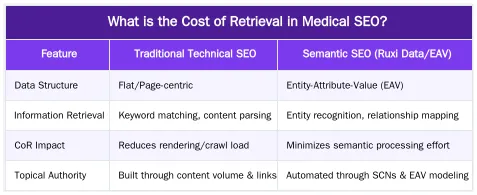
What is the Cost of Retrieval in Medical SEO?
The Cost of Retrieval (CoR) refers to the computational resources—processing power, memory, and time—a search engine expends to crawl, render, understand, and index a website’s content. For medical websites, minimizing this cost is paramount. Efficient information retrieval allows search engines to process vast amounts of complex health information more effectively, directly influencing how well a site ranks and establishes its authority in the highly sensitive Your Money Your Life (YMYL) sector.
Beyond Crawl Budget: Understanding Search Engine Efficiency
While crawl budget focuses on how many pages a search engine bot will visit, CoR encompasses the entire processing pipeline. It’s not just about getting bots to your site; it’s about making their job as easy and resource-light as possible once they arrive. A high CoR indicates that a search engine must work harder to extract meaning from a page, potentially leading to less frequent crawling, slower indexing, and a diminished understanding of the content’s relevance and quality. This broader concept of efficiency is crucial for modern search algorithms that prioritize semantic understanding.
Why CoR is Critical for YMYL Medical Sites
Medical websites, dealing with YMYL topics, are held to the highest standards of Experience, Expertise, Authoritativeness, and Trustworthiness (E-E-A-T). Search engines must be absolutely confident in the accuracy and reliability of medical information before ranking it prominently. When a site has a low CoR, it signals to search engines that its content is well-organized, clearly presented, and easy to interpret. This efficiency directly contributes to demonstrating E-E-A-T, as it facilitates the algorithmic assessment of content quality, author credentials, and factual accuracy. For instance, a site with clear schema markup for medical procedures and physician profiles makes it easier for search engines to verify expertise. Information retrieval efficiency is thus a foundational element for building trust and achieving visibility in the medical domain.
How Technical SEO Reduces Cost of Retrieval for Healthcare Websites
Technical SEO forms the bedrock for efficient information retrieval. By optimizing the underlying structure and performance of a medical website, practitioners can significantly reduce the computational burden on search engines. This involves a combination of site speed enhancements, clean code practices, and robust data structuring, all contributing to a more streamlined indexing process.
Optimizing Core Web Vitals for Lower CoR
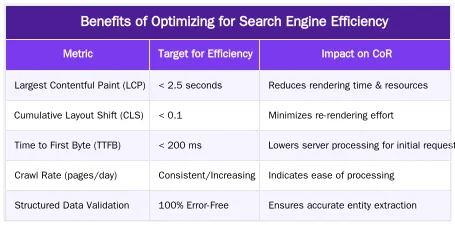
Core Web Vitals (CWV) are user experience metrics that directly impact how easily and quickly a page can be rendered and interacted with. Improving metrics like Largest Contentful Paint (LCP), First Input Delay (FID), and Cumulative Layout Shift (CLS) means a page loads faster and is more stable. For search engines, this translates to less computational effort required to render the page and extract its content. Faster loading times reduce server load during crawling, while stable layouts prevent unnecessary re-rendering, all contributing to a lower overall processing cost. Strategies include image optimization, efficient CSS/JavaScript delivery, and server response time improvements.
The Role of Semantic HTML and Structured Data in Information Retrieval
Semantic HTML provides meaning to web content beyond its visual presentation. Using tags like “, `
The Strategic Advantage: EAV Modeling & Ruxi Data for Medical Entities
For complex domains like healthcare, traditional SEO approaches often fall short in fully communicating the intricate relationships between medical entities. Abdurrahman Şimşek’s approach leverages advanced semantic engineering, specifically Entity-Attribute-Value (EAV) modeling and the Ruxi Data infrastructure, to create a highly efficient and authoritative digital presence. These methodologies are designed to drastically minimize the search engine’s processing effort for understanding complex medical information, thereby significantly contributing to reducing cost of retrieval.
Structuring Complex Medical Data with EAV Modeling
EAV modeling is a data architecture pattern that organizes information by defining entities (e.g., “Plastic Surgeon,” “Rhinoplasty Procedure,” “Hyaluronic Acid Filler”), their attributes (e.g., “specialty,” “duration,” “active ingredient”), and the values for those attributes (e.g., “facial surgery,” “2 hours,” “hyaluronic acid”). This flexible structure is ideal for medical content, where procedures can have numerous variations, conditions have multiple symptoms, and practitioners possess diverse specializations. By structuring content this way, medical websites provide search engines with a clear, unambiguous, and highly organized dataset. This precision reduces the ambiguity search engines face when interpreting medical terms and relationships, leading to more accurate and efficient indexing.
Ruxi Data: Automating Topical Authority and CoR Optimization
Ruxi Data is an advanced semantic infrastructure that leverages Large Language Models (LLMs) to automate the creation of sophisticated semantic content networks and topical maps. For medical entities, Ruxi Data transforms clinical expertise into structured, machine-readable knowledge graphs. This automation streamlines the process of building comprehensive topical authority by ensuring every piece of content is semantically linked and contextually relevant. By presenting information in a pre-digested, entity-rich format, Ruxi Data drastically reduces the search engine’s computational effort to understand, categorize, and rank medical entities. This proactive structuring of knowledge is a powerful method for optimizing information retrieval and establishing a dominant online presence for medical clinics and plastic surgeons.
Benefits of Optimizing for Search Engine Efficiency
Optimizing a medical website for search engine efficiency yields a cascade of benefits beyond just technical performance. It directly translates into enhanced organic visibility, stronger E-E-A-T signals, and the establishment of robust topical authority, which are all crucial for success in the competitive healthcare digital landscape. Abdurrahman Şimşek, with over 10 years of experience in search engineering, specializes in these advanced strategies for London’s private healthcare and aesthetic surgery sector.
Firstly, improved information retrieval leads to better rankings. When search engines can easily understand what a page is about, its relevance to user queries increases, resulting in higher positions in search results. This is particularly vital for YMYL content, where clarity and accuracy are paramount. Secondly, a lower CoR reinforces E-E-A-T. By presenting information in a structured, unambiguous manner, medical sites make it easier for algorithms to verify the expertise of authors, the authoritativeness of the content, and the overall trustworthiness of the domain. This is a core component of Abdurrahman Şimşek’s Semantic SEO Framework, which focuses on building a credible digital footprint.
Furthermore, efficient processing contributes to building dominant topical authority. When a website consistently provides clear, well-structured information across a specific medical topic, search engines recognize it as a comprehensive resource. This deep understanding of a topic, facilitated by reduced processing costs, helps establish the site as an expert in its field. For example, a plastic surgery clinic that meticulously structures information about various facial procedures, their risks, benefits, and recovery times, will be seen as more authoritative than a site with fragmented content. This holistic approach to SEO, integrating technical excellence with semantic depth, is a hallmark of effective medical digital strategy. For more on topical authority, refer to Wikipedia’s definition of topical authority.
Measuring and Monitoring Information Retrieval Efficiency
Effective optimization for search engine efficiency requires continuous measurement and monitoring. While there isn’t a single “CoR score,” various metrics and tools provide insights into how efficiently search engines are processing a website. Understanding these indicators allows for targeted improvements and ensures that efforts to streamline data processing are yielding tangible results.
Key metrics to monitor include Core Web Vitals (LCP, FID, CLS), server response times, and crawl statistics from Google Search Console. A consistently low LCP and high FID score, for instance, suggest that pages are quick to load and interactive, reducing the rendering burden on search engines. Similarly, monitoring crawl rate and indexed pages in Search Console can indicate if search engines are encountering issues or if their processing efficiency is improving. A sudden drop in crawl rate without a corresponding decrease in content could signal a higher CoR.
Advanced semantic analysis tools can also help identify areas where content clarity or structure could be improved. By analyzing entity recognition and semantic density, practitioners can refine their content to be even more machine-readable. For medical websites, regularly auditing structured data implementation is crucial. Tools like Google’s Rich Results Test and Schema Markup Validator ensure that JSON-LD is correctly implemented and understood by search engines, thereby minimizing the effort required for accurate information retrieval. This proactive monitoring is integral to maintaining a high-performing medical website and ensuring optimal search engine engagement. For insights into crawl budget optimization, consider resources like fixing crawl budget issues and crawl budget optimization workflow.
Expert Solutions for Efficient Medical Website Performance
Achieving optimal search engine efficiency for medical websites requires a specialized approach that integrates technical SEO with advanced semantic engineering. Abdurrahman Şimşek, a London-based Semantic SEO Strategist and Web Developer, offers bespoke solutions tailored for medical clinics, skin clinics, and plastic surgeons. His expertise in building high-authority Semantic Content Networks, leveraging Ruxi Data infrastructure, directly addresses the challenge of reducing cost of retrieval for complex medical information.
By transforming clinical expertise into structured, machine-readable data, Abdurrahman Şimşek helps medical practices establish dominant topical authority and minimize search engine processing overhead. This strategic advantage ensures that your valuable medical content is not only visible but also deeply understood and trusted by search engines. For a comprehensive strategy that prioritizes efficiency and authority, consider partnering with a specialist who understands the unique demands of the YMYL sector.
Conclusion
The concept of reducing cost of retrieval is fundamental to modern SEO, especially for medical websites operating in the YMYL space. By prioritizing technical SEO, semantic HTML, structured data, and advanced methodologies like EAV modeling and Ruxi Data, healthcare providers can significantly enhance search engine efficiency. This leads to improved organic visibility, stronger E-E-A-T signals, and the establishment of undeniable topical authority. For medical clinics and plastic surgeons seeking to optimize their digital presence and ensure their expertise is recognized by search engines, a strategic approach to information retrieval is not just an advantage, but a necessity. To explore how these strategies can benefit your practice, contact us today. You can also Book a Semantic SEO Audit, reach us via Direct WhatsApp Strategy Line: +90 506 206 86 86, or Hire as Semantic SEO Architect.
Frequently Asked Questions
What is “Cost of Retrieval” in medical SEO, and why is reducing cost of retrieval important?
“Cost of Retrieval” refers to the computational resources—processing power, memory, and time—a search engine expends to crawl, render, understand, and index a medical website’s content. Reducing cost of retrieval makes your site more efficient for search engines, leading to better understanding and indexing of your valuable medical information. This efficiency is crucial for improved search visibility and performance.
How does Abdurrahman Şimşek help medical websites in reducing cost of retrieval?
Abdurrahman Şimşek implements advanced technical SEO strategies, including semantic HTML, precise structured data, and EAV modeling via Ruxi Data. These techniques make medical content highly machine-readable, thereby significantly reducing cost of retrieval for search engines. This specialized approach ensures your content is processed with minimal computational effort.
What are the direct benefits of reducing cost of retrieval for a medical clinic?
Direct benefits include improved crawl efficiency, better indexing, and enhanced understanding by search engines. This optimization ultimately leads to higher rankings and increased visibility for relevant medical queries by reducing cost of retrieval. It also contributes to stronger topical authority for your medical website.
Is optimizing for search engine efficiency related to Core Web Vitals?
Yes, optimizing for search engine efficiency is closely related to Core Web Vitals. A technically optimized, semantically rich site that is easy for search engines to process often correlates with better user experience metrics like Largest Contentful Paint (LCP) and First Input Delay (FID). This synergy improves both how search engines perceive your site and how users experience it.
How does Ruxi Data specifically contribute to improving information retrieval for medical websites?
Ruxi Data automates the creation of highly structured, semantically coherent content networks and Entity-Attribute-Value (EAV) models. This significantly reduces the effort search engines need to understand and categorize complex medical information. By streamlining this process, Ruxi Data enhances overall information retrieval efficiency.
How can I get started with Abdurrahman Şimşek to enhance my medical website’s performance?
You can initiate the process by booking a Semantic SEO Audit directly through Abdurrahman Şimşek’s website at abdurrahmansimsek.com/contact/. Alternatively, you can use the direct WhatsApp Strategy Line at +90 506 206 86 86 for a quick consultation. These expert solutions are designed to optimize your site’s efficiency and build robust topical authority.
Ruxi Data brings together multi-model AI, automated website crawling, live indexation checks, topical authority mapping, E-E-A-T enrichment, schema generation, and full pipeline automation — from crawl to WordPress publish to social posting — all in one platform built for agencies and freelancers who run on results.