
AI Content Refresh Workflow: Automating WordPress Content Updates
An ai content refresh workflow automates the process of identifying, updating, and publishing content in WordPress to combat content decay and improve SEO. This article details leveraging AI, Google Search Console data, and programmatic integrations for efficient content updates. It outlines practical steps for historical optimization, enhancing SERP visibility through continuous SERP monitoring, and tracking performance. The workflow minimizes manual effort, ensuring content remains relevant and highly ranked through semantic refresh strategies and programmatic updates.
Abdurrahman Simsek specializes in advanced SEO strategies and content automation. This guide provides actionable insights for businesses seeking to optimize their content lifecycle and maintain strong organic search performance.
To explore your options, contact us to schedule your consultation.
Implementing an ai content refresh workflow is essential for maintaining search engine visibility and relevance in 2026. This article details a comprehensive, automated approach to identifying, updating, and publishing refreshed content within WordPress. Readers will learn how to leverage artificial intelligence, Google Search Console data, and programmatic integrations to combat content decay, improve organic rankings, and optimize content performance efficiently. The focus is on a streamlined process that minimizes manual effort while maximizing SEO impact.
Introduction to Content Refresh and Decay
Content decay refers to the gradual decline in a piece of content’s organic search performance over time. This phenomenon is common, as search engine algorithms evolve, competitor content emerges, and user intent shifts. A once top-ranking article might slowly lose its visibility, leading to decreased organic traffic and reduced impact on business goals. Understanding content decay is the first step toward proactive content management.
Content refreshing, also known as historical optimization, involves updating existing content to improve its accuracy, relevance, and SEO performance. This can include adding new information, updating statistics, improving readability, optimizing for new keywords, or enhancing multimedia elements. The goal is to signal to search engines that the content is current and valuable, thereby regaining or improving its search rankings.
Regular content maintenance is crucial for sustaining a strong online presence. Neglecting older content can lead to a significant portion of a website’s valuable assets becoming underperforming. Strategies like content pruning complement refreshing by removing or consolidating truly outdated or low-performing pages, ensuring that resources are focused on high-potential content. For further insights into content lifecycle management, resources like Google Search Central provide foundational guidelines on maintaining content quality and relevance.
Importance and Benefits of Content Refreshing for SEO
Refreshing existing content offers several significant advantages for SEO. Primarily, it can lead to improved SERP visibility. Search engines favor fresh, relevant content, and updates can signal renewed authority and topical expertise. This often results in higher organic traffic as pages climb in rankings for target keywords and related queries.
Beyond traffic, updated content typically sees better user engagement metrics. When users find current and comprehensive information, they are more likely to spend longer on the page, reducing bounce rates and increasing dwell time. These positive engagement signals can further reinforce the content’s value to search engines. Moreover, refreshing content is often more cost-effective than creating entirely new articles, as it leverages existing authority and backlinks.
An automated approach, such as an AI-powered content update process, amplifies these benefits. By continuously monitoring performance and programmatically applying updates, websites can maintain a competitive edge without extensive manual intervention. This ensures that content remains optimized against evolving search trends and competitor strategies, making content refreshing a cornerstone of sustainable SEO success.
Identifying Content Needing Refresh: Manual vs. Automated Methods
Identifying content ripe for refreshing is critical for effective content strategy. This process can be approached manually or through automated systems, with the latter offering significant scalability and precision.
Manual identification typically involves reviewing analytics platforms and search console data for pages experiencing declines in traffic or rankings. Automated methods, however, leverage APIs and AI to proactively detect content decay and opportunities for improvement. The integration of the Google Search Console API is particularly powerful for this, allowing for continuous monitoring of key performance indicators such as impressions, clicks, and average position, flagging content that shows early signs of decline or has lost its featured snippet position.

Automated systems can also analyze competitor content and identify new keyword opportunities or semantic gaps that existing content could address. This proactive approach ensures that content updates are timely and strategically aligned with current search intent and competitive landscapes.
Practical Steps for an Automated AI Content Refresh Workflow
Implementing an automated content refresh process involves several key stages, from detection to programmatic publishing. This structured approach ensures efficiency and consistent SEO gains.
- Performance Monitoring and Decay Detection: The workflow begins with continuous monitoring of content performance. This involves integrating with the Google Search Console API to track metrics like organic traffic, keyword rankings, and click-through rates. AI algorithms analyze this data to identify pages experiencing content decay or those with untapped potential for historical optimization. SERP monitoring tools also track competitor movements and ranking fluctuations.
- Content Analysis and Opportunity Identification: Once a page is flagged, AI tools perform a deep analysis. This includes evaluating the current on-page SEO, identifying keyword tracking gaps, analyzing semantic relevance, and comparing it against top-ranking competitor content. The AI pinpoints specific areas for improvement, such as outdated statistics, missing subtopics, or opportunities for better keyword integration.
- AI-Powered Content Generation and Semantic Refresh: Based on the analysis, AI models generate updated content sections, rewrite paragraphs, or suggest new additions. This semantic refresh ensures the content remains comprehensive and relevant to current search intent. The AI can also optimize for new related keywords and improve overall readability.
- Human Review and Approval: While AI automates much of the heavy lifting, human oversight remains crucial. Content strategists or editors review the AI-generated updates for accuracy, tone, brand voice, and overall quality. This step ensures that the refreshed content meets editorial standards and aligns with strategic goals.
- Programmatic Publishing and WordPress Integration: After approval, the updated content is programmatically published to WordPress. This integration allows for seamless updates, scheduling, and version control. The entire process, from detection to publishing, can be orchestrated to minimize manual intervention, creating a highly efficient ai content refresh workflow.
Tools and Technologies for an AI-Powered Content Refresh Workflow
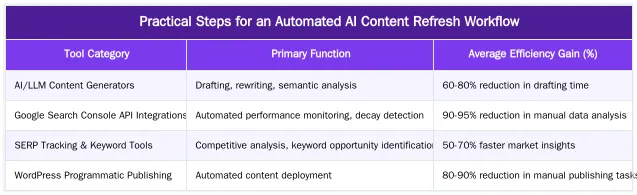
An effective AI-powered content refresh workflow relies on a suite of integrated tools and technologies. These components work in concert to automate detection, analysis, generation, and publishing tasks, significantly enhancing content operations.
At the core are AI models and Large Language Models (LLMs). These are responsible for analyzing content, identifying semantic gaps, generating updated text, and ensuring the refresh aligns with current search intent and on-page SEO best practices. They can perform tasks like keyword research, competitive analysis, and content drafting at scale.
Google Search Console API integration is fundamental for data acquisition. This API provides programmatic access to critical performance data, including impressions, clicks, average position, and query data. It enables automated monitoring for content decay, identifying pages that are losing visibility or have opportunities for improvement based on real user search behavior.
SERP tracking tools complement GSC data by providing competitive insights. These tools monitor keyword rankings, track competitor content changes, and identify new opportunities in the search landscape. They help in understanding the evolving nature of search results and inform the semantic refresh process.
Finally, robust WordPress integration is essential for programmatic updates. This allows the AI-generated and human-approved content to be published directly to the website without manual copy-pasting. Such integrations often include features for scheduling updates, managing revisions, and ensuring proper formatting. This capability is key to scaling content operations effectively.
Measuring Success and ROI of Content Refresh Efforts
Evaluating the impact of content refreshing is crucial for demonstrating its value and optimizing future strategies. Key performance indicators (KPIs) provide insights into the effectiveness of these efforts.
Primary metrics to track include organic traffic to refreshed pages, changes in keyword rankings for target terms, and improvements in click-through rates (CTR) from search results. Monitoring these over time, typically using tools like Google Analytics and Google Search Console, reveals whether the updates are resonating with search engines and users. Increases in impressions and average position are strong indicators of improved visibility.
Beyond traffic, consider engagement metrics such as dwell time, bounce rate, and pages per session. Better engagement suggests that the refreshed content is more valuable and satisfying to visitors. Ultimately, the return on investment (ROI) can be calculated by comparing the resources invested in the content refresh workflow (time, tools, personnel) against the gains in organic traffic, lead generation, or conversions directly attributable to the updated content. For comprehensive guidance on SEO analytics and ROI, industry resources like Moz provide valuable frameworks for measurement and reporting.
Streamline Your Content Strategy with an AI Content Refresh Workflow
Maintaining a competitive edge in organic search requires a proactive and efficient content strategy. An automated approach to content refreshing, powered by artificial intelligence, transforms this often-manual task into a scalable operation. By leveraging AI for detection, analysis, and content generation, businesses can ensure their existing content remains relevant, authoritative, and high-performing.
This systematic method not only combats content decay but also unlocks new opportunities for growth by continuously optimizing for evolving search intent and keyword landscapes. Embrace the power of automation to enhance your content’s lifespan and maximize its SEO potential. Discover how an intelligent ai content refresh workflow can revolutionize your content publishing process.
Conclusion
The strategic implementation of an AI-powered content refresh workflow is indispensable for modern SEO. By automating the detection of content decay, the analysis of performance gaps, and the generation of updated content, organizations can maintain a dynamic and high-performing content library. This approach ensures content remains relevant, improves organic visibility, and drives sustained traffic and engagement. Embracing an automated content refresh strategy is a forward-thinking step towards maximizing the ROI of existing content assets. To explore how an intelligent content refresh solution can benefit your operations, visit abdurrahmansimsek.com.
Frequently Asked Questions
How does the ai content refresh workflow identify content needing updates?
Our system integrates with your Google Search Console and a SERP tracker. It automatically monitors keyword rankings and traffic for your existing posts. When it detects significant ranking or traffic drops—a clear sign of content decay—it flags the article for an AI-driven refresh.
What does an ai content refresh workflow actually involve?
Once a decaying article is identified, our AI performs a fresh SERP analysis for its target keyword. This ai content refresh workflow identifies new subtopics, questions, and entities that top-ranking competitors are covering. It then rewrites and expands relevant sections of your original article to close these content gaps and improve relevance.
Is the ai content refresh workflow fully automated or does it require manual review?
The platform supports both approaches. You can run a fully automated ai content refresh workflow where the AI updates and republishes the content seamlessly within WordPress. Alternatively, you can configure it to send the AI-generated refresh to a draft for your manual review and approval before it goes live.
How does the ai content refresh workflow handle updating internal links?
Our AI content refresh workflow is deeply integrated with our internal linking engine. When an article is updated, the system re-evaluates its content and automatically suggests adding or updating internal links to newer, relevant articles on your site. This helps maintain strong content silos and improves overall site SEO.
Does an automated content refresh preserve the original publish date?
You have full control over the publish date settings. You can choose to either update the content while keeping the original publish date or change it to the refresh date to signal a major update to Google. Our system automatically handles updating the ‘last modified’ date, which is often recommended for SEO.
Ruxi Data brings together multi-model AI, automated website crawling, live indexation checks, topical authority mapping, E-E-A-T enrichment, schema generation, and full pipeline automation — from crawl to WordPress publish to social posting — all in one platform built for agencies and freelancers who run on results.