
Automated Redirect Management: Streamlining Large-scale Site Migrations
The article details the critical role of automated redirect management in successful large-scale site migrations. It explains how automating 301 redirects prevents common issues like 404 errors, redirect chains, and loops, which degrade user experience and dilute link equity. Readers will learn the benefits of automated systems for preserving SEO, improving efficiency, and reducing manual errors during complex website changes. The content covers detection, creation, validation, and monitoring of bulk redirects, including technical considerations for htaccess and Nginx environments.
This article provides insights into optimizing site migrations and maintaining SEO integrity. Abdurrahman Simsek’s expertise focuses on delivering practical solutions for complex digital challenges, ensuring robust technical implementations and sustained online performance.
To explore your options, contact us to schedule your consultation.
Navigating a large-scale site migration can be a daunting task, but effective automated redirect management is crucial for success. This process ensures that old URLs seamlessly transition to new ones, preserving search engine rankings and user experience. Implementing an automated system minimizes manual errors, reduces operational overhead, and maintains vital SEO signals during complex website changes. Understanding the mechanics and benefits of such systems is essential for any organization undertaking a significant digital transformation in 2026.
Challenges of Manual Redirect Management
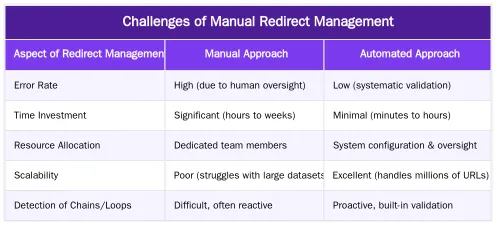
Managing 301 redirects manually during large-scale site migrations presents numerous challenges. The sheer volume of URLs often makes manual mapping impractical and prone to human error. A typical migration can involve thousands, or even millions, of URLs, each requiring a precise redirect rule.
Common issues include incorrect redirect destinations, leading to 404 errors and lost traffic. Manual processes frequently result in redirect chains, where a single request passes through multiple redirects before reaching its final destination. These chains degrade user experience, increase page load times, and dilute link equity. Redirect loops, a more severe form of misconfiguration, can trap users and search engine crawlers indefinitely, rendering pages inaccessible.
The time and resource investment for manual redirect mapping, testing, and deployment are substantial. This often diverts valuable development and SEO team resources from other critical migration tasks. Furthermore, identifying and fixing errors post-migration becomes a reactive and costly endeavor, impacting SEO performance and revenue.
Benefits of Automated Redirect Systems for SEO and Efficiency
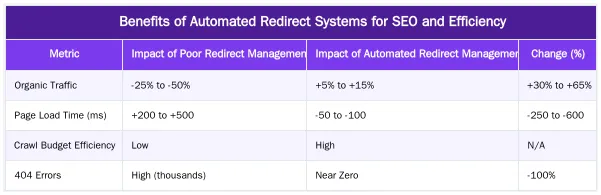
Automated redirect systems significantly enhance SEO and operational efficiency during site migrations. They ensure that search engines correctly transfer link equity from old URLs to new ones, preventing drops in organic rankings and traffic. This automation minimizes the risk of common redirect errors, such as 404s, redirect chains, and loops, which can severely impact user experience and crawl budget.
By streamlining the redirect mapping and deployment process, automated solutions drastically reduce the time and resources required for migration. This allows SEO and development teams to focus on strategic tasks rather than tedious manual configurations. The precision of automated systems ensures that every redirect is correctly implemented, preserving the integrity of internal linking structures and external backlinks. This proactive approach safeguards search visibility and maintains a positive user journey, which is critical for successful site transitions.
How Automated Systems Work: Detection, Creation, and Validation
Automated systems for redirect management operate through a structured three-phase process: detection, creation, and validation. The detection phase typically begins by crawling the old website or importing a list of existing URLs. This identifies all pages that require redirection, including those that might be linked externally or indexed by search engines. Advanced systems can also analyze server logs to identify frequently accessed URLs, ensuring comprehensive coverage.
During the creation phase, the system generates redirect rules. This often involves mapping old URLs to their corresponding new URLs based on predefined patterns, content similarity, or explicit mapping files. For instance, if a URL structure changes from `/category/product-name` to `/new-category/product-slug`, the system can apply a rule to transform all relevant URLs. Some platforms leverage machine learning to suggest optimal redirect destinations, especially for pages with no direct equivalent. This process aims to create 301 redirects, signaling a permanent move to search engines.
The final and critical phase is validation. Before deployment, the system tests all generated redirects to confirm they lead to the correct destination, are 301 (permanent) redirects, and do not create chains or loops. This involves simulating requests to old URLs and verifying the HTTP status codes and final landing pages. Tools often provide reports detailing any issues, allowing for corrections before the redirects go live. For further reading on HTTP status codes and their implications, refer to resources like MDN Web Docs on HTTP Status Codes.
Preventing Complex Redirect Scenarios with Advanced Automation
Advanced automation is pivotal in preventing complex redirect scenarios like chains and loops, which can severely degrade site performance and SEO. These systems employ sophisticated logic, including regular expressions (regex), to handle dynamic URL patterns and ensure precise mapping. Regex allows for the creation of flexible rules that can match and transform entire categories of URLs, rather than requiring individual entries for each page.
Semantic URL mapping is another key capability. Instead of just matching exact strings, advanced tools can analyze the content or metadata of old and new pages to suggest semantically relevant redirect destinations. This helps preserve link equity more effectively, especially when content moves to a completely different URL structure or is consolidated. For example, an old product page might redirect to a new, similar product page even if the URL paths are entirely different.
Validation engines within these systems continuously check for redirect chains (multiple redirects before reaching a final destination) and loops (redirects that send users or crawlers back to a previous URL in the chain). They can flag these issues pre-deployment, allowing for immediate correction. This proactive identification and resolution of complex redirect issues are crucial for maintaining a healthy site architecture and optimal search engine performance.
Technical Considerations for htaccess and Nginx Redirect Automation
Implementing redirect automation requires specific technical considerations for different server environments, primarily Apache (using `.htaccess`) and Nginx. Both offer powerful ways to manage redirects, but their syntax and configuration methods differ significantly.
For Apache servers, `.htaccess` files are commonly used for URL rewriting and redirects. Automated systems can generate `RewriteRule` and `RedirectMatch` directives. It is crucial to ensure that these rules are optimized for performance, as excessive or poorly written `.htaccess` rules can slow down server response times. The order of rules is also critical; more specific rules should generally precede more general ones to prevent unintended redirects. Tools should validate the syntax and logic before deployment to avoid server errors.
Nginx uses its configuration files (e.g., `nginx.conf`) for redirects, typically within `server` or `location` blocks. Nginx’s `rewrite` directive is highly efficient for complex URL transformations, while `return 301` is suitable for simple, direct redirects. Automated redirect solutions for Nginx must generate configurations that adhere to Nginx’s syntax and best practices, such as avoiding redundant processing. Nginx configurations are generally parsed once upon server restart or reload, making syntax errors more impactful. Therefore, automated tools must provide robust validation for Nginx configurations to ensure stability and performance.
Impact on SEO: Link Equity and Crawl Budget
Effective 301 redirects are fundamental for preserving SEO value during a site migration. When a page moves, its existing link equity—the value passed from backlinks—must be transferred to the new URL. A properly implemented 301 redirect signals to search engines that the move is permanent, allowing most of this equity to flow to the new destination. Incorrect or missing redirects can result in significant loss of link equity, leading to drops in search rankings and organic traffic.
Redirects also directly influence crawl budget, which is the number of pages search engines will crawl on a site within a given timeframe. Redirect chains consume crawl budget unnecessarily, as crawlers must follow multiple hops to reach the final content. This can prevent search engines from discovering and indexing new or updated pages efficiently. By minimizing redirect chains and ensuring direct 301s, automated systems help optimize crawl budget, allowing search engines to focus on valuable content. This also helps in addressing issues like fixing crawl budget issues and preventing orphan pages.
Continuous Redirect Monitoring and Optimization
Deploying redirects is not a one-time task; continuous monitoring and optimization are essential for long-term SEO health. Even after a migration, new issues can arise, such as broken external links pointing to old URLs, or internal links that were missed during the initial mapping. Automated monitoring systems regularly crawl the site and external backlinks to identify any 404 errors or redirect chains that may have developed.
These systems integrate with broader SEO workflows, providing alerts for critical redirect issues. For example, if a high-value page suddenly starts returning a 404, the system can immediately notify the SEO team. This proactive approach helps maintain link equity and ensures a smooth user experience. Monitoring also extends to analyzing server logs for redirect performance, identifying frequently hit old URLs that might indicate a need for further internal linking updates or content consolidation.
Optimization involves refining redirect rules based on ongoing data. This might include consolidating multiple redirects into a single rule, updating temporary 302 redirects to permanent 301s, or removing redirects for pages that no longer hold SEO value. Integrating redirect monitoring with tools that track technical E-E-A-T signals ensures that the site’s authority and trustworthiness are consistently maintained.
Tools and Solutions for Automated Redirect Management
A variety of tools and solutions exist to facilitate automated redirect management, catering to different scales and technical requirements. These range from server-side modules to specialized SaaS platforms.
For smaller sites or those with specific server configurations, server-level solutions like Apache’s `mod_rewrite` or Nginx’s `rewrite` module can be scripted for automation. While powerful, these require significant technical expertise to configure and maintain. Content Management Systems (CMS) often offer plugins or built-in features for basic redirect management, but these may lack the advanced capabilities needed for large-scale migrations.
Dedicated SaaS platforms provide comprehensive automated redirect management. These tools typically offer features such as bulk URL upload, regex-based mapping, real-time validation, and continuous monitoring. They can integrate with various server types and often provide user-friendly interfaces for managing complex redirect rules without direct server access. Such platforms are designed to handle millions of URLs, detect redirect chains and loops, and provide detailed reports on redirect performance. They are particularly beneficial for enterprises undergoing frequent or extensive site changes, offering a robust and scalable solution.
Conclusion
Successful large-scale site migrations depend heavily on robust redirect strategies. Implementing automated redirect management is not merely a convenience but a critical investment in preserving SEO, user experience, and operational efficiency. By leveraging advanced systems for detection, creation, validation, and continuous monitoring, organizations can mitigate risks associated with manual processes and ensure a seamless transition. Prioritizing automation in redirect handling safeguards link equity, optimizes crawl budget, and prevents costly errors, ultimately contributing to sustained online visibility and performance. To explore how advanced solutions can streamline your next site migration, visit abdurrahmansimsek.com.
Frequently Asked Questions
How does automated redirect management handle complex scenarios?
Automated redirect management systems excel by automatically detecting URL pattern changes and generating efficient, regex-based redirects. They validate each redirect path to prevent common issues like circular redirects or excessively long chains. This proactive approach ensures a smooth transition for users and search engines.
Can an automated system preserve link equity during site migrations?
Yes, these systems are designed to preserve link equity by intelligently mapping old URLs to their most semantically equivalent new pages. This ensures maximum PageRank flow, preventing loss of SEO value. Furthermore, they identify and consolidate duplicate redirect targets for efficiency.
What is the performance impact of using automated redirects?
Properly implemented redirect solutions typically add only a minimal 50-100ms latency to page load times. Our system generates server-level redirects, such as those for htaccess or nginx, which are significantly more performant than client-side or plugin-based alternatives. This ensures minimal impact on user experience.
How does automated redirect management ensure ongoing redirect health?
Automated redirect management includes continuous monitoring post-migration to ensure ongoing health. This involves daily checks for broken redirect chains, 404 errors, and response time degradation. Automated alerts are triggered immediately for any detected issues, allowing for prompt resolution.
Can an automated system manage international redirects effectively?
Yes, advanced systems can effectively manage international redirects by being hreflang-aware. They ensure that both users and search engine bots are directed to the appropriate language and region variant of a page. This is crucial for maintaining global SEO value and providing a localized user experience.
Why is automated redirect management crucial for large-scale site migrations?
For large-scale site migrations, automated systems are crucial because they significantly minimize manual errors and reduce operational overhead. They ensure that vital SEO signals, such as link equity and crawl budget, are preserved during complex website changes. This leads to a smoother transition and protects search engine rankings.
Ruxi Data brings together multi-model AI, automated website crawling, live indexation checks, topical authority mapping, E-E-A-T enrichment, schema generation, and full pipeline automation — from crawl to WordPress publish to social posting — all in one platform built for agencies and freelancers who run on results.