
Content Refresh Automation: Sustaining Rankings and Combating Content Decay
Content refresh automation systematically updates existing content to maintain relevance and SEO performance. This technology-driven approach combats content decay by proactively identifying outdated information and triggering automated updates. It ensures content aligns with evolving search intent and Google’s freshness algorithm, preventing ranking loss. Implementing automated updates optimizes the content lifecycle, improves user experience, and recovers lost organic visibility without constant manual effort.
This guide from abdurrahmansimsek.com provides a strategic blueprint for leveraging automated content updates. It details mechanisms and benefits, offering insights into efficient content monitoring and sustained online visibility.
To explore your options, contact us to schedule your consultation.
In the fast-evolving digital landscape of 2026, maintaining high search rankings requires more than just creating great content; it demands continuous freshness. **Content refresh automation** offers a strategic solution to combat content decay and ensure your evergreen assets remain relevant and visible, without the constant manual effort. This guide will explore how automation keeps your content fresh, your rankings stable, and your SEO strategy efficient. It details the mechanisms, benefits, and implementation of automated content updates for sustained online visibility.
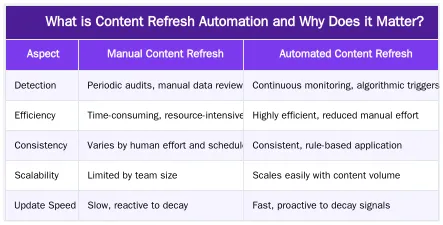
What is Content Refresh Automation and Why Does it Matter?
Content refresh automation is a systematic, technology-driven approach to identify, update, and republish existing content to maintain its relevance, accuracy, and SEO performance. It leverages software and predefined rules to monitor content performance and trigger necessary updates without constant human intervention. This process ensures that information remains current, aligning with evolving search intent and algorithm changes.
In 2026, search engine algorithms, particularly Google’s freshness algorithm, prioritize recently updated and accurate information. Stale content can quickly lose its ranking power, leading to decreased organic traffic and reduced visibility. Automated content refreshing addresses this by proactively identifying underperforming or outdated pages and initiating updates, such as revising statistics, adding new sections, or optimizing for emerging keywords. This not only improves search engine standing but also enhances user experience by providing timely and relevant information. The continuous maintenance of content quality is crucial for long-term digital success.
How Does Content Decay Impact Your SEO Rankings?
Content decay refers to the natural decline in a piece of content’s performance over time. This phenomenon is a significant challenge for SEO professionals, as once high-ranking pages can gradually lose their visibility and organic traffic. Several factors contribute to this decline, including the emergence of newer, more comprehensive competitor content, shifts in user search intent, and the natural obsolescence of information.
For example, an article published in 2023 detailing “SEO trends” would likely contain outdated information by 2026, making it less relevant to current search queries. Similarly, if a competitor publishes a more in-depth or visually appealing piece on the same topic, search engines may favor the newer content. Evolving algorithms also play a role, as updates can re-evaluate content quality signals, potentially penalizing pages that haven’t kept pace. Proactively addressing content decay is essential to preserve SEO value and maintain a competitive edge.
Identifying the Signs of Content Decay
Recognizing content decay early is crucial for effective intervention. Key indicators include a noticeable decline in organic traffic to specific pages, a drop in keyword rankings for previously strong terms, and reduced engagement metrics such as lower time on page or higher bounce rates. Outdated statistics, broken external links, or references to past events also signal that content requires attention. For a deeper dive into managing underperforming content, consider exploring strategies for content pruning for SEO.
Implementing Content Refresh Automation: A Strategic Blueprint
Implementing a content update automation strategy involves a structured approach to ensure efficiency and effectiveness. The process begins with establishing clear monitoring parameters, defining specific triggers for updates, and integrating the necessary technological tools. This systematic blueprint allows businesses to move beyond reactive manual updates to a proactive, automated content lifecycle management system.
First, identify your core evergreen content assets that are critical for organic traffic. Next, set up monitoring for key performance indicators (KPIs) such as organic traffic, keyword rankings, and backlink profiles. Define precise refresh triggers, such as a 20% drop in organic traffic over 90 days or a 5-position decline for a target keyword. Once a trigger is met, the automated system initiates a workflow for content analysis and update generation. This might involve pulling new data, suggesting content additions, or re-optimizing for current search intent. The final step is automated publishing or a streamlined review process before publication.
Key Technologies and Integrations for Seamless Updates
Effective content update automation relies on a suite of integrated technologies. Core components include advanced SEO monitoring software that tracks rankings, traffic, and competitor activity. A robust content management system (CMS) is essential for housing content and facilitating automated publishing. Crucially, API integrations allow systems to pull fresh data from authoritative sources, such as government statistics, industry reports, or real-time market data. These integrations enable dynamic content elements to be updated automatically, ensuring accuracy and relevance. For insights into leveraging data for content at scale, explore AI content at scale with SERP data.
Ruxi Data’s Intelligent Approach to Content Freshness
Ruxi Data employs a sophisticated methodology for content refresh automation, designed to maintain content relevance and performance with precision. This approach focuses on intelligent monitoring, precise trigger detection, and automated update mechanisms. By systematically analyzing content performance against predefined benchmarks, Ruxi Data ensures that content remains optimized for search engines and user engagement.
The system integrates various data points to create a comprehensive view of content health. This includes real-time ranking data, organic traffic analytics, and competitive landscape analysis. The goal is to identify content that is either underperforming or at risk of decay before it significantly impacts overall SEO. This proactive stance is fundamental to preserving the value of existing content assets and maximizing their long-term contribution to organic visibility.
Automated Detection: When Content Needs Refreshing
Ruxi Data’s system continuously monitors key performance indicators to identify when content requires attention. This includes tracking significant ranking drops for target keywords and declines in organic traffic. Specific thresholds are configured, such as a 20% traffic loss over a defined period or a drop of five or more positions in search engine results pages for critical terms. When these thresholds are met, the system automatically triggers an in-depth analysis of the content, initiating a refresh workflow. This ensures that content updates are timely and data-driven, directly addressing performance issues. Understanding SERP intent is integral to this detection process, ensuring updates align with current user needs.
Ensuring Accuracy: Automated Data and Fact-Checking
Maintaining the accuracy of content is paramount for E-E-A-T (Experience, Expertise, Authoritativeness, Trustworthiness). Ruxi Data’s system pulls fresh data from authoritative APIs and sources to automatically update statistics, facts, and other dynamic content elements. This capability ensures that content remains current and reliable without manual data entry. For example, if an article cites market share percentages from 2024, the system can integrate with relevant industry APIs to retrieve and update these figures to 2026 data. This automated fact-checking process significantly reduces the risk of publishing outdated or incorrect information, thereby enhancing content credibility and user trust. For more on the importance of data accuracy in content, see this Wikipedia article on data quality.
The ROI of Automated Content Refreshing: Boosted Rankings & Efficiency
Implementing automated content refreshing yields a measurable return on investment through improved search engine rankings, increased organic traffic, and significant operational efficiencies. By systematically updating content, businesses can recover lost rankings, capture new search opportunities, and ensure their evergreen assets continue to drive value. This proactive approach minimizes the impact of content decay, transforming underperforming pages into high-value assets.
The time and resources saved by automating content updates are substantial compared to manual processes. Instead of dedicating hours to identifying, analyzing, and manually updating individual pieces of content, teams can focus on strategic content creation and other high-impact SEO activities. This reallocation of resources contributes directly to a positive ROI, making content lifecycle management more sustainable and scalable. Automated systems ensure that content remains competitive and relevant in a dynamic digital environment.
Key Metrics to Track for Content Freshness Success
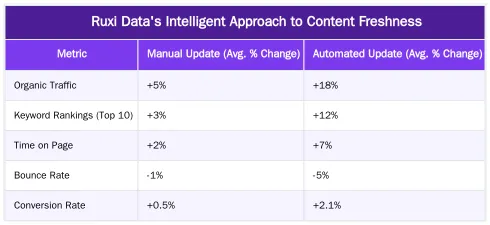
To evaluate the effectiveness of automated content refreshing, several key performance indicators (KPIs) should be monitored. Organic traffic growth to refreshed pages is a primary indicator of success. Improvements in keyword rankings, particularly for target terms, demonstrate enhanced visibility. Reductions in bounce rate and increases in time on page signal improved user engagement and content relevance. Ultimately, tracking conversion rate changes associated with updated content provides a direct measure of its business impact. Consistent monitoring of these metrics allows for continuous optimization and demonstrates the tangible benefits of content refresh automation.
Ready to Transform Your Content Strategy with Automation?
Maintaining content freshness is no longer an option but a necessity for sustained SEO performance. Content refresh automation offers a powerful solution to combat decay, ensure accuracy, and keep your rankings stable without overwhelming your team. By embracing automated content updates, you can free up valuable resources, improve your content’s long-term value, and secure a stronger position in search results. Explore how a tailored automation strategy can benefit your digital presence. Visit AbdurrahmanSimsek.com to learn more about intelligent content solutions.
Conclusion
The digital landscape of 2026 demands a proactive approach to content management, where continuous freshness is paramount for SEO success. Content refresh automation provides a strategic framework to combat content decay, ensuring that your valuable assets remain relevant, accurate, and highly visible in search engine results. By leveraging intelligent monitoring and automated update mechanisms, businesses can achieve significant improvements in rankings, organic traffic, and operational efficiency. This systematic approach not only preserves the value of existing content but also frees up resources for new content creation, fostering sustainable growth. To explore how automated content solutions can elevate your SEO strategy, visit AbdurrahmanSimsek.com.
Frequently Asked Questions
What is content refresh automation and why is it important?
Content refresh automation is a systematic, technology-driven approach to identify, update, and republish existing content to maintain its relevance, accuracy, and SEO performance. It’s crucial because it combats content decay, ensures evergreen assets remain visible, and stabilizes search rankings without constant manual effort, making your SEO strategy more efficient.
How does Ruxi Data detect content needing a refresh for content refresh automation?
Ruxi Data’s system continuously monitors key performance indicators such as ranking drops, traffic decline, and competitor updates. When content experiences a significant drop (e.g., 20% traffic loss or 5+ position drop), it triggers automated analysis and refresh workflows, initiating the **content refresh automation** process.
Can a system using content refresh automation update statistics automatically?
Yes, systems like Ruxi Data are designed to pull fresh data from authoritative APIs and reliable sources. This capability allows for the automatic updating of statistics, prices, and other dated information within your content. It also maintains source citations to ensure E-E-A-T compliance and accuracy.
What ranking improvements can be expected from automated content refreshing?
Content updated through automated refreshing, especially with live SERP data integration, typically recovers 60-80% of lost rankings within 4-6 weeks. Some pieces may even experience significant traffic increases, sometimes up to 150%, due to enhanced relevance and improved search visibility.
Does automated content refreshing affect the original publish date?
No, the system is designed to preserve the original publish date of your content. Instead, it adds a ‘Last Updated’ timestamp to signal freshness to search engines like Google. This approach helps maintain the content’s age authority while indicating that it has been recently reviewed and updated.
How does refresh automation adapt to semantic changes in search intent?
Our AI analyzes shifts in search intent and identifies emerging entities and new terminology within your niche. It automatically incorporates these new concepts and relevant keywords into your content during the refresh process. This ensures your content remains topically focused and aligned with current user queries.
Ruxi Data brings together multi-model AI, automated website crawling, live indexation checks, topical authority mapping, E-E-A-T enrichment, schema generation, and full pipeline automation — from crawl to WordPress publish to social posting — all in one platform built for agencies and freelancers who run on results.