
YMYL SEO Compliance: Elevating Medical Website Trust
YMYL SEO compliance is crucial for medical websites to achieve visibility and patient trust. This article outlines a practical checklist for medical content accuracy, authoritativeness, and trustworthiness, directly addressing Google’s E-E-A-T signals and Quality Rater Guidelines. Understanding YMYL principles ensures content meets the highest standards for health-related information, safeguarding users and enhancing search engine rankings. Implementing these strategies helps medical practices establish online authority and attract patients, aligning with helpful content update objectives.
Abdurrahman Şimşek, a Semantic SEO Strategist, offers actionable insights for medical websites to navigate complex Google updates. This content delivers a clear framework for demonstrating Expertise, Experience, Authoritativeness, and Trustworthiness (E-E-A-T) signals through elements like author bios and schema markup.
To explore your options, contact us to schedule your consultation. You can also reach us via: Book a Semantic SEO Audit, Direct WhatsApp Strategy Line: +90 506 206 86 86
For medical websites, ymyl seo compliance is critical for visibility and patient trust. This article provides a checklist for London’s private healthcare clinics to navigate Google’s ‘Your Money or Your Life’ guidelines and meet Expertise, Experience, Authoritativeness, and Trustworthiness (E-E-A-T) standards to maintain online authority and attract patients.
What is YMYL SEO and Why is it Critical for Medical Websites?
YMYL, or ‘Your Money or Your Life,’ is a Google classification for topics that impact a person’s health, happiness, or financial stability. For medical websites, this classification is critical because inaccurate information can harm users. Google scrutinizes YMYL content, requiring high quality and trustworthiness for user safety.
Understanding Google’s ‘Your Money or Your Life’ Classification
Google categorizes content as YMYL if it affects a user’s health, financial decisions, safety, or legal standing. Medical topics are in this category, including disease information, treatment options, surgical procedures, and pharmaceutical advice. Google’s algorithms prioritize authoritative, accurate, and reliable sources for these queries, making YMYL compliance non-negotiable for medical practices seeking online visibility.
The Foundational Role of E-E-A-T in Medical SEO
E-E-A-T stands for Expertise, Experience, Authoritativeness, and Trustworthiness. Google uses these principles to evaluate YMYL content. Google’s Quality Rater Guidelines detail how human raters assess these signals. Medical content must demonstrate that information comes from qualified professionals, is based on experience, is recognized as authoritative, and is presented on a trustworthy platform. Without strong E-E-A-T signals, medical websites struggle to rank for health-related queries.
Decoding E-E-A-T Signals: Google’s Blueprint for Trustworthy Medical Content
Demonstrating E-E-A-T requires strategic implementation across your medical website. Each component—Expertise, Experience, Authoritativeness, and Trustworthiness—must be communicated to search engines and patients. This requires attention to content creation, website structure, and transparent presentation of credentials.
Demonstrating Expertise and Experience in Healthcare Content
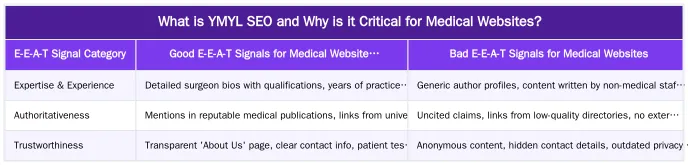
For medical content, expertise is based on formal qualifications, certifications, and professional development. Showcase the medical degrees, board certifications, and specialized training of your surgeons and staff. Experience reflects years of practical application and patient care. Content must be authored or reviewed by individuals with direct clinical experience in the topics discussed. Highlight this with detailed author bios, case studies, and testimonials. For more detail, see our guide on Establishing E-E-A-T: Foundational Content and Signals for Surgeons.
Building Authoritativeness and Trustworthiness for Your Clinic
Authoritativeness comes from recognition by reputable sources, including mentions in medical journals, professional association memberships, and backlinks from established healthcare institutions. Trustworthiness requires transparency and reliability. A detailed ‘About Us’ page with your clinic’s history, mission, and team is crucial. Clear contact information, patient testimonials, and secure data handling practices (GDPR, HIPAA) reinforce trust. Consistent branding and a professional online presence contribute to your clinic’s perceived reliability.
Your YMYL SEO Compliance Checklist for Medical Websites
YMYL compliance requires addressing content quality, technical foundations, and external signals. This checklist provides steps for medical practices to meet Google’s standards, particularly for competitive markets like London.
Content Accuracy & Editorial Standards for Medical Information
All medical content must be accurate and current. Implement an editorial process including:
- Fact-checking: All medical claims must be verifiable against authoritative sources (e.g., peer-reviewed journals, government health organizations).
- Citing Sources: Clearly reference the medical literature or expert bodies that support your content.
- ‘Last Reviewed’ Dates: Display a prominent ‘last reviewed’ or ‘last updated’ date, along with the name and credentials of the reviewing medical professional.
- Medical Disclaimers: Include clear disclaimers stating that the content is for informational purposes only and not a substitute for professional medical advice.
- Originality: Prioritize original research, insights, and patient-centric perspectives.
These practices align with Google’s Quality Rater Guidelines.
Technical SEO & Schema Markup for E-E-A-T Signals
Technical SEO helps convey E-E-A-T.
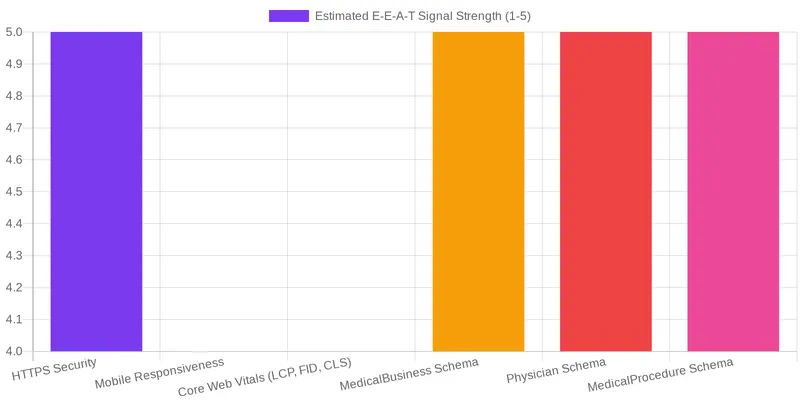
- Secure Hosting (HTTPS): Essential for patient data privacy and a baseline trust signal.
- Mobile-Friendliness: A responsive design ensures accessibility, a key ranking factor.
- Core Web Vitals: Optimize for page loading speed, interactivity, and visual stability for a better user experience.
- Strategic Schema Markup: Implement MedicalBusiness, Physician, and MedicalProcedure JSON-LD schema to define your clinic, practitioners, and services. This helps search engines understand your site’s entities and attributes, boosting E-E-A-T signals. For implementation details, see Implementing Advanced Medical Schema for Entity Recognition.
Beyond the Basics: Advanced YMYL Strategies for London’s Elite Clinics
In London’s competitive private healthcare market, basic YMYL compliance is the entry point. Clinics require advanced semantic SEO strategies to differentiate, build topical authority, and reduce Google’s ‘Cost of Retrieval’ for complex medical information. Specialized semantic engineering expertise is invaluable here.
Building Topical Authority for Algorithm-Proof YMYL Content
Topical authority is comprehensive coverage of a subject, establishing your clinic as a resource. For YMYL content, this means creating interconnected content that addresses all facets of a medical topic, from symptoms and diagnoses to treatments and recovery. This structured approach, often built through semantic content networks, signals deep knowledge to Google, reinforcing E-E-A-T and making content resilient to algorithm updates.
The Role of Semantic Engineering in YMYL Trust Signals
Semantic engineering, through Entity-Attribute-Value (EAV) modeling, helps search engines understand relationships between medical entities (e.g., a surgical procedure, the surgeon, and its risks). Defining these entities and their attributes provides Google with structured, unambiguous data. Tools like Ruxi Data automate creating topical maps and EAV models. This precision reduces Google’s ‘Cost of Retrieval’ (CoR)—the effort to understand and verify information—enhancing trust signals and improving ranking potential for YMYL queries. This approach aligns with principles in semantic web technologies and knowledge representation.
Conclusion
YMYL compliance is fundamental for medical websites to succeed in Google’s search results. By addressing E-E-A-T signals, maintaining content accuracy, optimizing technical elements, and using semantic strategies, London’s private healthcare clinics can build trust and authority. This approach safeguards against algorithm penalties and positions your practice as an authoritative source, attracting patients. To meet these standards, partner with a specialist in medical semantic SEO. Visit abdurrahmansimsek.com. Book a Semantic SEO Audit, Direct WhatsApp Strategy Line: +90 506 206 86 86.
Frequently Asked Questions
What does YMYL stand for and why is it important for medical SEO?
YMYL stands for “Your Money or Your Life,” a Google classification for topics that can significantly impact a person’s health, happiness, or financial stability. For medical websites, this classification is critical because inaccurate information can lead to harm. Google scrutinizes content under YMYL SEO guidelines, demanding the highest levels of trust and accuracy to ensure user safety and well-being.
What is the single most important factor for YMYL SEO compliance?
Demonstrating E-E-A-T (Experience, Expertise, Authoritativeness, Trustworthiness) is the single most crucial factor for meeting these strict guidelines. This is achieved through content written or reviewed by qualified medical experts, detailed author biographies with verifiable credentials, and clear information about who is responsible for the website’s content. Prioritizing E-E-A-T signals helps Google understand the reliability and quality of your medical information.
How can I improve my medical website’s ‘Trustworthiness’ signal for YMYL content?
To enhance trustworthiness, ensure contact information is easy to find and maintain a comprehensive ‘About Us’ page detailing your clinic’s mission and team. Showcasing patient testimonials and providing clear policies for privacy and medical disclaimers also builds confidence. Secure hosting (HTTPS) and transparent pricing information further contribute significantly to establishing credibility under YMYL standards.
How do author pages contribute to YMYL SEO for medical websites?
For medical websites, every article should be attributed to a qualified author with a dedicated biography page. This page must detail their credentials, experience, education, and link to professional profiles like LinkedIn or a medical register. This transparency is a powerful E-E-A-T signal, directly supporting the high standards required for YMYL content by proving the expertise behind the information.
How does technical SEO support YMYL compliance for medical sites?
Technical SEO elements, such as Physician and MedicalClinic schema markup, help Google accurately identify the experts and the organization behind your content. A secure, professional, and error-free website also contributes to the overall perception of trustworthiness. These technical aspects are paramount for YMYL compliance, ensuring your site is both discoverable and credible.
How can Abdurrahman Şimşek help my medical website with its YMYL SEO strategy?
Abdurrahman Şimşek, a Semantic SEO Strategist, specializes in medical and plastic surgery SEO for London clinics, leveraging his Semantic SEO Framework to build topical authority. He can assess your site’s compliance and develop a tailored strategy to meet Google’s stringent requirements. You can book a Semantic SEO Audit or reach out directly via WhatsApp at +90 506 206 86 86 for strategic guidance.
Ruxi Data brings together multi-model AI, automated website crawling, live indexation checks, topical authority mapping, E-E-A-T enrichment, schema generation, and full pipeline automation — from crawl to WordPress publish to social posting — all in one platform built for agencies and freelancers who run on results.