
Topical Authority Mapping: Building Robust Content Silos
Topical authority mapping is a strategic SEO process for organizing content into comprehensive subject areas, demonstrating deep expertise to search engines. This article outlines a data-driven workflow to construct robust content silo architecture, moving beyond basic keyword strategies to encompass semantic relevance and entity relationships. Readers will learn to leverage SERP analysis, identify key entities, and implement effective pillar page and topic cluster models. This approach enhances content visibility, improves search engine understanding of expertise, and drives qualified organic traffic by satisfying diverse user intents.
This guide provides a structured methodology for implementing advanced SEO strategies, focusing on comprehensive content organization. It offers actionable insights for businesses aiming to establish themselves as authoritative sources within their respective niches, aligning content with modern search engine algorithms and user expectations.
To explore your options, contact us to schedule your consultation.
Mastering topical authority mapping is essential for achieving prominent search engine rankings and establishing industry leadership in 2026. This guide unveils a data-driven workflow designed to construct robust content silos, ensuring your content strategy precisely aligns with search engine understanding and user intent. By implementing these methods, you can accelerate your journey to becoming an undeniable authority in your niche, moving beyond basic keyword strategies to comprehensive semantic relevance. This approach optimizes content architecture for maximum visibility and impact.
The Data-Driven Workflow for Content Silo Architecture
A data-driven workflow for establishing content silo architecture begins with a deep dive into search engine results pages (SERPs) and semantic analysis. This systematic approach ensures content creation is guided by actual user intent and search engine understanding, rather than assumptions. The process involves identifying core topics, extracting key entities, and mapping their relationships to construct a logical and comprehensive content structure. This analytical foundation is critical for building a robust information architecture that search engines can easily crawl, understand, and rank.
The workflow moves from broad topic identification to granular entity analysis, culminating in a structured content plan. This involves using specialized tools to uncover hidden semantic connections and content gaps that traditional keyword research might miss. By focusing on the interconnectedness of information, this methodology helps create a website structure that mirrors the complexity of a subject, signaling deep expertise. This structured approach to content creation is fundamental for achieving significant organic visibility and establishing a brand as a definitive source of information.
Leveraging SERP Analysis for Topic Identification
Analyzing live SERP data is foundational for identifying relevant topics and understanding user intent. This involves examining the top-ranking pages for broad keywords related to your niche. Observe the types of content, common themes, questions addressed, and the entities frequently mentioned by competitors. Tools that perform semantic analysis can extract these insights, revealing not just keywords, but the underlying concepts and relationships Google associates with a query. This deep analysis helps uncover the full scope of a topic and potential content gaps. For a deeper dive into structuring your content, explore our content silo architecture guide.
From Entities to Content Silos: A Step-by-Step Process
The transition from identified entities to structured content silos involves several steps. First, extract all significant entities from your SERP analysis and categorize them. Group related entities into logical clusters, which will form your sub-topics. Next, identify a central, broad entity or concept that can serve as a pillar page for each cluster. The remaining entities become supporting content pieces within that cluster. This process of entity optimization ensures comprehensive coverage of a subject. For example, if “digital marketing” is a core topic, “SEO,” “PPC,” and “social media marketing” might be pillar pages, with specific entities like “keyword research,” “bid management,” and “influencer outreach” forming their respective cluster content. This hierarchical organization creates a clear information architecture.
Implementing Pillar Pages & Topic Clusters Effectively
Effective implementation of pillar pages and topic clusters is the architectural backbone of a successful content strategy. A pillar page serves as a comprehensive, high-level overview of a broad topic, linking out to more detailed cluster content. Topic clusters, in turn, delve into specific sub-topics and entities, providing in-depth information and linking back to the pillar page. This interconnected structure signals to search engines that your site offers extensive coverage of a subject. A data-driven approach ensures these structures are optimized for Google’s understanding of semantic relationships and entity relevance, moving beyond simple keyword targeting to holistic topic coverage.
The strategic placement of internal links within this architecture is paramount. Pillar pages should link to all supporting cluster content, and each piece of cluster content should link back to its respective pillar page. This robust internal linking structure distributes link equity, enhances crawlability, and reinforces the topical relevance of the entire cluster. It also guides users through related content, improving user experience and time on site. This systematic organization is key to building strong topical authority and improving overall organic performance.
Building Your Content Silo Architecture for Maximum Impact
Building a content silo architecture involves creating a central pillar page that broadly covers a topic, then developing multiple supporting articles (topic clusters) that explore specific aspects in detail. Each cluster article links back to the pillar page, and the pillar page links to all cluster articles. This creates a tight, interlinked structure. For example, a pillar page on “Content Marketing Strategy” might link to cluster articles on “Keyword Research for Content,” “Content Promotion Tactics,” and “Measuring Content ROI.” This organized approach ensures search engines recognize the depth of your expertise. Learn more about developing a robust pillar page SEO strategy.
Automation and AI in Accelerating Topical Authority
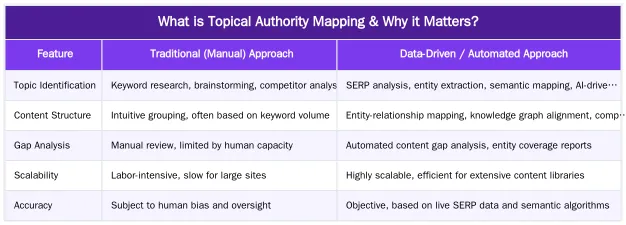
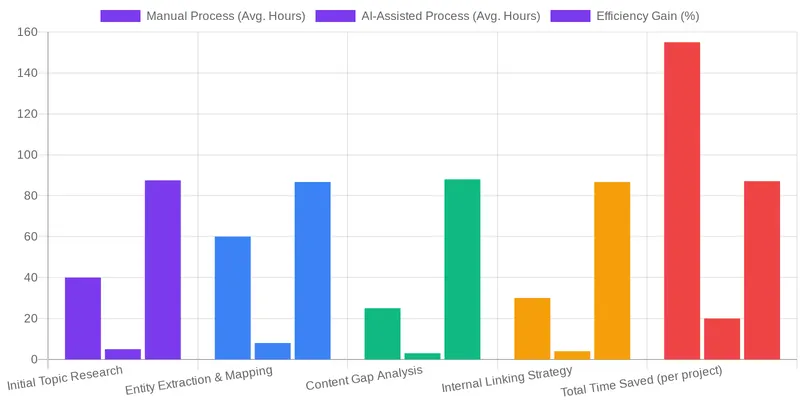
Automation and artificial intelligence play a transformative role in accelerating the process of building topical authority. Manual content mapping is time-consuming and prone to human error, especially for large websites or complex niches. AI-powered tools can analyze vast amounts of SERP data, identify entities, map semantic relationships, and uncover content gaps with unparalleled speed and precision. These tools streamline the entire workflow, from initial topic research to content structuring and internal linking recommendations. They can process millions of data points to reveal comprehensive topic landscapes that would be impossible for a human to discern manually.
AI algorithms can also assist in generating content briefs, suggesting optimal internal linking opportunities, and even identifying potential pillar page candidates based on existing content. This automation frees up SEO professionals and content creators to focus on strategy and content quality, rather than repetitive data analysis. By leveraging these technologies, businesses can significantly reduce the time and resources required to establish and maintain strong topical authority, ensuring their content strategy remains agile and responsive to evolving search trends. For a detailed guide on leveraging automation, consider our topic cluster strategy workflow.
Conclusion
Achieving topical authority is no longer a luxury but a necessity for sustainable SEO success. By embracing a data-driven workflow for topical authority mapping, businesses can build content silos that accurately reflect search engine understanding and user intent. This strategic approach, leveraging advanced SERP analysis, entity optimization, and the power of AI, transforms content creation from a guessing game into a precise, scalable operation. The resulting benefits—higher rankings, increased organic traffic, and enhanced brand credibility—are foundational for long-term digital growth. Elevate your content strategy and establish your brand as an undeniable expert by implementing these advanced techniques. Discover how to streamline your content efforts and achieve unparalleled topical dominance at abdurrahmansimsek.com.
Frequently Asked Questions
What is topical authority mapping and why is it important?
Topical authority mapping is the strategic process of planning and organizing content to comprehensively cover a subject. This data-driven approach demonstrates deep expertise to search engines like Google. It helps your site rank for a wide range of related queries and establishes you as a trusted leader in your niche.
What is the primary benefit of using topical authority mapping to build content silos?
The main benefit is that it organizes your content around specific topics, creating clear thematic signals for search engines. This structure, created through topical authority mapping, concentrates link equity, improves site crawlability, and demonstrates comprehensive expertise, leading to higher rankings for competitive terms.
Can I apply a topical authority mapping strategy to an existing website?
Absolutely. You can audit your existing content to identify thematic gaps and then use a topical authority mapping process to recommend a new internal linking and content structure. This often involves pruning or consolidating old content and creating new pillar pages to strengthen your site’s authority.
How many articles are typically needed for a topic cluster?
The number varies based on the topic’s complexity and competition, but a typical cluster has one central pillar page and 5-20 supporting articles. The goal is to comprehensively cover the subject, answering all related user questions identified through SERP analysis.
Does building topical authority impact E-E-A-T signals?
Yes, building deep, organized content on a specific subject is a powerful way to demonstrate Expertise and Authoritativeness. A well-executed content mapping strategy directly contributes to your site’s E-E-A-T profile, which is a critical ranking factor, especially for YMYL niches.
How can automation assist with topical authority mapping?
Modern SEO tools can automate the process by analyzing live SERP data to identify semantic relationships and sub-topics. This can automatically generate a content silo structure with pillar pages and supporting clusters, ensuring your content architecture aligns with how search engines understand a subject.
Ruxi Data brings together multi-model AI, automated website crawling, live indexation checks, topical authority mapping, E-E-A-T enrichment, schema generation, and full pipeline automation — from crawl to WordPress publish to social posting — all in one platform built for agencies and freelancers who run on results.