
Structure Medical Procedure Pages: Optimize for Semantic SEO & AI Overviews
To effectively structure medical procedure pages for optimal search engine visibility and patient engagement, this guide details how to design and optimize these critical pages. It emphasizes leveraging robust structured data like MedicalProcedure schema and FAQ schema, alongside clear content hierarchy and semantic HTML, to enhance discoverability for both human readers and AI Overviews. Readers will learn to improve user experience, align with the patient journey, and build topical authority, ensuring medical content is trustworthy and accessible. This approach boosts conversion rates and digital presence.
Abdurrahman Şimşek, a Semantic SEO Strategist, provides expert guidance on optimizing digital health content. This content delivers actionable strategies for healthcare providers to enhance online visibility and patient engagement through advanced SEO techniques.
To explore your options, contact us to schedule your consultation. You can also reach us via: Book a Semantic SEO Audit, Direct WhatsApp Strategy Line: +90 506 206 86 86, Hire as Semantic SEO Architect
To effectively structure medical procedure pages for optimal search engine visibility and patient engagement, a strategic approach is essential. This guide outlines how to design and optimize these critical pages, ensuring they rank prominently in traditional search results and are readily understood by AI Overviews. By focusing on clear content hierarchy, robust structured data, and an exceptional user experience, medical clinics and plastic surgeons can enhance their digital presence, build topical authority, and ultimately connect with more patients seeking specific treatments. Understanding these principles is key to transforming clinical expertise into discoverable, trustworthy online information.
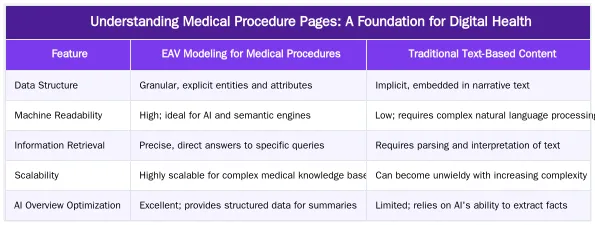
Understanding Medical Procedure Pages: A Foundation for Digital Health
Medical procedure pages serve as the digital storefront for a clinic’s services, detailing specific treatments, surgeries, or diagnostic processes. These pages are crucial for informing potential patients, establishing credibility, and guiding them through their healthcare journey. Effective content design for these pages goes beyond merely listing services; it involves creating a comprehensive resource that addresses patient queries, concerns, and decision-making factors.
The primary goal of these pages is to provide clear, accurate, and accessible information about a medical intervention. This includes explaining what the procedure entails, who is an ideal candidate, and what outcomes can be expected. For healthcare providers, well-organized procedure pages are fundamental to attracting and converting patients, especially in competitive markets like London’s aesthetic surgery sector. They also form a vital part of a broader pillar page SEO strategy, supporting a clinic’s overall topical authority.
Key Content Elements for Comprehensive Procedure Pages
A robust medical procedure page must address a patient’s full spectrum of questions and concerns. Key content elements ensure clarity, build trust, and facilitate informed decision-making. These elements typically include a detailed description of the procedure, its benefits, potential risks, and the recovery process.
- Procedure Overview: A concise explanation of the treatment, its purpose, and how it is performed.
- Benefits and Expected Outcomes: Clearly articulate what a patient can gain from the procedure, including realistic expectations.
- Risks and Side Effects: Transparently disclose potential complications, ensuring patients are fully aware. This is critical for YMYL (Your Money Your Life) content and E-E-A-T.
- Preparation and Recovery: Provide detailed instructions for pre-procedure preparation and post-procedure care, including typical recovery timelines.
- Cost Information: Offer clear pricing structures or explain how costs are determined, addressing a common patient query.
- Patient Testimonials and Before/After Galleries: Visual evidence and social proof can significantly enhance patient confidence, adhering to ethical guidelines.
- FAQs: Address common questions directly, improving user experience and providing content for potential AI Overviews.
Structuring these elements logically, often using headings, bullet points, and accordions, improves readability and helps users quickly find the information they need.
Leveraging Structured Data with MedicalProcedure Schema
Structured data, particularly `MedicalProcedure` schema, is vital for search engines to understand the specific details of a medical service. Implementing this JSON-LD markup directly on your procedure pages helps search engines categorize and present your content more effectively, often leading to rich results and improved visibility in AI Overviews.
Properly applied, `MedicalProcedure` schema communicates key attributes of a treatment directly to search algorithms. This reduces the search engine’s Cost of Retrieval (CoR) by providing explicit data points, making your content easier to process and rank. For detailed guidance on implementation, refer to resources on medical schema for surgeons.
Key properties to include in `MedicalProcedure` schema:
@type: “MedicalProcedure”name: The name of the procedure (e.g., “Rhinoplasty”).description: A brief summary of the procedure.procedureType: The category of the procedure (e.g., “Plastic Surgery”).bodyLocation: The part of the body affected (e.g., “Nose”).preparation: Instructions for preparing for the procedure.procedurePerformed: Details about how the procedure is carried out.recoveryTime: Expected duration of recovery.risks: Potential complications or side effects.outcome: Expected results or benefits.code: Relevant medical codes (e.g., CPT codes), if applicable.associatedAnatomy: Link to `AnatomicalStructure` or `AnatomicalSystem` entities.signOrSymptom: Conditions the procedure addresses.
By defining these attributes, you create a machine-readable representation of your content, enhancing its discoverability and semantic relevance.
Optimizing for User Experience and the Patient Journey
User experience (UX) is paramount for medical procedure pages, directly impacting patient engagement and conversion rates. A well-designed page guides the patient through their decision-making process, from initial research to booking a consultation. This involves intuitive navigation, clear calls to action, and a logical information architecture.
Consider the patient journey: they typically start with a broad search, then narrow down their options. Your page should anticipate these stages. For instance, an initial overview should lead to detailed sections, followed by FAQs and contact options. Visual elements like high-quality images and videos can significantly enhance understanding and trust. Ensuring mobile responsiveness is also critical, as many patients access health information on smartphones.
Content design should prioritize readability, using clear headings, short paragraphs, and bullet points. Accessibility features, such as appropriate font sizes and color contrasts, are also essential for a diverse audience. Ultimately, a positive user experience fosters trust and encourages patients to take the next step, whether it’s downloading a brochure or scheduling an appointment.
Semantic SEO Best Practices for Medical Content
For medical content, particularly in the YMYL (Your Money Your Life) category, establishing E-E-A-T (Experience, Expertise, Authoritativeness, Trustworthiness) is non-negotiable. Semantic SEO moves beyond keyword density to focus on understanding the full context and relationships between entities. This approach is central to Abdurrahman Şimşek’s methodology, leveraging over 10 years of experience in search engineering to build high-authority semantic content networks for London clinics.
Building topical authority involves creating comprehensive content clusters around core medical entities. For example, a page on “Rhinoplasty” should semantically link to related concepts like “nasal anatomy,” “septoplasty,” “facial aesthetics,” and “recovery from surgery.” This interconnectedness signals deep expertise to search engines. Utilizing robust semantic HTML for SEO further enhances this understanding, providing a clear structure for both users and machines.
Incorporating references to authoritative medical sources, such as the NHS website or peer-reviewed journals, reinforces trustworthiness. Abdurrahman Şimşek’s strategies, often powered by the Ruxi Data semantic engine, focus on transforming clinical expertise into structured, entity-rich content that reduces the search engine’s Cost of Retrieval (CoR) and establishes dominant topical authority for aesthetic practices.
Enhancing Visibility for AI Overviews and Generative Engines
The rise of AI Overviews and generative search experiences in 2026 demands a new approach to content optimization, often termed Generative Engine Optimization (GEO). These AI systems synthesize information from various sources to provide direct answers, making structured and semantically rich content more critical than ever. To effectively appear in these summaries, medical procedure pages must be designed for clarity and explicit data extraction.
Content that is well-organized, uses clear headings, and incorporates structured data (like `MedicalProcedure` schema and `FAQPage` schema) is more easily processed by AI. This explicit structuring helps AI models identify key facts, definitions, and procedural steps, making your content a prime candidate for inclusion in AI-generated summaries. Reducing the Search Engine Cost of Retrieval (CoR) is a core principle here; the easier an AI can understand and extract information, the more likely it is to feature your content.
Implementing Entity-Attribute-Value (EAV) modeling for surgical procedures is a powerful technique for this. By breaking down complex medical information into discrete, machine-readable entities and their attributes, you provide AI with a precise dataset to work with. This granular approach ensures that even nuanced details of a procedure are accurately represented and discoverable by advanced search algorithms.
Implementing Entity-Attribute-Value (EAV) Modeling for Surgical Procedures
Entity-Attribute-Value (EAV) modeling is a sophisticated data structure that organizes information by defining entities, their attributes, and the corresponding values. For medical procedure pages, EAV modeling allows for a highly granular and machine-readable representation of complex clinical data. This approach is particularly beneficial for optimizing for AI Overviews and reducing the Cost of Retrieval (CoR) for search engines.
Instead of presenting information solely in free-form text, EAV breaks down each procedure into its core components. For example, for “Rhinoplasty,” the “Entity” is Rhinoplasty, “Attributes” could be ‘Procedure Type’, ‘Body Location’, ‘Recovery Time’, ‘Anesthesia Type’, and ‘Potential Risks’. The “Values” would then be ‘Plastic Surgery’, ‘Nose’, ‘2-4 weeks’, ‘General’, and ‘Swelling, Bruising’. This structured approach makes the data unambiguous for AI and semantic search engines.
This method facilitates the creation of comprehensive topical maps and semantic content networks, allowing for dynamic content generation and precise information retrieval. It moves beyond simple keyword matching to a deep understanding of medical concepts and their interrelationships, which is crucial for establishing medical E-E-A-T infrastructure for surgeons.
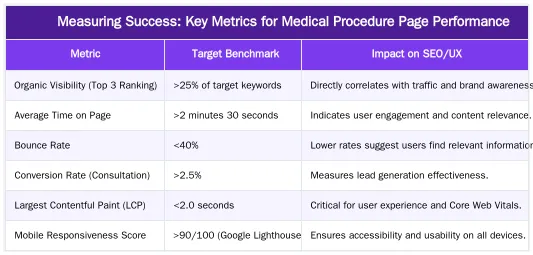
Measuring Success: Key Metrics for Medical Procedure Page Performance
To ensure medical procedure pages are achieving their objectives, it is essential to track specific performance metrics. These metrics provide insights into user engagement, search visibility, and ultimately, conversion effectiveness. Monitoring these indicators allows for continuous optimization and refinement of content and structure.
Key metrics include organic search rankings for target keywords, which indicate visibility. User engagement metrics such as average time on page, bounce rate, and scroll depth reveal how deeply users are interacting with the content. Conversion rates, such as consultation requests, form submissions, or phone calls, directly measure the page’s effectiveness in generating leads.
Technical performance metrics, like Core Web Vitals (e.g., Largest Contentful Paint – LCP), are also crucial for user experience and search engine ranking. A fast, responsive page contributes to better engagement and lower bounce rates. By regularly analyzing these data points, clinics can identify areas for improvement and ensure their digital assets are performing optimally in the competitive healthcare landscape.
Partnering for Semantic Excellence in Medical SEO
Optimizing medical procedure pages for semantic SEO and AI Overviews requires specialized expertise in both healthcare digital strategy and technical web development. Abdurrahman Şimşek offers a unique blend of these skills, focusing on building dominant topical authority for medical clinics and plastic surgeons in London. His approach leverages advanced semantic engineering and the Ruxi Data infrastructure to create highly structured, machine-readable content networks.
By partnering with a semantic SEO architect, clinics can ensure their online presence is not only visible but also deeply understood by the evolving search landscape. This strategic collaboration transforms clinical expertise into a powerful digital asset, driving organic growth and patient engagement. For a tailored strategy to enhance your medical procedure pages and establish unparalleled topical authority, consider a specialized consultation.
Book a Semantic SEO Audit today to discover how a holistic approach can redefine your digital success. For immediate strategic discussions, you can also reach out via Direct WhatsApp Strategy Line: +90 506 206 86 86. Alternatively, Hire as Semantic SEO Architect to implement these advanced strategies for your practice.
Conclusion
Effectively structuring medical procedure pages is no longer just about keywords; it’s about building a robust, semantically rich content network that caters to both human patients and advanced AI systems. By prioritizing clear content elements, implementing precise structured data, optimizing for user experience, and embracing entity-attribute-value modeling, medical clinics can achieve superior visibility and establish undeniable topical authority. This strategic approach ensures that your valuable medical information is not only found but also deeply understood and trusted by those seeking care. Elevate your digital presence and connect with more patients by mastering the art of semantic content architecture for your medical services. To explore how these strategies can transform your clinic’s online performance, contact us today. You can also Book a Semantic SEO Audit, use the Direct WhatsApp Strategy Line: +90 506 206 86 86, or Hire as Semantic SEO Architect.
Frequently Asked Questions
What is the most critical element when you structure medical procedure pages for optimal SEO?
The most critical element is a clear, comprehensive breakdown of the procedure itself. This includes sections like ‘Benefits’, ‘Risks’, ‘Recovery’, and ‘Cost’, all enhanced with appropriate semantic HTML and JSON-LD schema. This approach ensures the content satisfies both user intent and search engine requirements, making it easier to structure medical procedure pages effectively.
Should I include pricing information when I structure medical procedure pages?
Providing a transparent price range (e.g., ‘from £X,XXX’) is highly recommended for these pages. It directly addresses a primary user question, helps qualify potential leads, and can be marked up with Offer schema for rich results. This transparency builds trust and improves the user experience when you structure medical procedure pages.
How important are videos and images when optimizing these procedure pages?
High-quality visual content, such as before-and-after galleries and surgeon-led explainer videos, is extremely important. These elements significantly increase user engagement, build trust, and clarify complex information. Always ensure all media is optimized for fast loading and includes descriptive alt text for accessibility and SEO.
What specific schema types are essential to structure medical procedure pages for search engines?
To effectively structure medical procedure pages for search engines, essential schema types include `MedicalProcedure`, `Physician` (for the performing surgeon), `FAQPage`, and `BreadcrumbList`. This combination provides search engines with a rich, interconnected understanding of the content, enhancing visibility and semantic relevance.
How can I optimize procedure pages to appear in AI Overviews?
To enhance visibility in AI Overviews, use clear, question-based headings (H2s, H3s) that directly answer common patient queries. Combine this with semantic HTML5 tags like `
Where can I find expert help to improve the semantic SEO of my medical procedure pages?
Abdurrahman Şimşek, a Semantic SEO Strategist with over 10 years of experience, specializes in medical and plastic surgery SEO for London clinics. You can book a Semantic SEO Audit to get tailored strategies for your pages or contact him directly via WhatsApp at +90 506 206 86 86 for a strategy discussion.
Ruxi Data brings together multi-model AI, automated website crawling, live indexation checks, topical authority mapping, E-E-A-T enrichment, schema generation, and full pipeline automation — from crawl to WordPress publish to social posting — all in one platform built for agencies and freelancers who run on results.