
SERP Feature Tracking: Mastering Rich Results for Visibility
Automated serp feature tracking is essential for securing prominent visibility in evolving search engine results pages (SERPs). This article details how continuous monitoring identifies rich result opportunities, including featured snippets, knowledge panels, and AI Overviews. It outlines strategies for optimizing content to win these valuable SERP features, leveraging automation for competitive intelligence and adapting to feature volatility. Understanding advanced schema performance and utilizing AI for predictive insights are crucial for maximizing organic traffic and user engagement in the dynamic 2026 search landscape.
Abdurrahman Simsek specializes in advanced SEO strategies, offering insights into automated rich results monitoring and performance optimization. This content provides actionable guidance for enhancing search visibility and adapting to evolving SERP dynamics.
To explore your options, contact us to schedule your consultation.
In the dynamic landscape of 2026, automated serp feature tracking is no longer a luxury but a necessity for SEO success. This guide explores how advanced monitoring systems identify, track, and win valuable rich results, ensuring content stands out and drives significant organic traffic. Understanding the mechanics of feature monitoring and leveraging AI for predictive insights offers a critical advantage. By implementing strategic optimizations based on real-time data, businesses can secure prominent visibility and enhance their digital presence in an increasingly competitive search environment.
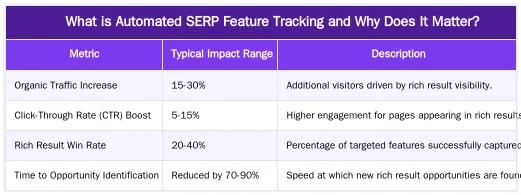
What is Automated SERP Feature Tracking and Why Does It Matter?
Automated serp feature tracking involves the continuous, systematic monitoring of search engine results pages (SERPs) to detect the appearance, disappearance, or ownership changes of rich results. These systems track over 15 distinct SERP features daily across a defined set of keywords. This process is critical in 2026 for maintaining visibility and driving organic traffic, as rich results often occupy prime real estate above traditional organic listings, significantly impacting click-through rates and user engagement.
In the complex 2026 SEO landscape, manual monitoring of rich results is impractical. Automated tools provide the necessary scale and speed to identify opportunities and threats across thousands of keywords. They alert SEO professionals to shifts in feature ownership, allowing for rapid response and optimization. This proactive approach ensures content remains competitive and visible where it matters most.
The Evolving SERP Landscape in 2026
The search engine results page continues to evolve rapidly, with new elements like AI Overviews becoming increasingly prominent in 2026. These generative AI summaries often appear at the top of the SERP, directly answering user queries. This shift necessitates sophisticated, automated monitoring to understand how these new features impact traditional rich results and organic rankings. Keeping pace with these changes requires tools that can adapt and track diverse feature types, providing a comprehensive view of search visibility. For detailed strategies on adapting to these changes, explore optimizing for AI Overviews in 2026.
How Does Automated Tracking Uncover Rich Result Opportunities?
Automated rich results monitoring systems operate by regularly crawling target keywords and analyzing the structure of the SERP for each query. These systems identify a wide array of rich results, including featured snippets, People Also Ask (PAA) boxes, knowledge panels, local packs, video carousels, image packs, top stories, shopping results, and more. Data is collected on which URLs own which features, the content displayed, and any changes over time. AI algorithms then process this vast dataset to identify patterns, such as emerging feature types for specific query categories or shifts in content preferences for existing features.
The AI component is crucial for predicting new opportunities. By analyzing historical data and current trends, AI can suggest keywords where a featured snippet might be attainable or where a new PAA box is likely to appear. It can also highlight content gaps or structural deficiencies in existing pages that prevent them from winning rich results. This predictive capability transforms reactive SEO into a proactive strategy, allowing businesses to optimize content before competitors secure the prime SERP real estate.
Decoding SERP Feature Volatility
SERP feature volatility refers to the frequent changes in the appearance, content, or ownership of rich results. Factors like algorithm updates, new content being published, user behavior shifts, and competitive actions all contribute to this dynamism. Automated tracking provides real-time insights and alerts whenever a rich result is gained, lost, or altered. This immediate notification enables SEOs to react quickly, whether by refining content to regain a lost snippet or by optimizing for a newly identified opportunity. Understanding and adapting to this volatility is essential for maintaining consistent rich result visibility and maximizing organic traffic.
Strategies for Optimizing and Winning SERP Features in 2026
Winning rich results in 2026 requires a multi-faceted approach, particularly with the rise of AI Overviews. For AI Overviews, focus on clear, concise, and semantically structured content that directly answers common user questions. Employing strong semantic HTML, such as “, `
` tags with clear headings, helps search engines and AI models extract information efficiently. Ensure factual accuracy and provide comprehensive yet succinct answers within your content.
Schema markup optimization remains a cornerstone for many rich results. Implementing advanced schema types, beyond basic organization and article markup, can signal specific content types to search engines. This includes `HowTo`, `FAQPage`, `Recipe`, `Product`, and `Event` schema, among others. Regularly auditing and updating your schema ensures it aligns with current search engine guidelines and accurately reflects your content. For more on advanced schema, refer to advanced schema markup 2026.
To win and maintain multiple SERP features simultaneously, adopt a holistic content strategy. Create content that addresses a broad range of user intents related to a topic, structuring it to answer specific questions concisely for featured snippets, provide detailed explanations for AI Overviews, and offer related queries for People Also Ask boxes. This layered approach maximizes the chances of capturing diverse rich results from a single piece of content.
Leveraging Automated Feature Monitoring for Competitive Intelligence
Automated feature monitoring provides a powerful lens into competitor strategies and performance within the SERP. By tracking the rich results owned by key competitors, businesses can identify their strengths and weaknesses. This includes understanding which content types or topics consistently win featured snippets for competitors, or which schema implementations lead to their rich result visibility. Such insights allow for targeted content development and optimization efforts.
The system can highlight instances where competitors gain or lose rich results, signaling shifts in their SEO focus or content updates. For example, if a competitor suddenly wins a significant number of PAA boxes for a specific keyword cluster, it indicates a successful strategy that can be analyzed and potentially emulated. Conversely, if they lose a prominent featured snippet, it presents an immediate opportunity for your own content to capture that position. This continuous competitive analysis informs strategic adjustments, helping to refine content, improve schema, and target new rich result opportunities. Understanding the competitive landscape is crucial for any digital strategy, as highlighted by resources like Wikipedia’s overview of competitive intelligence.
This advanced competitive intelligence extends beyond simple keyword rankings. It focuses on the specific visibility points that drive high-value traffic, enabling businesses to prioritize efforts on features that yield the greatest impact. By consistently monitoring competitor rich result performance, organizations can proactively adapt their SEO tactics to maintain or gain a leading edge.
The Role of AI in Predicting and Managing Feature Opportunities
Artificial intelligence plays a transformative role in predicting and managing SERP feature opportunities. Beyond simple data collection, AI algorithms analyze vast datasets of SERP changes, keyword trends, and content performance to identify subtle patterns that human analysts might miss. Machine learning models can predict which new rich results are likely to emerge for specific queries or content types, based on historical data and evolving search intent signals. This predictive capability allows SEO teams to optimize content proactively, rather than reactively.
AI also assists in managing feature volatility by providing intelligent alerts and recommendations. When a rich result is lost, AI can analyze the content, the competitor’s winning content, and recent algorithm updates to suggest precise adjustments for regaining the feature. This might include rephrasing a paragraph, adding specific schema, or restructuring a section. Furthermore, AI can identify content that is “on the cusp” of winning a rich result, requiring only minor tweaks to secure a prominent position. This intelligent guidance streamlines optimization efforts and significantly improves the success rate of rich result acquisition.
The integration of AI into rich results monitoring transforms raw data into actionable insights, enabling more efficient and effective SEO strategies. It empowers businesses to stay ahead of SERP changes and consistently capture valuable visibility points.
Measuring ROI and Impact of Rich Results Monitoring
Investing in automated rich results monitoring yields measurable returns through increased organic visibility, higher click-through rates (CTRs), and ultimately, improved conversions. The primary impact is seen in the enhanced presence on the SERP, as rich results often appear above traditional organic listings, capturing immediate user attention. This “position zero” visibility translates directly into more organic traffic, even without a top-ranking traditional link.
Key metrics for evaluating the ROI include the number of rich results won, the percentage increase in organic traffic from rich results, and the conversion rate of users arriving via these features. By tracking these metrics over time, businesses can quantify the direct impact of their rich results optimization efforts. The ability to quickly identify and capitalize on new feature opportunities or recover lost ones minimizes periods of reduced visibility, ensuring a consistent flow of qualified traffic. This proactive approach safeguards against competitive erosion of SERP presence.
The long-term impact extends to brand authority and trust. Consistently appearing in rich results signals to users and search engines that your content is authoritative and highly relevant. This builds brand recognition and reinforces expertise within your niche. For example, a study by Moz highlighted the significant traffic benefits of featured snippets, often driving over 8% of clicks for a query, even when not ranking first organically. (Source: Moz Blog)
Advanced Schema Performance and Structured Data Monitoring
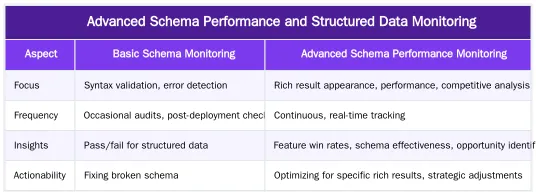
Beyond basic implementation, advanced schema performance and structured data monitoring are critical for maximizing rich result potential. This involves continuously validating the integrity and effectiveness of your structured data, not just for syntax errors but also for semantic accuracy and alignment with search engine guidelines. Automated tools can detect issues such as outdated schema, incorrect property usage, or conflicts that might prevent rich results from appearing.
The goal is to ensure that your structured data consistently provides search engines with the clearest possible understanding of your content. This includes monitoring how different schema types perform across various rich results, identifying which implementations lead to higher win rates for specific features like review stars, product carousels, or event listings. Continuous monitoring allows for iterative improvements, refining your schema strategy based on real-world performance data.
Effective structured data monitoring also involves tracking changes in search engine interpretation of schema. As algorithms evolve, the requirements or preferred formats for structured data can shift. Proactive monitoring ensures your schema remains optimized and compliant, preventing sudden losses of rich results due to outdated implementations. For a deeper dive into this topic, refer to structured data monitoring.
Conclusion
Automated SERP feature tracking is an indispensable component of modern SEO, especially in the dynamic 2026 landscape. By continuously monitoring rich results, leveraging AI for predictive insights, and implementing data-driven optimization strategies, businesses can significantly enhance their organic visibility and traffic. Adapting to feature volatility, optimizing for new formats like AI Overviews, and employing advanced schema monitoring are crucial for maintaining a competitive edge. Embrace the power of automated monitoring to identify, track, and win valuable rich results, securing your position at the forefront of search. Discover how advanced tools can transform your rich results strategy by visiting abdurrahmansimsek.com.
Frequently Asked Questions
How does automated serp feature tracking work?
Automated serp feature tracking systems continuously monitor a wide range of rich results across your target keywords daily. They identify when features appear, disappear, or change ownership, providing real-time data. AI often analyzes these patterns to predict new opportunities and inform optimization strategies.
Can automated serp feature tracking improve rich result win rates?
Yes, automated serp feature tracking significantly enhances your ability to secure rich results. By providing instant data on feature changes and competitor performance, it allows for rapid content optimization. This proactive approach can substantially increase your success in winning and retaining valuable SERP features.
Which SERP features provide the best ROI from rich result monitoring?
The ROI of different rich results varies, but Featured Snippets often drive high CTRs (around 35%), while People Also Ask (PAA) boxes can capture 15%, and FAQ rich results 20%. Prioritizing features depends on your specific traffic goals and the competitive landscape. Effective rich result monitoring helps identify the most impactful opportunities for your business.
How quickly can lost rich results be recaptured with automated monitoring?
With continuous monitoring and agile optimization, lost rich results can often be recapt
Ruxi Data brings together multi-model AI, automated website crawling, live indexation checks, topical authority mapping, E-E-A-T enrichment, schema generation, and full pipeline automation — from crawl to WordPress publish to social posting — all in one platform built for agencies and freelancers who run on results.