
SEO Vs PPC Plastic Surgeons: Optimizing 2026 Marketing Budgets
For plastic surgeons, understanding seo vs ppc plastic surgeons is crucial for 2026 budget allocation and effective patient acquisition. This analysis details how SEO builds long-term organic authority and sustainable lead generation, contrasting it with PPC’s immediate, targeted visibility for cosmetic surgery marketing. The article provides a strategic framework for optimizing marketing ROI by evaluating each channel’s cost, speed, and sustainability. It guides practices in balancing inbound marketing for enduring growth with direct response advertising for rapid patient acquisition.
Authored by Abdurrahman Şimşek, a Semantic SEO Strategist, this content provides expert guidance on healthcare digital marketing strategies. It leverages deep insights into search engine algorithms and paid advertising platforms to inform strategic investment decisions for plastic surgery practices.
To explore your options, contact us to schedule your consultation.
For plastic surgeons in 2026, patient acquisition depends on the choice between seo vs ppc plastic surgeons. This guide analyzes both strategies to help London-based aesthetic clinics and plastic surgery practices optimize their marketing budget for sustainable growth.
SEO vs. PPC: Understanding the Core Differences for Plastic Surgeons
The primary difference between search engine optimization (SEO) and pay-per-click (PPC) for patient acquisition is their operational model and timeline. SEO earns organic visibility through content and technical optimization for long-term results. PPC, via platforms like Google Ads, provides immediate, paid visibility for targeted keywords, generating rapid leads but requiring continuous investment.
What is the primary difference between SEO and PPC for patient acquisition?
For plastic surgeons, distinguishing between these digital marketing channels is crucial for resource allocation. Each has distinct benefits and drawbacks regarding cost, speed, and sustainability.
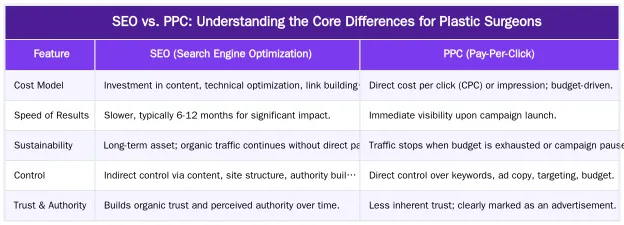
SEO builds a trusted presence, while PPC offers agility for specific campaigns or immediate patient acquisition. Both are components of a search engine marketing strategy.
Immediate Impact: Google Ads & PPC Strategies for Cosmetic Surgery
While organic growth builds over time, Google Ads and PPC platforms offer plastic surgeons immediate visibility and targeted lead generation. These campaigns place clinics at the top of search results for high-intent keywords, reaching patients actively searching for procedures. PPC’s agility is useful for launching new services, promoting offers, or filling appointment slots.
Crafting High-Converting Google Ads for Aesthetic Procedures
Effective Google Ads for aesthetic procedures require planning. Keyword selection must balance search volume with intent, focusing on terms like “breast augmentation London” or “rhinoplasty specialist Harley Street.” Ad copy must be compelling, highlighting unique selling propositions like surgeon experience, location, or patient care philosophy. Landing pages must be optimized: they must be fast, mobile-friendly, and relevant to the ad, with clear calls to action (CTAs).
Geo-targeting is essential, focusing ad spend on specific London postcodes or areas where the target demographic resides. Ad extensions, such as call, location, and structured snippets, enhance ad visibility, provide more information to patients, and improve click-through rates and campaign effectiveness.
Understanding Cost Per Lead (CPL) and ROI in Cosmetic Surgery PPC
For cosmetic surgery, understanding cost per lead (CPL) and return on investment (ROI) is paramount. CPL varies by procedure, competition, and location. In the UK cosmetic surgery market, CPLs can range from £50 to £200+ for competitive terms. Ad spend optimization strategies include keyword refinement, negative keywords, A/B testing ad copy, and improving landing page conversion rates.
Calculating ROI involves tracking leads, lead-to-patient conversion rates, and average revenue per procedure. A tracking system integrating Google Ads with CRM software attributes patient acquisition to PPC campaigns. This data-driven approach ensures efficient budget allocation and maximizes profitability.
2026 Budget Allocation: How to Strategically Invest in SEO and PPC
The optimal marketing budget split between SEO and PPC for plastic surgeons in 2026 depends on a clinic’s goals, online presence, competition, and growth objectives. A balanced approach is often most profitable for patient acquisition.
Comparing Investment Timelines and Expected Returns
Budget planning requires understanding the timelines and ROI for each channel. PPC offers quick wins, while SEO builds a lasting asset. A new clinic might invest more in PPC for immediate visibility, shifting to SEO as organic authority grows.
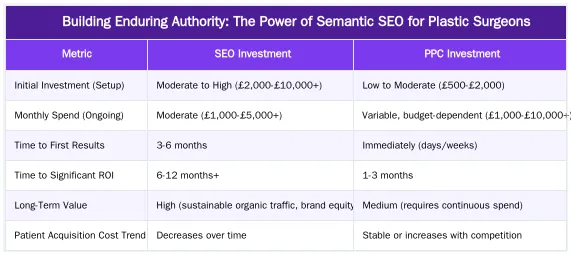
A plastic surgery practice typically allocates 5-15% of gross revenue to marketing. Clinics aiming for rapid expansion might justify a higher percentage.
Synergistic Strategies: Making SEO and PPC Work Together
Effective digital marketing strategies integrate organic and paid efforts. PPC can test keywords and ad copy before investing in long-form SEO content, providing data on patient intent and conversion rates. A strong organic presence can improve the Quality Score of PPC campaigns, potentially lowering cost per click (CPC).
For example, a plastic surgeon might use Google Ads to target high-value procedures for immediate leads while investing in a semantic SEO strategy to build authority around broader cosmetic surgery topics. This dual approach ensures short-term patient acquisition and long-term brand growth.
Measuring Success: ROI, Patient Acquisition Cost, and Long-Term Growth
Effective digital marketing for plastic surgeons requires measuring key performance indicators (KPIs). Tracking ROI and patient acquisition cost (PAC) helps clinics understand the profitability of their marketing investments. This ensures resources are allocated to high-value channels for sustainable growth.
Key Metrics for Evaluating SEO Performance
SEO success is measured by metrics including organic traffic growth (visibility), keyword rankings for high-intent terms (authority), and conversion rates from organic search (patient inquiries). Topical authority’s impact is seen in increased visibility for related queries and improved engagement metrics like time on page. Monitoring these metrics shows the long-term value of organic efforts.
SEO also contributes to brand awareness and trust, which are crucial for a medical practice. A strong organic presence reduces reliance on paid channels, lowering patient acquisition cost over time.
Analyzing PPC Campaign Effectiveness for Surgical Leads
PPC campaign effectiveness is evaluated with metrics like click-through rate (CTR) for ad relevance and conversion rate for desired actions (e.g., booking a consultation). Cost per click (CPC) and cost per acquisition (CPA) measure ad spend efficiency and profitability. A low CPA indicates an efficient campaign; a high CPA may signal a need for optimization in targeting, ad copy, or landing pages.
For surgical leads, tracking must go beyond initial conversion (e.g., form fill) to include lead quality and conversion into patients. Integrating Google Ads data with clinic CRM systems allows analysis of the patient journey, from click to procedure, providing a clear marketing ROI.
Elevate Your Practice: Partner with a Semantic SEO Expert
Digital marketing for plastic surgeons in 2026 requires a specialized approach, as generic strategies fall short in the competitive, regulated healthcare sector. A partner with expertise in semantic SEO, E-E-A-T, and the London private healthcare market provides a distinct advantage.
Unlock Your Clinic’s Full Potential with Semantic SEO
Abdurrahman Şimşek, a London-based Semantic SEO Strategist, specializes in building high-authority Semantic Content Networks for medical clinics and plastic surgeons. Using Ruxi Data infrastructure, he helps practices dominate local organic search, attract high-value patients, and reduce their Cost of Retrieval. A tailored semantic SEO and web development strategy is essential for plastic surgeons seeking to optimize their digital presence for sustainable growth. Book a Semantic SEO Audit to develop a bespoke strategy for your London practice.
Conclusion
For plastic surgeons in 2026, the choice between SEO and PPC is a strategic balance. SEO builds authority, trust, and organic visibility as a long-term asset. PPC provides immediate, targeted patient acquisition and campaign flexibility. The most effective strategy integrates both, using PPC for rapid impact while investing in semantic SEO for an E-E-A-T-driven online presence.
Understanding each channel’s strengths, measuring performance, and adapting strategies allows plastic surgeons to optimize their budget for maximum ROI and sustained growth. Partnering with a medical semantic SEO specialist ensures an effective digital strategy built for resilience in the competitive healthcare landscape. For guidance on your clinic’s digital strategy, visit abdurrahmansimsek.com.
Frequently Asked Questions
What is the fundamental difference between SEO vs PPC for plastic surgeons seeking patient acquisition?
PPC (Google Ads) offers immediate visibility and leads for a direct cost per click, but traffic ceases when payment stops. SEO, conversely, builds a sustainable organic presence over time, generating ‘free’ traffic and leads through long-term asset building. This distinction is crucial for plastic surgeons planning their marketing spend.
Which marketing channel typically offers a superior long-term ROI for plastic surgeons?
SEO generally delivers a significantly higher return on investment over the long term. Once topical authority is established, the cost per patient acquisition from organic search dramatically decreases, unlike PPC costs which are subject to continuous inflation and competitive bidding. This makes SEO a powerful asset for sustained growth.
When might PPC be a more advantageous strategy than SEO for a plastic surgery clinic?
PPC is ideal for immediate needs such as launching a new clinic, promoting a novel procedure, or quickly targeting a very specific demographic. It provides instant data and can generate consultations while a long-term organic strategy is still developing momentum. For certain short-term goals, PPC can outperform SEO.
How should a new plastic surgery practice strategically allocate its budget between SEO vs PPC for plastic surgeons?
A balanced approach is often recommended for new practices. A common strategy involves allocating 60-70% of the budget to a foundational SEO strategy for sustainable long-term growth, and 30-40% to targeted PPC campaigns to generate initial patient flow and test effective marketing messages. This blend optimizes both immediate and future patient acquisition.
Can SEO and PPC campaigns mutually benefit each other for a cosmetic surgery practice?
Absolutely. Insights derived from PPC keyword data can directly inform and refine your SEO content strategy, highlighting terms that convert into actual patients. Furthermore, a strong organic presence achieved through SEO can improve the Quality Score of your paid ads, potentially lowering your cost-per-click in PPC campaigns.
How can London-based aesthetic clinics get expert help with their SEO vs PPC plastic surgeons strategy?
London Private Healthcare SEO Service specializes in YMYL & E-E-A-T optimization for surgeons, focusing on building topical authority for healthcare domains. Clinics in Harley Street and Central London can contact us for a tailored budget allocation analysis and strategy development. We help practices navigate the complexities of digital marketing to achieve sustainable patient growth.
Ruxi Data brings together multi-model AI, automated website crawling, live indexation checks, topical authority mapping, E-E-A-T enrichment, schema generation, and full pipeline automation — from crawl to WordPress publish to social posting — all in one platform built for agencies and freelancers who run on results.