
SEO for Private Healthcare: Elevating London Clinic Visibility
SEO for private healthcare clinics in London is essential for attracting high-value patients and establishing digital authority. This guide details strategies for medical websites to navigate Google’s stringent YMYL and E-E-A-T guidelines, crucial for building trust and credibility. It covers local SEO tactics, content optimization, and technical foundations to enhance visibility for specific treatments and specialists. Effective seo for private healthcare ensures sustainable patient acquisition in competitive areas like Harley Street, focusing on medical accuracy and patient safety.
Abdurrahman Şimşek, a Semantic SEO Strategist, provides insights into advanced strategies for medical clinics. This content focuses on building topical authority and improving search engine rankings through precise semantic optimization.
To explore your options, contact us to schedule your consultation. You can also reach us via: Book a Semantic SEO Audit, Direct WhatsApp Strategy Line: +90 506 206 86 86
SEO for private healthcare clinics in London attracts high-value patients and establishes an online presence. This guide covers strategies to enhance clinic visibility, build digital authority, and secure a competitive edge in London’s medical market. Healthcare SEO helps ensure sustainable patient acquisition.
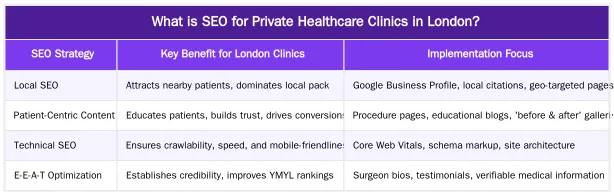
What is SEO for Private Healthcare Clinics in London?
Search engine optimization (SEO) for private healthcare clinics in London improves a medical website’s visibility in search engine results. Its goal is to connect clinics with patients searching for specific treatments, procedures, or specialists in their local area. This differs from general SEO by prioritizing trust, medical accuracy, and patient safety, aligning with Google’s guidelines for health-related content.
For London’s private healthcare sector, medical SEO means ranking for high-value queries, such as “Harley Street plastic surgeon” or “private dermatologist Mayfair.” It includes technical optimization, content creation, and local presence management. The competitive London market, particularly in areas like Harley Street, requires an approach beyond basic keyword targeting to build authority and patient confidence.
Practical Strategies for Dominating London’s Private Healthcare Search
Succeeding in London’s private healthcare market requires a focus on local visibility, patient-centric content, and a technical foundation to attract and convert high-value patients. These strategies help your clinic appear when potential patients search for medical services in specific London areas.
Mastering Local SEO for Harley Street & Premium Postcodes
Local SEO is critical for London clinics. Optimizing your Google Business Profile (GBP) with accurate business information, services, and hours is a key step. Building local citations across online directories and healthcare platforms reinforces your presence. Creating geo-targeted content, such as service pages for specific London boroughs (e.g., “cosmetic surgery Chelsea” or “dermatologist Knightsbridge”), attracts patients in those areas. This hyper-local focus is critical for clinics in locations like Harley Street. For a guide, refer to Mastering Local SEO for Harley Street & Premium London Medical Practices.
Crafting Patient-Centric Content for High-Value Acquisition
Content marketing for patient acquisition involves creating informative content that addresses patient needs. This includes procedure pages detailing treatments, recovery, and expected outcomes. Educational blog posts can answer common questions and alleviate concerns. ‘Before and after’ galleries, with consent and context, help patients visualize potential results. This content guides individuals from initial awareness to booking a consultation. Explore content strategies in The Patient Acquisition Blueprint: A Content Marketing Guide for London’s Private Surgeons.
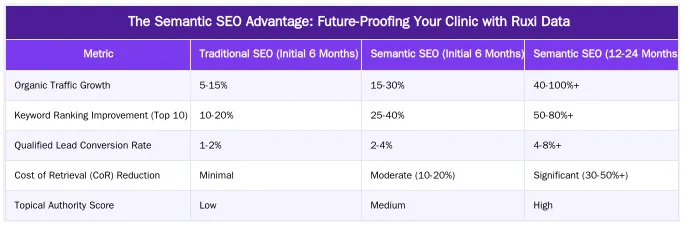
The Semantic SEO Advantage: Future-Proofing Your Clinic with Ruxi Data
Semantic SEO moves beyond keyword matching to understand the meaning and context of search queries. For private healthcare clinics, this means building topical authority by establishing expertise around specific medical entities and their relationships. This methodology ensures search engines recognize your website as an authoritative resource. Abdurrahman Şimşek, a Semantic SEO Strategist, specializes in these techniques for London clinics.
A core component of this strategy is Entity-Attribute-Value (EAV) modeling. EAV structures medical information for search engines to understand, linking procedures (entities) with their characteristics (attributes) and details (values). This data modeling reduces Google’s Cost of Retrieval (CoR), making it easier for search engines to process and rank your content. This approach is effective for complex medical topics, ensuring accuracy and relevance.
Building Topical Authority with Semantic Content Networks
A semantic content network organizes content around interconnected entities and topics, rather than isolated keywords. For a private clinic, this means creating a web of information covering every facet of a medical procedure, from symptoms and diagnosis to treatment options, recovery, and risks. By establishing these interconnected relationships, your website becomes the definitive source for specific medical inquiries. This approach is central to semantic SEO for surgeons, ensuring long-term relevance and visibility.
Leveraging Ruxi Data for Automated Topical Map Creation
Ruxi Data is a semantic engine that automates building topical authority. It analyzes search engine results pages (SERPs) to identify the entities, attributes, and relationships Google expects for a topic. This allows for the automated creation of topical maps and content briefs, guiding content production to meet E-E-A-T standards at scale. By reducing manual effort in content planning, Ruxi Data helps clinics develop authoritative content that reduces Google’s Cost of Retrieval. This is a strategic advantage for clinics aiming to dominate their niche. For further insights, consult resources on semantic SEO for surgeons.
Achieving Sustainable Patient Growth: What to Expect from Medical SEO
Medical SEO is a long-term strategy that builds a digital asset for your private healthcare clinic. Unlike paid advertising, organic visibility compounds over time, delivering sustainable patient growth. Expect measurable results within 6-12 months, with significant impact in 18-24 months as topical authority strengthens. The ROI for medical SEO extends beyond direct bookings to enhanced brand reputation and patient trust.
Key performance indicators (KPIs) for medical SEO extend beyond keyword rankings. Focus on metrics that correlate with patient acquisition and revenue, such as qualified lead generation, consultation bookings, and conversion rates from organic traffic. Monitoring website traffic, user engagement, and local search visibility is also crucial. This ensures SEO efforts align with your clinic’s business objectives.
Setting Realistic SEO Goals and KPIs for Your Clinic’s Growth
Defining clear, measurable SEO goals is vital for a private healthcare clinic. Instead of solely chasing top rankings, focus on objectives like increasing organic traffic by a specific percentage, increasing online appointment requests, or expanding visibility for niche procedures in targeted London postcodes. KPIs should include qualified lead volume, conversion rates from organic channels, and the patient acquisition cost. For guidance on defining these metrics, refer to Setting Realistic SEO Goals and KPIs for Your Clinic’s Growth.
The Long-Term Value of Organic Visibility vs. Paid Advertising
While paid advertising (PPC) offers immediate visibility, its impact ends when the budget runs out. Organic search visibility, built through medical SEO, creates a lasting digital asset. Authoritative content, technical optimization, and E-E-A-T signals contribute to a compounding effect, attracting patients without ongoing ad spend. This makes organic search a foundational investment for sustainable growth, complementing a Harley Street SEO strategy. For a deeper comparison, see resources like How to Choose a Specialist Medical SEO Agency in London: A Clinic Director’s Guide.
Partner with a Specialist: Elevate Your London Clinic’s Online Presence
SEO for private healthcare in London requires specialized expertise. Partnering with a semantic SEO strategist who understands the London private healthcare market, YMYL guidelines, and semantic techniques is crucial. Abdurrahman Şimşek, with 10 years of experience, specializes in building semantic content networks for medical clinics, ensuring a visible, trusted, and authoritative online presence. His fixed-price strategic consulting model offers transparent value, focusing on sustainable patient acquisition and digital asset building.
Elevate your clinic’s online presence and attract high-value patients. Book a Semantic SEO Audit today to develop a tailored strategy. For immediate consultation, reach out via Direct WhatsApp Strategy Line: +90 506 206 86 86.
Conclusion
SEO for private healthcare in London is competitive and requires trust and authority. A strategy that prioritizes YMYL and E-E-A-T, masters local search, and uses semantic techniques can achieve sustainable patient growth. Building a digital presence is an investment in your clinic’s future, ensuring long-term visibility and a steady stream of high-value patients.
To improve your clinic’s online performance and establish digital authority, partner with a specialist who understands the London medical market. Book a Semantic SEO Audit or connect directly via WhatsApp: +90 506 206 86 86.
Frequently Asked Questions
What is the primary goal of SEO for private healthcare clinics?
The primary goal of seo for private healthcare is to significantly increase online visibility in search engines like Google, attracting high-value, relevant patients. This involves ranking for specific procedures and conditions, building trust through E-E-A-T signals, and ultimately driving qualified inquiries and bookings for the clinic.
Why is local search optimization critical for clinics in London?
Local SEO is vital for London clinics because patients typically search for specialists within a specific geographic area, such as ‘plastic surgeon Harley Street’. Optimizing for local search ensures your clinic appears in map packs and localized results, connecting you directly with patients actively seeking services in your vicinity.
How do YMYL and E-E-A-T guidelines affect medical clinic SEO?
YMYL (Your Money or Your Life) guidelines mean Google holds medical websites to the highest standards of accuracy, expertise, and trust. Effective healthcare SEO must prioritize demonstrating E-E-A-T (Experience, Expertise, Authoritativeness, Trustworthiness) through expert-written content, clear author credentials, and verifiable information to rank well.
What is a typical timeframe to see results from a medical SEO campaign?
While initial improvements can be observed in 3-4 months, significant and sustainable results from a comprehensive medical SEO strategy typically take 6-12 months. This timeframe is due to the high competition in the healthcare sector and the time required to build deep topical authority and E-E-A-T signals that Google trusts.
Can a new clinic effectively compete with established practices using SEO for private healthcare?
Yes, a new clinic can compete by implementing a sophisticated semantic SEO strategy focused on niche procedures and long-tail keywords. By building deep topical authority in specific areas and leveraging advanced technical SEO, a new practice can effectively outmaneuver larger, less agile competitors in the SERPs.
How can a London clinic get started with a specialized SEO for private healthcare strategy?
To begin enhancing your clinic’s online presence, you can book a Semantic SEO Audit with Abdurrahman Şimşek to assess your current standing and identify growth opportunities. For immediate strategic discussions, you can also reach out directly via the WhatsApp Strategy Line at +90 506 206 86 86.
Ruxi Data brings together multi-model AI, automated website crawling, live indexation checks, topical authority mapping, E-E-A-T enrichment, schema generation, and full pipeline automation — from crawl to WordPress publish to social posting — all in one platform built for agencies and freelancers who run on results.