
SEO API Integration: Automating Data for Strategic Insights
Mastering seo api integration enables programmatic connection of essential SEO data sources like Google Search Console, Google Analytics, and various SERP data providers. This guide details how to aggregate diverse datasets for comprehensive insights and automated workflows, transforming raw information into actionable intelligence. Effective integration streamlines data collection, analysis, and reporting, facilitating real-time monitoring and agile strategic adjustments. By unifying performance metrics, professionals can identify opportunities, resolve issues faster, and optimize resource allocation for improved campaign effectiveness.
This content provides practical guidance on leveraging API connectivity for advanced SEO data management. It focuses on technical challenges, solutions, and workflow automation to enhance decision-making and operational efficiency in digital marketing.
To explore your options, contact us to schedule your consultation.
Unlock the full potential of your SEO strategy by mastering SEO API integration. This guide will walk you through connecting essential platforms like Google Search Console, Google Analytics, and various SERP data providers, revealing how to aggregate data for comprehensive insights and automated workflows. Effective integration transforms raw data into actionable intelligence, enabling more precise decision-making and efficient resource allocation. Understanding the technical nuances and strategic applications of these connections is crucial for any modern SEO professional aiming to optimize performance in 2026.
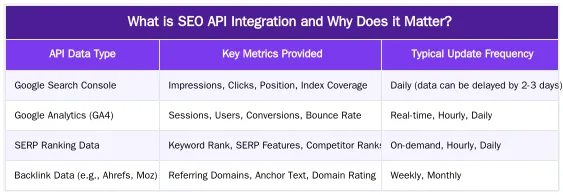
What is SEO API Integration and Why Does it Matter?
SEO API integration involves programmatically connecting various SEO data sources, such as Google Search Console, Google Analytics, and third-party SERP providers, to a centralized system or application. This process facilitates automated data retrieval, aggregation, and analysis, moving beyond manual data exports and disparate spreadsheets. It provides a unified view of performance metrics, enabling deeper insights and more agile strategic adjustments.
The primary purpose of integrating SEO APIs is to streamline data collection and analysis workflows. By automating the extraction of key metrics like organic traffic, keyword rankings, crawl data, and user behavior, SEO professionals can dedicate more time to strategy and less to manual reporting. This automation leads to significant efficiency gains, allowing for real-time monitoring and quicker identification of opportunities or issues. Furthermore, combining data from multiple sources offers a holistic understanding of a website’s organic performance, revealing correlations and causal relationships that might be missed when analyzing data in isolation. This integrated approach supports data-driven decision-making, optimizing resource allocation and improving overall SEO campaign effectiveness.
Essential SEO APIs: Connecting GSC, Analytics & SERP Data
Several core APIs are indispensable for a robust SEO data infrastructure. Each provides unique datasets critical for comprehensive analysis.
Google Search Console API
The Google Search Console (GSC) API offers programmatic access to performance data, including search queries, impressions, clicks, and average position. It also provides information on index coverage, sitemaps, and URL inspection results. This data is vital for understanding how Google views a site, identifying technical SEO issues, and tracking keyword performance. For instance, you can automate the monitoring of indexing status for critical pages, as discussed in detail in our guide on Google Indexing API integration in 2026.
Google Analytics API
The Google Analytics API (GA4 Data API for current implementations) delivers insights into user behavior on your website. This includes traffic sources, bounce rates, conversion metrics, and audience demographics. Integrating GA data allows SEOs to connect organic traffic performance with on-site engagement and business outcomes, providing a complete picture of user journeys originating from search.
SERP APIs
Third-party SERP (Search Engine Results Page) APIs provide real-time or historical ranking data for specific keywords across various locations and devices. These APIs can also extract additional SERP features like featured snippets, local packs, and knowledge panels. This data is crucial for competitive analysis, tracking keyword visibility, and understanding the evolving search landscape. For a deeper dive into real-time SERP analysis, explore our live SERP analysis case study. Some SERP APIs also offer access to Google Knowledge Graph data, which can be explored further in our article on the Google Knowledge Graph API.
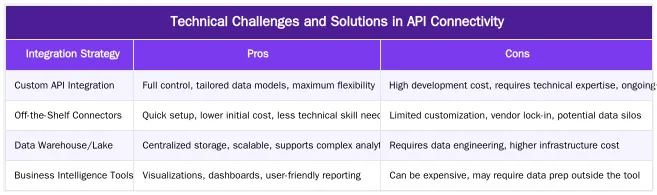
Technical Challenges and Solutions in API Connectivity
Implementing effective API connections involves navigating several technical hurdles. Understanding these challenges and their solutions is key to a stable and reliable data flow.
API Authentication and Authorization
Secure access to APIs is paramount. Most SEO APIs utilize OAuth 2.0 for authorization, requiring applications to obtain user consent to access their data. Implementing this involves setting up developer projects, obtaining client IDs and secrets, and managing refresh tokens to maintain continuous access without repeated user interaction. Robust error handling for authentication failures is essential to prevent data gaps.
Rate Limiting and Quota Management
APIs impose rate limits to prevent abuse and ensure fair usage. Exceeding these limits results in temporary blocks or errors. Solutions include implementing exponential backoff strategies, where failed requests are retried after progressively longer delays. A more sophisticated approach involves a queue system that manages API calls, ensuring requests are sent within the allowed rate. This system prioritizes critical data fetches and retries failed calls automatically, preventing service interruptions and data loss. Monitoring API usage against quotas is also crucial for proactive management.
Data Volume and Storage
Aggregating data from multiple APIs can generate substantial volumes. Efficient data storage solutions, such as cloud databases (e.g., Google BigQuery, PostgreSQL) or data warehouses, are necessary. Data schemas must be designed to accommodate diverse data types and facilitate efficient querying. Incremental data loading and data deduplication strategies help manage storage costs and improve query performance.
Error Handling and Logging
API integrations are prone to various errors, from network issues to malformed requests. Comprehensive error handling, including detailed logging, is vital for debugging and maintaining data integrity. Implementing alerts for critical failures ensures prompt intervention, minimizing data discrepancies and service downtime.
Advanced Data Aggregation and Holistic SEO Insights
Beyond simply collecting data, the true power of an API-driven approach lies in aggregating disparate datasets to generate holistic insights. This involves combining information from GSC, Analytics, SERP APIs, and potentially other sources like backlink tools or CRM systems, into a unified data model.
For example, by merging GSC keyword performance data with GA user behavior metrics, you can identify high-impression keywords that drive low engagement, signaling content relevance issues. Conversely, keywords with high engagement but low impressions might indicate opportunities for content expansion or improved internal linking. Integrating SERP data allows for competitive benchmarking, showing how your visibility compares to rivals for target keywords and identifying opportunities in SERP features like featured snippets or image packs.
This integrated view facilitates advanced analysis, such as correlating technical SEO changes (e.g., site speed improvements tracked in GA) with organic visibility shifts (tracked in GSC). It also supports more sophisticated segmentation, allowing SEOs to analyze performance by content type, user segment, or geographic region with greater precision. The ability to cross-reference data points from different platforms provides a richer context for decision-making, moving beyond isolated metrics to understand the full impact of SEO efforts on business goals.
Automation and Workflow Applications with API Orchestration
Beyond data aggregation, API orchestration enables the automation of complex SEO workflows, transforming manual tasks into efficient, repeatable processes. This involves chaining multiple API calls and logic to execute multi-step operations automatically.
Consider automating a content audit workflow. An orchestrated system could:
- Fetch a list of all URLs from a sitemap via a custom API.
- Query GSC API for impression and click data for each URL.
- Query GA4 API for bounce rate and conversion data.
- Use a SERP API to check current rankings for target keywords.
- Analyze the combined data to identify underperforming content.
- Trigger an alert or add tasks to a project management tool for content updates.
This level of automation significantly reduces manual effort and ensures consistency in data collection and analysis. It allows SEO teams to scale their operations without proportionally increasing headcount. For more insights into automating SEO tasks, refer to our guide on SEO workflow automation. API orchestration also facilitates proactive monitoring, where predefined thresholds trigger automated actions, such as notifying a team when a critical keyword drops significantly in rankings or when a sudden spike in 404 errors is detected in GSC.
The ability to programmatically control and combine various SEO tools and data sources through a unified framework represents a significant advancement in SEO practice. It moves beyond simple reporting to create dynamic, responsive SEO systems that adapt to changes in real-time.
Leveraging Custom API Integrations via Webhooks
While many standard connectors exist, custom API integrations via webhooks offer a powerful way to extend functionality and create highly specific, event-driven workflows. Webhooks are automated messages sent from applications when a specific event occurs, acting as “reverse APIs” where the application pushes data to a specified URL.
For SEO, webhooks can enable real-time responses to critical events. For example:
- A content management system (CMS) could send a webhook notification to an indexing API (like Google’s Indexing API) whenever a new page is published or an existing one is updated, prompting faster indexing.
- A monitoring tool detecting a sudden drop in site speed could trigger a webhook to a custom script that fetches detailed performance metrics from Google PageSpeed Insights API and logs the data for immediate review.
- A SERP tracking tool could send a webhook when a target keyword enters the top 3 positions, automatically updating a dashboard or sending an email alert.
This approach allows for immediate action based on real-world events, rather than relying on scheduled data pulls. It bypasses the need for constant polling, making integrations more efficient and responsive. Custom webhook endpoints require careful development to handle incoming data securely and process it effectively, but they provide unparalleled flexibility for building bespoke SEO solutions tailored to unique business needs. Integrating webhooks into an existing API framework enhances the responsiveness and dynamism of any SEO data pipeline.
Transforming SEO with Integrated Data
The strategic implementation of an integrated API framework fundamentally transforms traditional SEO practices. It shifts the focus from reactive problem-solving to proactive optimization, driven by a continuous stream of aggregated and analyzed data. This approach empowers SEO professionals to move beyond surface-level metrics, diving deep into the correlations between technical health, content performance, user engagement, and search visibility.
By automating data collection and enabling sophisticated analysis, teams can identify trends, predict outcomes, and allocate resources more effectively. This leads to more impactful SEO strategies, improved organic performance, and a clearer understanding of ROI. The ability to quickly adapt to algorithm changes and market shifts, backed by real-time data, provides a significant competitive advantage. Embracing a comprehensive approach to data integration is no longer optional but a necessity for achieving sustained SEO success in 2026 and beyond.
Conclusion
Mastering API connections for SEO is a foundational skill for modern digital marketing. By effectively integrating platforms like Google Search Console, Google Analytics, and various SERP data providers, businesses can unlock a wealth of insights and automate critical workflows. Overcoming technical challenges such as authentication and rate limiting, and leveraging advanced techniques like API orchestration and webhooks, enables a holistic view of organic performance. This integrated approach not only streamlines operations but also empowers data-driven strategies, leading to more efficient and impactful SEO outcomes. To explore how robust API solutions can elevate your SEO strategy, visit abdurrahmansimsek.com.
Frequently Asked Questions
What is seo api integration and why is it important for SEO?
SEO API integration involves programmatically connecting various SEO data sources like Google Search Console and Analytics. It’s crucial for aggregating data, gaining comprehensive insights, and enabling automated workflows that transform raw data into actionable intelligence. This allows for more precise decision-making and efficient resource allocation, optimizing overall SEO performance.
Which essential SEO APIs are typically connected in an seo api integration?
Essential APIs for an effective seo api integration include Google Search Console, Google Analytics, and various SERP data providers. Ruxi Data also integrates PageSpeed Insights and the Knowledge Graph API, with custom options available via webhooks. These connections provide a holistic view of performance data.
How does Ruxi Data manage API rate limits during data collection?
Our system employs a robust queue management approach to handle API rate limiting effectively. It automatically throttles requests and implements exponential backoff strategies to prevent service interruptions and ensure data integrity. Priority queues are also utilized to ensure that critical data processing occurs without delay.
Can seo api integration automate content creation workflows?
Yes, leveraging an seo api integration can indeed automate content creation. The system can be configured to trigger automated content workflows based on specific data events, such as significant ranking drops or traffic spikes. It analyzes these opportunities and generates targeted content to address them proactively, enhancing efficiency.
What security measures are in place for API credential storage?
Security is paramount for API credential storage. All credentials are encrypted at rest using industry-standard AES-256 encryption and transmitted securely over TLS 1.3 protocols. Furthermore, our OAuth 2.0 implementation ensures that only the minimal necessary permissions are granted, enhancing overall data protection and compliance.
What is the typical data refresh rate for integrated SEO APIs?
Data refresh rates vary depending on the source and specific integration. Google Search Console data typically updates daily, while SERP positions are refreshed every three days to capture changes. Live competitor data can be accessed on-demand, and custom refresh schedules are available for enterprise clients to meet specific operational needs.
Ruxi Data brings together multi-model AI, automated website crawling, live indexation checks, topical authority mapping, E-E-A-T enrichment, schema generation, and full pipeline automation — from crawl to WordPress publish to social posting — all in one platform built for agencies and freelancers who run on results.