
Semantic HTML Structures: Winning AI Overviews and Zero-click Searches
Mastering semantic HTML structures is crucial for digital visibility in 2026, especially with the rise of AI Overviews and zero-click searches. This guide explains how proper semantic HTML structures ensure content is understood by advanced search engines and AI models, providing essential context and meaning. By transforming raw text into machine-readable data, these structures give your content a critical advantage for improved indexing and relevance matching. Leveraging HTML5 tags like <article> and <section> helps content win featured snippets and AI Overviews, optimizing for the latest AI-driven search environments.
Abdurrahman Simsek is dedicated to providing cutting-edge insights and actionable strategies for navigating the evolving digital landscape. Our content prioritizes accuracy, ethical practices, and measurable outcomes, empowering businesses to achieve superior online performance and future-proof their digital presence.
To explore your options, contact us to schedule your consultation.
In 2026, mastering semantic HTML structures is paramount for digital visibility, especially as AI Overviews and zero-click searches redefine how users find information. This guide will explore how proper semantic HTML ensures your content is not just seen, but truly understood by advanced search engines and AI models. By providing essential context and meaning, semantic HTML gives your content a critical advantage, making it machine-readable and highly optimizable for the latest AI-driven search environments. Understanding these structures is key to winning the modern search landscape.
What are Semantic HTML Structures & Why They Matter?
Semantic HTML structures are HTML elements that convey meaning about the content they contain, rather than just dictating its presentation. Unlike non-semantic tags like <div> or <span>, which offer no inherent meaning, semantic tags explicitly describe the role of their content. This clarity is fundamentally important for search engines and AI models, enabling them to better understand the context, hierarchy, and relationships within your web pages. For SEO, this means improved indexing, better relevance matching, and a higher chance of ranking for complex queries.
In essence, semantic HTML transforms raw text into structured data that machines can easily process. This distinction is crucial for modern search algorithms, which increasingly rely on contextual understanding to deliver precise results. By using meaningful tags, you help search engines categorize and prioritize your content effectively, laying a strong foundation for superior search performance.
Beyond Divs: Understanding HTML5 Semantic Tags
HTML5 introduced a rich set of semantic tags designed to provide clearer structural meaning to web documents. These tags move beyond the generic <div>, offering specific roles like <header>, <nav>, <main>, <article>, <section>, <aside>, and <footer>. Each tag serves a distinct purpose, helping to delineate different parts of a webpage. For instance, an <article> tag clearly indicates self-contained content, while <nav> signifies navigation links. This explicit labeling is vital for both human readability and machine comprehension, setting the stage for more effective content parsing by AI.
For more details on HTML5 semantic elements, refer to the W3C HTML5 Specification.
How Semantic HTML Wins AI Overviews & Zero-Click Searches
In 2026, the direct link between robust semantic HTML structures and success in AI Overviews (Google SGE) is undeniable. AI Overviews aim to provide immediate, comprehensive answers directly within the search results, often eliminating the need for users to click through to a website. Well-structured content, rich with semantic HTML, significantly increases the likelihood of your information being accurately extracted and featured in these prominent zero-click results. Search engines leverage these structural cues to quickly identify key information, summarize complex topics, and present concise answers to user queries.
Without proper semantic markup, your content might be overlooked or misinterpreted by AI models, reducing its chances of appearing in these high-visibility placements. Investing in semantic HTML is no longer just good practice; it’s a strategic imperative for capturing attention in an AI-dominated search landscape.
The AI’s Lens: How LLMs Interpret Structured Content
Large Language Models (LLMs), the backbone of Google’s AI Overviews, rely heavily on semantic cues to understand content hierarchy, relationships, and context. When content is wrapped in appropriate HTML5 tags like <article>, <section>, and headings (<h1>–<h6>), LLMs can more efficiently parse and categorize information. This structured approach helps AI identify main topics, sub-topics, related content, and key takeaways, making it easier to extract relevant snippets for AI Overviews. Think of semantic HTML as providing a clear roadmap for the AI, guiding it to the most important parts of your content. For a deeper dive into optimizing for AI Overviews, see our guide on AI Overviews and Technical SEO in 2026.
Winning the Zero-Click Game with Clarity
Clear, semantically structured content is inherently more digestible for both human readers and AI systems. This clarity is crucial for winning the zero-click game. When your content is logically organized with distinct sections, headings, lists, and paragraphs, AI Overviews can directly answer user questions by pulling precise information. This reduces the need for users to click through to your site, but it also establishes your brand as an authoritative source, potentially leading to future engagement. By making your content unambiguous and easy to process, you maximize its potential to be featured directly in search results, providing immediate value to users and boosting your digital footprint.
Google’s continuous advancements in understanding web content, including its Search Central documentation, underscore the importance of well-structured data for optimal indexing and display.
Practical Guide: Structuring Content with Semantic HTML5
Effectively structuring your web content with HTML5 semantic tags is a cornerstone of modern SEO. It involves more than just using the right tags; it’s about applying them logically to reflect the true meaning and hierarchy of your information. For content creators and developers, this means moving away from generic <div> elements for layout and embracing tags that describe the content’s purpose. This approach not only improves machine readability but also enhances maintainability and accessibility. Implementing strong semantic HTML structures ensures your content is optimized for current and future search algorithms.
Key HTML5 Tags for Article Structure & Purpose
Understanding the specific roles of HTML5 semantic tags is crucial for proper implementation. Here’s a comparison of essential tags and their contribution to content meaning:
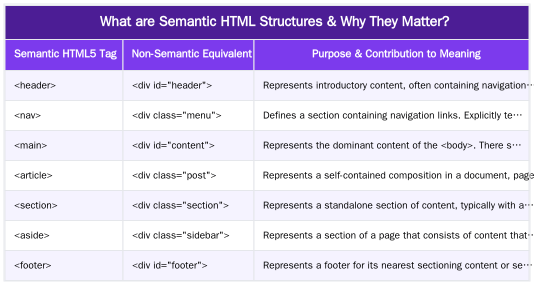
These tags work in conjunction with schema markup to provide even richer context, creating a powerful combination for search engine understanding.
Structuring Your Content for Maximum Clarity
When structuring your content, prioritize logical nesting and a clear heading hierarchy. Use <h1> for the main title of the page, followed by <h2> for major sections, and <h3>–<h6> for sub-sections. While technically possible to use multiple <h1> tags in HTML5, it’s generally best practice for SEO and accessibility to use only one <h1> per page, clearly indicating the primary topic. Ensure that your headings accurately reflect the content that follows. Use <section> tags to group related content under a heading, and <article> for self-contained pieces. This logical flow benefits both human readers, who can easily scan and understand your content, and AI parsers, which can accurately interpret the relationships between different content blocks.
Ruxi Data’s Edge: Automating Semantic HTML for AI Success
At Abdurrahman Simsek, we understand the complexities of implementing robust semantic HTML structures consistently across vast amounts of content. This is precisely where Ruxi Data, our advanced SaaS solution, provides a significant advantage. Ruxi Data is engineered to automatically generate and optimize content with correct semantic HTML structures, ensuring that every piece of information is inherently machine-readable and primed for AI-driven search environments. Our platform’s expertise in this area reinforces our E-E-A-T (Experience, Expertise, Authoritativeness, Trustworthiness) in the SaaS industry, offering a reliable solution for businesses aiming for top search performance.
By leveraging Ruxi Data, organizations can confidently produce content that not only engages human audiences but also speaks directly to the sophisticated algorithms of Google’s AI Overviews, securing a competitive edge in 2026 and beyond.
Ensuring Machine-Readable Content with Ruxi Data
Ruxi Data’s platform integrates sophisticated algorithms that automatically apply appropriate HTML5 semantic tags and proper heading hierarchies during content generation. This means that from the moment content is created, it is inherently optimized for Google’s AI Overviews and Large Language Models. Our system analyzes content context and intent, then intelligently wraps text in <article>, <section>, <aside>, and other relevant tags, ensuring maximum clarity for AI parsers. This automated precision eliminates manual errors and inconsistencies, guaranteeing that your content is always presented in the most machine-readable format possible. Learn more about how Ruxi Data optimizes for AI Overviews in our dedicated guide: Optimizing for AI Overviews in 2026.
The Future of Content: AI-Optimized from Creation
The future of content creation demands an AI-first approach, and Ruxi Data delivers this by automating semantic structuring. This automated process saves invaluable time for content teams and developers, allowing them to focus on strategy and creativity rather than manual markup. More importantly, it ensures consistent quality and adherence to best practices for AI-driven search. With Ruxi Data, your content is not just published; it’s launched with an inherent advantage, ready to be understood, indexed, and featured by the most advanced search technologies. This proactive optimization ensures your digital assets are future-proofed against evolving search landscapes.
Measuring Impact: Boosted Visibility & User Experience
Implementing robust semantic HTML structures yields tangible benefits that extend far beyond technical compliance. The most immediate impact is often seen in improved search visibility, particularly in the context of AI Overviews and featured snippets. Content that is semantically rich is more easily understood by search engines, leading to better indexing and higher relevance scores for complex queries. This translates into increased organic traffic and a greater likelihood of your content being chosen for direct answers in zero-click searches. Furthermore, semantic HTML inherently boosts web accessibility, making your content usable for a wider audience, including those using assistive technologies. This enhanced user experience is a critical factor for overall search engine performance and user satisfaction.
Tools to Verify Your Semantic HTML
Ensuring your website employs correct semantic HTML is crucial. Several tools can help you audit your pages and identify areas for improvement. Regularly checking your site’s structure can help maintain its SEO advantage and accessibility compliance.
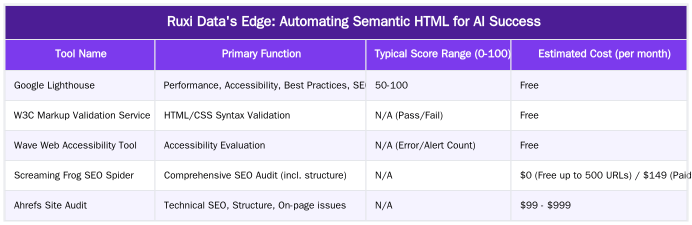
Utilizing these tools helps you maintain high standards for your web content. Improved accessibility, a direct benefit of semantic HTML, is also a key ranking factor. For more information on web accessibility standards, consult resources like WebAIM’s WCAG Checklist.
Conclusion
In the dynamic digital landscape of 2026, the strategic implementation of semantic HTML structures is no longer a mere suggestion but a fundamental requirement for SEO success. By providing explicit meaning to your content, you empower search engines and AI models to understand, index, and feature your information more effectively in AI Overviews and zero-click searches. This commitment to structured, machine-readable content not only boosts your visibility but also significantly enhances user experience and accessibility. To future-proof your digital strategy and ensure your content consistently ranks at the forefront of AI-driven search, embracing semantic HTML is essential. Discover how Ruxi Data can automate this crucial process for your business and elevate your content’s performance today. Visit abdurrahmansimsek.com to learn more.
Frequently Asked Questions
How does Ruxi Data ensure content uses correct semantic HTML structures?
Our platform automatically structures generated content with proper semantic HTML5 tags like `
Why are semantic HTML structures more important now with AI Overviews?
AI Overviews need to understand the context and hierarchy of information on a page to generate accurate summaries. Semantic HTML structures provide this context directly, making your content easier for AI to parse and cite effectively. Without these clear structures, AI models struggle to grasp the true meaning and relationships within your content.
Does using semantic HTML structures guarantee a spot in AI Overviews?
No single factor guarantees inclusion, but implementing strong semantic HTML structures significantly increases your chances. Clean, semantic HTML combined with high-quality, E-E-A-T compliant content is the most effective strategy for visibility in AI-driven search results. It signals to AI models that your content is well-organized and authoritative.
What’s the biggest mistake companies make regarding semantic HTML structures for SEO?
A common mistake is ‘divitis’—using non-semantic `
Can I fix my site’s semantic HTML structures without a full redesign?
Yes, for many CMS platforms like WordPress, you can often edit the templates for your posts and pages to replace non-semantic tags with correct ones, improving your semantic HTML structures. A technical SEO audit can identify the highest-priority areas to fix, allowing for targeted improvements without a complete overhaul. This can significantly boost your content’s machine readability.
What specific HTML5 tags are considered semantic HTML structures?
Semantic HTML5 tags include `
Ruxi Data brings together multi-model AI, automated website crawling, live indexation checks, topical authority mapping, E-E-A-T enrichment, schema generation, and full pipeline automation — from crawl to WordPress publish to social posting — all in one platform built for agencies and freelancers who run on results.