
Semantic Content Network: Building Medical Topical Authority
A semantic content network is an advanced content architecture that interlinks entity-focused content to create a site-specific knowledge graph, significantly enhancing topical authority. This strategy moves beyond traditional keyword approaches, structuring complex information to demonstrate deep expertise and build a robust information architecture. For medical and YMYL sectors, a semantic content network is crucial for signaling E-E-A-T to search engines by mapping intricate entity relationships. Readers will learn how to implement this framework to achieve superior search engine visibility and establish themselves as comprehensive, trustworthy sources.
This article, authored by a Semantic SEO Strategist, outlines a blueprint for healthcare providers to build dominant topical authority. It details how structured content and advanced information architecture enhance E-E-A-T, crucial for medical and YMYL websites.
To explore your options, contact us to schedule your consultation. You can also reach us via: Book a Semantic SEO Audit, Direct WhatsApp Strategy Line: +90 506 206 86 86, Hire as Semantic SEO Architect
In the complex landscape of modern SEO, achieving dominant topical authority is paramount. This article demystifies the semantic content network, an advanced strategy that moves beyond traditional keyword stuffing to build a robust, entity-rich web presence. This approach is especially crucial for medical clinics and plastic surgeons aiming for superior search engine visibility and E-E-A-T. Understanding this framework allows healthcare providers to structure their clinical expertise into a format search engines readily comprehend and prioritize.
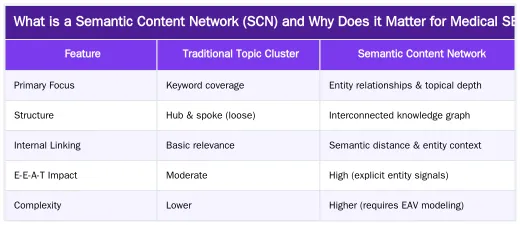
What is a Semantic Content Network (SCN) and Why Does it Matter for Medical SEO?
A semantic content network (SCN) represents an advanced content architecture that interlinks entity-focused content to create a site-specific knowledge graph, significantly enhancing topical authority. Unlike traditional topic clusters that primarily group content by keywords, an SCN maps out the intricate relationships between concepts, procedures, conditions, and treatments. This structured approach helps search engines understand the full breadth and depth of a website’s expertise on a given subject.
For Your Money Your Life (YMYL) sectors, such as medical clinics and plastic surgery practices, SCNs are critical. They provide a robust framework for demonstrating E-E-A-T (Experience, Expertise, Authoritativeness, Trustworthiness) by organizing complex clinical information into a highly coherent and semantically rich format. This explicit structuring signals to search engines that the website is a comprehensive and trustworthy source of information, which is paramount for ranking in sensitive medical queries. Understanding the foundational principles of semantic networks is key to grasping this concept. Learn more about semantic networks on Wikipedia.
The Architecture of Authority: How SCNs Build Topical Dominance
The construction of a robust SCN involves a deliberate architectural design that goes beyond simple content silos. It focuses on establishing deep semantic connections between various pieces of content, creating a cohesive and authoritative information architecture. This structure allows search engines to easily navigate and comprehend the relationships between different medical entities and procedures discussed on a site.
Pillar Pages and Supporting Content: The Foundation of Your Network
Pillar pages serve as comprehensive guides, covering broad topics like “Facial Aesthetic Procedures” or “Breast Augmentation Options.” These pages are designed to be authoritative resources, providing a high-level overview of a subject. Supporting content then delves into specific sub-topics, such as “Rhinoplasty Recovery Time” or “Types of Dermal Fillers,” expanding on the details introduced in the pillar page. This creates a robust content ecosystem where each piece contributes to the overall topical authority. For more on this, explore our guide on pillar page SEO strategy.
Entity Relationships and Internal Linking for Semantic Depth
Intelligent internal linking is the circulatory system of an SCN. It reinforces entity relationships by connecting relevant content using contextual anchor text that reflects the semantic distance between topics. For instance, a link from a “Rhinoplasty” pillar page to a supporting article on “Septoplasty for Breathing Issues” with anchor text like “correcting nasal septum deviations” signals a clear, specific relationship. This goes beyond basic keyword matching, providing search engines with explicit cues about the site’s comprehensive understanding of related medical entities. This strategic approach to linking is fundamental to effective topic cluster creation and semantic depth.
Beyond Keywords: Leveraging Entity-Attribute-Value (EAV) Modeling with Ruxi Data
Modern search engines operate on a sophisticated understanding of entities and their relationships, moving far beyond simple keyword matching. Entity-Attribute-Value (EAV) modeling is a critical concept in this evolution, forming the backbone of how search engines process and organize information for their knowledge graphs. Integrating EAV into a content strategy is a significant differentiator for building a powerful SCN.
Understanding EAV: The Language of Google’s Knowledge Graph
EAV provides a structured way to represent information, mirroring how search engines process data. An ‘entity’ could be a medical procedure like ‘rhinoplasty’. Its ‘attributes’ might include ‘cost’, ‘recovery time’, ‘benefits’, or ‘risks’. The ‘values’ would then be the specific data points for those attributes, such as ‘$8,000 – $15,000’ for cost, or ‘2 weeks’ for recovery time. By explicitly defining these relationships, websites can communicate their expertise in a language search engines understand, making content more discoverable and authoritative. This structured data helps search engines build a comprehensive understanding of the topic. Google’s documentation on entities provides further insight.
Ruxi Data: Automating Semantic Mapping for Medical Practices
Manually implementing EAV modeling across extensive medical content can be resource-intensive. This is where specialized infrastructure like Ruxi Data becomes invaluable. Ruxi Data’s LLM-driven platform automates the transformation of complex clinical data into structured EAV models. This automation significantly reduces the ‘Cost of Retrieval’ (CoR) for search engines, meaning they expend less computational effort to understand and rank the content. For medical practices, this translates directly into enhanced visibility and a stronger signal of expertise, as their information is presented in an optimal, machine-readable format.
Implementing Your Semantic Content Network: A Step-by-Step Blueprint
Building an SCN for a medical clinic or plastic surgery practice requires a systematic approach. This blueprint outlines the essential steps to transform clinical expertise into a highly authoritative and search-engine-friendly digital presence.
Step 1: Entity Research and Topical Mapping
Begin by identifying core medical entities relevant to your practice, such as specific procedures (e.g., ‘liposuction’, ‘facelift’), conditions (e.g., ‘acne scars’, ‘skin laxity’), and related concepts (e.g., ‘anesthesia’, ‘post-operative care’). Use advanced tools to map out the relationships between these entities, understanding how they connect and form broader topics. This foundational research informs the entire content strategy, ensuring comprehensive coverage and logical structure. Our topical authority mapping workflow provides a detailed guide.
Step 2: Content Creation and Pillar Page Development
Develop comprehensive pillar pages for your primary service areas, acting as central hubs of information. For instance, a plastic surgeon might have a pillar page on “Cosmetic Breast Surgery” that covers various procedures. Then, create detailed supporting content that expands on specific aspects, such as “Breast Augmentation Techniques” or “Breast Lift Recovery.” Each piece of content should be rich in relevant entities and provide clear, accurate medical information, adhering to the highest E-E-A-T standards.
Step 3: Strategic Internal Linking and Schema Markup
Implement a robust internal linking strategy that connects pillar pages to supporting content and related articles, using descriptive, entity-rich anchor text. This strengthens the semantic relationships across your site. Simultaneously, integrate structured data (Schema Markup) like `MedicalBusiness`, `Physician`, and `MedicalProcedure` JSON-LD. This explicit markup helps search engines understand the nature of your content and services, further reducing their Cost of Retrieval (CoR) and boosting your site’s authority.
The Private Knowledge Graph: SCNs for Generative Engine Optimization (GEO)
As search evolves with Large Language Models (LLMs) and generative AI, the concept of a website’s “private knowledge graph” becomes increasingly important. A well-constructed SCN effectively builds this internal knowledge graph, allowing a website to function as its own authoritative data source for search engines and AI models.
This private knowledge graph is a structured representation of all the entities, attributes, and relationships within a website’s content. When a search engine or LLM encounters a query, it can quickly and accurately retrieve information from this organized structure. For medical practices, this means that detailed information about a specific procedure, its benefits, risks, and recovery, can be instantly understood and synthesized by AI, even for complex, multi-faceted questions.
This capability is central to Generative Engine Optimization (GEO). In a GEO landscape, search results are increasingly synthesized and presented as direct answers, rather than just lists of links. Websites with strong SCNs provide the clear, structured data that LLMs need to generate these precise answers. By presenting information in an entity-rich, interconnected manner, medical sites can ensure their expertise is accurately represented and prioritized in future generative search experiences, establishing themselves as the definitive source for their niche.
Measuring Success: Impact on Search Visibility and E-E-A-T
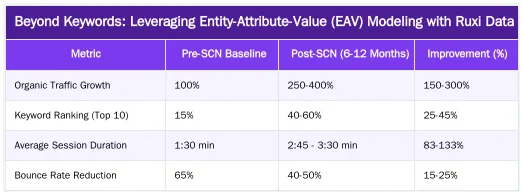
The implementation of an SCN yields measurable improvements in search visibility and significantly strengthens a website’s E-E-A-T signals. Tracking key performance indicators (KPIs) provides insight into the effectiveness of this advanced strategy.
Expected results include higher organic rankings for broad, competitive medical terms, increased traffic from long-tail queries, and improved click-through rates due to enhanced relevance in search results. Beyond raw traffic, the impact on E-E-A-T is profound. By structuring clinical expertise and demonstrating comprehensive topical coverage, medical websites signal their authority and trustworthiness to search engines. This is particularly vital in the YMYL space, where Google places a premium on credible sources.
Abdurrahman Şimşek, with over 10 years of experience in search engineering, specializes in building these high-authority networks for London’s aesthetic clinics. His methodology focuses on transforming complex medical information into a search-engine-friendly, authoritative digital presence. This approach has consistently delivered significant organic growth for medical practitioners, solidifying their position as leaders in their respective fields.
Conclusion
The future of medical SEO lies in semantic understanding and structured content. Implementing a semantic content network allows medical clinics and plastic surgeons to move beyond basic keyword optimization, building a powerful, entity-rich web presence that resonates with modern search algorithms. This strategy not only enhances visibility but also solidifies E-E-A-T, positioning your practice as a trusted authority. By leveraging advanced methodologies like EAV modeling and intelligent content architecture, you can ensure your expertise is accurately represented and highly discoverable. To begin constructing your own authoritative digital ecosystem, contact us. You can also Book a Semantic SEO Audit, use our Direct WhatsApp Strategy Line: +90 506 206 86 86, or Hire as Semantic SEO Architect.
Frequently Asked Questions
What is a semantic content network?
A semantic content network (SCN) is an advanced content strategy that organizes your website’s information into a highly interconnected structure. It moves beyond simple topic clusters by defining entities and their relationships, effectively building a private knowledge graph on your site. This architecture helps search engines understand the depth and breadth of your expertise on specific subjects.
How does a semantic content network differ from traditional content strategies like simple blogs?
Unlike a chronological blog, this advanced content architecture is architecturally planned and entity-driven. It features a central pillar page for a broad topic, which then links out to and receives links from highly specific cluster pages. This structured approach ensures that all related content is deeply interconnected, signaling comprehensive topical authority to search engines.
Why is a semantic content network crucial for medical practices and plastic surgeons?
For medical practices, implementing a semantic content network establishes undeniable topical authority and E-E-A-T (Experience, Expertise, Authoritativeness, Trustworthiness). By comprehensively covering a medical specialty and its related procedures in a structured, interconnected way, this network signals to Google that your website is the most authoritative source. This is vital for ranking highly in competitive medical search results and building trust with potential patients.
Can the creation of a semantic content network be automated?
Yes, the process of building a robust content network can be significantly automated. Abdurrahman Şimşek’s Ruxi Data infrastructure analyzes the entities within your content and automates the creation of a dense, semantically relevant internal linking structure. This automation ensures efficiency and accuracy in forming a powerful SCN.
How is the success of a semantic content network measured?
The success of such a structured content approach is measured by several key performance indicators. These include an increase in rankings for a wide range of related long-tail keywords, improved rankings for the main ‘head’ term on pillar pages, and higher user engagement metrics. We also look at increased time on site and pages per session, indicating deeper user interaction and satisfaction.
How can I get started with building a semantic content network for my medical website?
To begin building a powerful semantic content infrastructure for your medical practice, it’s recommended to start with a professional assessment. You can book a Semantic SEO Audit with Abdurrahman Şimşek to analyze your current content and identify opportunities for entity-based structuring. This initial step provides a tailored blueprint for achieving superior topical authority and search visibility.
Ruxi Data brings together multi-model AI, automated website crawling, live indexation checks, topical authority mapping, E-E-A-T enrichment, schema generation, and full pipeline automation — from crawl to WordPress publish to social posting — all in one platform built for agencies and freelancers who run on results.