
Schema Markup Validation: Streamlining Structured Data Testing
Schema markup validation is essential for ensuring search engines accurately interpret structured data, directly impacting search visibility and rich result eligibility. This guide compares top automated tools for structured data testing, helping users identify and rectify common markup errors. Achieving robust schema.org compliance is crucial for enhancing SEO performance and ensuring content stands out. Understanding JSON-LD validator functions and performing regular structured data audits are key to maintaining an effective digital presence.
Abdurrahman Simsek delivers expert guidance on optimizing structured data implementation. This content provides practical strategies for identifying and resolving markup errors, ensuring robust schema.org compliance for improved search engine understanding and rich result eligibility.
To explore your options, contact us to schedule your consultation.
Effective schema markup validation is crucial for ensuring search engines accurately interpret your website’s structured data, which directly impacts search visibility and rich result eligibility. This guide will compare top automated testing tools, helping you identify and rectify markup errors to achieve robust schema.org compliance. Understanding the nuances of structured data testing is essential for enhancing your SEO performance and ensuring your content stands out in search engine results pages (SERPs).
What is Schema Markup Validation and Why Does It Matter?
Schema markup validation is the process of verifying that the structured data implemented on a website adheres to the specifications set by schema.org and search engine guidelines. This verification ensures that search engines can correctly parse and understand the context of your content, which is fundamental for displaying rich results and improving overall search visibility.
The Core Purpose of Structured Data Testing
Structured data testing primarily verifies the syntax and structure of your chosen markup format, whether it’s JSON-LD, Microdata, or RDFa. It checks for missing required properties, incorrect data types, and structural errors that could prevent search engines from processing the information. Adherence to schema.org standards is paramount for effective communication with search engine crawlers.
Impact on Rich Results and Search Visibility
Valid schema markup directly influences a website’s eligibility for rich results in SERPs. These enhanced listings, such as star ratings, product snippets, FAQ accordions, or recipe cards, provide more information to users directly in the search results. This increased visibility can lead to higher click-through rates (CTRs) and a stronger presence, ultimately boosting organic traffic and SEO performance.
Navigating the Landscape: Types of Structured Data Validators
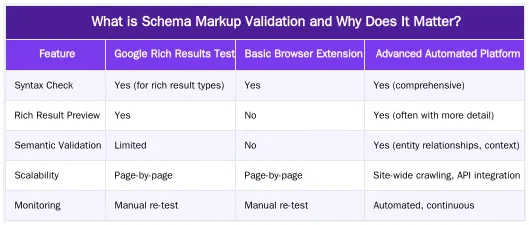
The ecosystem of structured data testing tools ranges from basic browser extensions to sophisticated automated platforms. Each type offers different levels of functionality, catering to various needs for schema.org compliance and error detection.
Google provides essential tools for initial checks. The Rich Results Test specifically evaluates if your structured data is eligible for rich results on Google Search. For broader syntax checks, the Schema.org Validator (formerly Google’s Structured Data Testing Tool) verifies general schema.org compliance for JSON-LD validator, microdata testing, and RDFa formats.
Beyond Google’s offerings, third-party tools provide additional features. Some browser extensions offer quick, on-page structured data audits, while more comprehensive platforms integrate validation into larger SEO or development workflows. These tools often provide detailed reports, historical data, and advanced error identification capabilities.
Here’s a comparison of common validator types:
Common Schema Markup Errors and How to Identify Them
Even well-intentioned structured data implementations can contain errors that prevent search engines from fully leveraging the markup. Identifying these issues is the primary goal of any structured data audit.
Common errors include:
- Syntax Errors: These are fundamental coding mistakes, such as missing commas, incorrect curly braces in JSON-LD, or malformed attributes in Microdata. These errors often prevent the entire block of structured data from being parsed.
- Missing Required Properties: Schema.org types often have mandatory properties. For example, a “Product” schema requires a “name” and “offers” property. Omitting these will invalidate the schema for rich result eligibility.
- Incorrect Data Types: Providing a string where a number is expected (e.g., “five stars” instead of “5” for a ratingValue) can lead to parsing issues.
- Semantic Inaccuracies: This involves using the correct syntax but applying it in a semantically incorrect way. For instance, marking up a blog post as a “Product” or using a “Review” schema for self-promotional text.
- Policy Violations: Search engines have specific guidelines beyond schema.org. For example, Google’s rich results policies prohibit marking up hidden content or using misleading ratings.
Tools like Google’s Rich Results Test will flag critical errors that prevent rich result display and provide warnings for issues that might affect quality. Advanced structured data testing platforms go further, identifying semantic inconsistencies and potential policy violations across an entire website, offering a more holistic view of markup health.
Manual vs. Automated Structured Data Validation: A Strategic Comparison
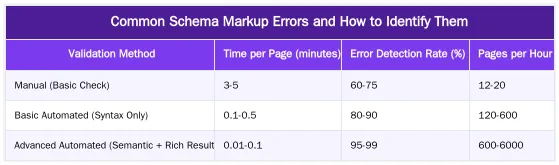
The approach to structured data testing can significantly impact efficiency and accuracy. Manual validation involves individually checking pages, while automated solutions leverage technology to streamline the process, especially for large-scale websites.
Manual validation typically involves copying and pasting JSON-LD code into a validator or using browser extensions to inspect individual pages. This method is suitable for small websites or for testing specific code snippets during development. However, it becomes impractical and error-prone for sites with hundreds or thousands of pages, as it lacks scalability and consistency.
Automated validation, conversely, employs crawlers or API integrations to scan entire websites, identifying structured data across multiple pages. These tools can detect errors at scale, track changes over time, and often integrate with development pipelines for continuous integration and deployment. The depth of analysis also varies, with advanced automated platforms offering more than just syntax checks.
For large enterprises or dynamic websites, automated solutions are indispensable. They provide a comprehensive overview of structured data health, enabling proactive error resolution and ensuring consistent schema.org compliance across the entire digital footprint. This approach minimizes the risk of rich result loss due to unnoticed markup errors.
Consider the comparative efficiency:
Beyond Syntax: Advanced Validation for Semantic Accuracy and Rich Results
While basic structured data testing tools confirm correct syntax, advanced validation goes further, assessing semantic accuracy, entity relationships, and real-world rich result eligibility. This depth is crucial for maximizing the impact of your structured data.
Advanced validators analyze how different schema types relate to each other on a page and across a site. They can identify if an “Author” schema is correctly linked to a “BlogPosting” schema, or if a “Product” schema accurately reflects the visible product details. This ensures the structured data not only passes syntax checks but also provides a coherent and truthful representation of the content.
Furthermore, these tools often simulate how search engines interpret the markup, predicting rich result eligibility with greater precision. They can highlight potential issues that might not be syntax errors but could still prevent rich results, such as policy violations or insufficient data for a specific rich result type. Post-deployment schema performance monitoring is also a key feature, tracking rich result impressions and clicks over time to ensure the markup continues to deliver value.
For businesses aiming to truly optimize their search presence, leveraging advanced automated schema markup tools is essential. These platforms offer capabilities that extend beyond simple checks, providing insights into how structured data contributes to overall SEO strategy. Learn more about automated schema markup tools in 2026 and explore advanced schema markup automation for comprehensive insights.
Best Practices for Ongoing Schema Compliance and Performance
Maintaining valid and effective structured data is an ongoing process, not a one-time task. Implementing best practices ensures your schema markup continues to support your SEO goals and adapt to evolving search engine requirements.
Firstly, integrate structured data testing into your development workflow. Before deploying new pages or significant content updates, validate the schema markup. This proactive approach prevents errors from reaching live production environments. Secondly, regularly monitor your rich result performance through tools like Google Search Console. This helps identify any sudden drops in rich result eligibility, signaling potential issues with your structured data.
Stay informed about schema.org updates and search engine guidelines. Schema.org is a living vocabulary, and new types or properties are introduced periodically. Adapting your markup to these changes ensures you leverage the latest enhancements. For instance, in 2026, new properties for specific industry niches might become critical for rich result eligibility. Additionally, ensure your structured data accurately reflects the visible content on your page. Misleading markup can lead to manual penalties from search engines.
Consider using robust schema markup generation tools that simplify the creation of complex structured data, reducing the likelihood of manual errors. These tools often incorporate validation checks during the generation process. Explore options for schema markup generation to streamline your implementation efforts.
For further reading on structured data, consult the Google Search Central documentation on structured data, which provides comprehensive guidance on implementation and best practices.
Choosing Your Schema Markup Validation Tool: Key Considerations
Selecting the right tool for schema markup validation depends on your website’s scale, the complexity of your structured data, and your desired depth of analysis. For small sites with simple markup, Google’s free tools might suffice for initial checks. However, for larger enterprises or those with dynamic content, a comprehensive automated platform offers significant advantages.
Prioritize tools that provide continuous monitoring, detailed error reporting, and insights into rich result eligibility beyond basic syntax. The ability to validate structured data at scale and integrate with existing development workflows is also crucial for efficiency. Evaluate whether the tool supports all your necessary schema types and offers features for semantic validation. A robust solution will help maintain optimal structured data health and secure your rich result presence.
To explore advanced solutions for automated structured data management and validation, visit abdurrahmansimsek.com.
Conclusion
Effective schema markup validation is a cornerstone of modern SEO, directly influencing a website’s ability to achieve rich results and enhance search visibility. While basic tools offer essential syntax checks, the true power lies in advanced automated platforms that delve into semantic accuracy, entity relationships, and continuous performance monitoring. By understanding the types of validators available and adopting best practices for ongoing compliance, businesses can ensure their structured data consistently communicates valuable information to search engines. Prioritizing robust structured data testing is an investment in long-term SEO success and a competitive edge in the evolving digital landscape. Discover how comprehensive structured data solutions can transform your SEO strategy by visiting abdurrahmansimsek.com today.
Frequently Asked Questions
What is schema markup validation and why is it important for SEO?
Schema markup validation is the process of checking structured data for syntax errors, compliance with schema.org standards, and eligibility for rich results. It’s crucial for SEO because it ensures search engines accurately understand your content, directly impacting visibility and the potential for enhanced search listings. Correct validation helps your website stand out in search engine results pages (SERPs).
How does Ruxi Data’s schema markup validation differ from Google’s tool?
While Google’s tool primarily checks basic syntax and rich result eligibility, Ruxi Data offers a more comprehensive approach. Our platform validates semantic accuracy, entity relationships, and also monitors schema performance post-deployment. This ensures deeper compliance and ongoing optimization.
Can automated schema markup validation catch entity mismatches?
Yes, advanced automated validators are designed to catch entity mismatches. They cross-reference entities within your structured data against established knowledge graphs, like Google’s. This ensures your schema accurately represents real-world entities, preventing brand ambiguity and improving data integrity.
What are the most common structured data errors found on SaaS websites?
On SaaS sites, missing or incorrect Organization and Product schemas are among the most prevalent errors, accounting for a significant percentage of issues. These errors can prevent rich snippets from appearing and impact brand visibility. Automated validation tools are highly effective at identifying and flagging these common mistakes.
How quickly can bulk structured data validation be performed?
Tools like Ruxi Data are built for efficiency, capable of validating structured data for up to 10,000 pages per hour. This rapid process generates detailed reports on errors, warnings, and optimization opportunities. Such speed is essential for large websites to maintain schema compliance.
Does schema markup validation include mobile and AMP versions of pages?
Yes, comprehensive schema markup validation tools ensure consistent structured data across all page variants. They check how your schema renders and is interpreted on mobile, desktop, and AMP versions. This guarantees that your structured data is effective regardless of how users access your content.
Ruxi Data brings together multi-model AI, automated website crawling, live indexation checks, topical authority mapping, E-E-A-T enrichment, schema generation, and full pipeline automation — from crawl to WordPress publish to social posting — all in one platform built for agencies and freelancers who run on results.