
Schema Markup Automation: Enhancing Search Visibility and Rich Results
Effective schema markup automation is crucial for modern SEO, enabling websites to communicate content context directly to search engines. This process involves generating and implementing structured data, which helps search engines understand entities and relationships on a page. Automating schema markup enhances visibility, qualifies for rich results, and prepares for evolving search paradigms like AI Overviews. The article details methods, benefits, and impact of automating structured data implementation for improved online presence and entity SEO. It provides a comprehensive guide to leveraging this technical SEO task for better search performance.
This article, published on abdurrahmansimsek.com, offers a detailed guide to understanding and implementing structured data. It provides practical strategies for leveraging JSON-LD and other tools to enhance search engine comprehension and improve online visibility. The content focuses on actionable steps for effective technical SEO.
To explore your options, contact us to schedule your consultation.
Effective schema markup automation is crucial for modern SEO, enabling websites to communicate their content’s context directly to search engines. This process involves generating and implementing structured data, which helps search engines understand entities, relationships, and content types on a page. By automating this technical SEO task, websites can enhance their visibility in search results, qualify for rich snippets, and prepare for evolving search paradigms like AI Overviews in 2026. This article explores the methods, benefits, and impact of automating structured data implementation for improved online presence.
Definition of Schema Markup and Its Purpose
Schema markup, often referred to simply as schema, is a form of microdata that website owners can add to their HTML to help search engines better understand the content on their pages. Developed collaboratively by Google, Bing, Yandex, and Yahoo! through Schema.org, this vocabulary provides a standardized way to classify information. It allows webmasters to tag specific elements on a page, such as an article’s author, publication date, ratings, or product prices, with semantic meaning.
The primary purpose of schema markup is to enhance search engine comprehension. While search engines are adept at crawling and indexing content, they sometimes struggle with the nuances of context and relationships between entities. By explicitly labeling data with schema, websites provide clear signals, transforming unstructured data into structured data that is easily digestible. This clarity enables search engines to display richer, more informative results to users, improving the overall search experience. For instance, a recipe page marked with schema can show cooking time, ingredients, and star ratings directly in the search results, making it more appealing to users. This process is fundamental to modern technical SEO strategies.
Understanding and implementing schema markup is a core component of entity SEO, where the goal is to establish clear relationships between concepts and entities on a website and within the broader web. This contributes to a website’s authority and relevance in specific topic areas. More information on the foundational principles of schema can be found on Schema.org itself.
Understanding Structured Data Formats: JSON-LD
Structured data can be implemented using various formats, but JSON-LD (JavaScript Object Notation for Linked Data) has emerged as the preferred method for most search engines, including Google. JSON-LD is a lightweight, script-based format that allows webmasters to embed structured data directly into the HTML of a page without altering the visible content. It typically resides within a <script type="application/ld+json"> tag in the <head> or <body> section of a webpage.
The advantage of JSON-LD lies in its flexibility and ease of implementation. Unlike older formats like Microdata or RDFa, which require wrapping individual HTML elements, JSON-LD allows for a consolidated block of code. This separation of structured data from the visual presentation simplifies maintenance and reduces the risk of errors. For example, to mark up an article, a single JSON-LD script can define the article type, title, author, publication date, and an image URL.
JSON-LD facilitates the creation of a Knowledge Graph for a website, connecting various entities and their attributes. This semantic web approach helps search engines build a comprehensive understanding of a site’s content, improving its chances of appearing in relevant, high-visibility search features. Its widespread adoption by major search engines underscores its importance in contemporary SEO practices.
Benefits of Schema Markup for SEO and Rich Results
Implementing schema markup offers several advantages for SEO, primarily by enhancing a website’s visibility and user engagement in search engine results pages (SERPs).
- Rich Results Eligibility: Schema markup makes a page eligible for rich results, such as star ratings, product prices, event dates, or recipe details, which stand out in SERPs.
- Improved Click-Through Rate (CTR): Visually appealing rich results attract more attention, leading to higher CTRs compared to standard blue-link results.
- Enhanced Search Engine Understanding: Structured data helps search engines better comprehend the context and meaning of content, improving relevance for user queries.
- Voice Search Optimization: As voice search grows, structured data provides clear, concise answers that voice assistants can easily extract and deliver.
- Knowledge Panel Integration: For entities like businesses or individuals, schema can contribute to the information displayed in Google’s Knowledge Panels, boosting authority.
- Future-Proofing SEO: With the evolution of search, including AI Overviews, structured data provides the foundational semantic information search engines need.
These benefits collectively contribute to a stronger online presence and better performance in organic search. Websites that leverage structured data effectively gain a competitive edge by providing search engines with the precise information they need to serve users.
Schema Markup’s Role in AI Overviews (2026)
As of 2026, AI Overviews represent a significant evolution in how search engines present information, moving beyond traditional ten blue links to provide synthesized, conversational answers. Schema markup plays a critical role in enabling websites to contribute effectively to these AI-generated summaries. AI models rely on well-structured, semantically rich data to accurately understand, extract, and synthesize information.
When a user poses a complex query, AI Overviews aim to provide a direct, comprehensive answer, often drawing from multiple sources. Websites that have meticulously implemented structured data, particularly using JSON-LD, make it easier for these AI systems to identify key entities, facts, and relationships within their content. For example, an AI Overview seeking to explain a complex medical condition can quickly pull definitions, symptoms, and treatments from pages marked with MedicalCondition schema.
Semantic HTML, combined with robust schema, provides the contextual signals necessary for AI to trust and prioritize information. It helps AI Overviews understand not just what a piece of content says, but what it *means* in relation to other entities. Therefore, investing in advanced structured data implementation is not just about rich results; it is about ensuring content is discoverable and interpretable by the next generation of search algorithms. For further insights into preparing content for these advancements, explore semantic HTML for AI Overviews.
Implementing Schema Markup: A Step-by-Step Guide
Implementing schema markup involves a systematic approach to ensure accuracy and effectiveness. The process begins with identifying the content types on your website that can benefit from structured data. Common types include articles, products, local businesses, reviews, events, and FAQs.
1. Identify Content Types and Relevant Schema
Determine which Schema.org types best describe your content. For a blog post, Article or BlogPosting is appropriate. For an e-commerce page, Product schema is essential. Consult Schema.org for a comprehensive list of types and their properties.
2. Generate the JSON-LD Code
Manually writing JSON-LD can be complex. Tools like Google’s Structured Data Markup Helper or various plugins for content management systems (CMS) can assist in generating the correct code. These tools typically guide you through selecting properties and inputting values. For advanced generation, consider specialized platforms discussed later. More on generation can be found at schema markup generation.
3. Implement the Code on Your Website
Once generated, the JSON-LD code needs to be embedded into your webpage. For WordPress users, plugins like Yoast SEO or Rank Math offer dedicated fields for structured data. Alternatively, the code can be inserted directly into the <head> section or via Google Tag Manager for more dynamic implementation.
4. Validate Your Schema Markup
After implementation, use Google’s Rich Results Test to validate your structured data. This tool checks for syntax errors and confirms eligibility for rich results. It provides immediate feedback on any issues that need correction.
5. Monitor Performance in Google Search Console
Regularly check the “Enhancements” section in Google Search Console. This report shows which rich results your site is eligible for, any errors detected, and how your structured data is performing in search.
Tools and Advanced Strategies for Schema Markup Automation
While manual schema implementation is feasible for small sites, larger websites or those with dynamic content require robust schema markup automation. Automation streamlines the process, ensures consistency, and reduces the likelihood of errors across numerous pages. Several tools and strategies facilitate this.
Automation Tools
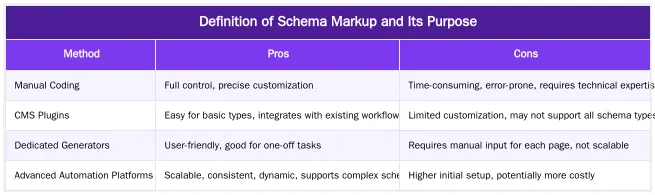
Many CMS plugins, such as those for WordPress, offer basic schema generation for common content types. Dedicated schema generators can help create specific JSON-LD blocks. For more comprehensive automation, platforms designed for enterprise-level structured data management can integrate with existing content systems. These tools often use templates or rules to automatically apply relevant schema based on content attributes or page types.
Here is a comparison of different approaches to schema implementation:
Advanced Automation Strategies
Advanced strategies involve dynamic schema generation based on content attributes. This can include using APIs to pull data from product databases or content repositories and automatically generating JSON-LD. For instance, an e-commerce site can automate product schema by linking its product catalog to a schema generation system. This ensures that every product page, even new ones, has accurate and up-to-date structured data.
Another strategy involves leveraging AI and machine learning to analyze content and suggest or generate schema automatically. These systems can identify entities and relationships within text, then propose appropriate schema types and properties. This approach is particularly beneficial for large content hubs or news sites with frequently updated information. For deeper insights into these capabilities, explore advanced schema markup automation.
Measuring Impact: Search Visibility and Performance
After implementing schema markup, it is essential to measure its impact on search visibility and overall performance. This involves utilizing various analytics tools to track changes in rich result eligibility, click-through rates, and organic traffic. Google Search Console (GSC) is the primary tool for monitoring structured data performance.
Google Search Console Reports
GSC’s “Enhancements” section provides specific reports for different schema types (e.g., Product, Article, FAQ). These reports indicate:
- Valid Items: Pages with correctly implemented schema.
- Items with Warnings: Pages where schema is present but has minor issues that might prevent rich results.
- Invalid Items: Pages with critical errors in schema implementation, preventing rich result eligibility.
Monitoring these reports helps identify and rectify issues promptly. GSC also provides data on rich result impressions and clicks, allowing you to see how often your rich results appear and how frequently users interact with them.
Key Performance Indicators (KPIs)
To assess the effectiveness of your structured data efforts, track the following KPIs:
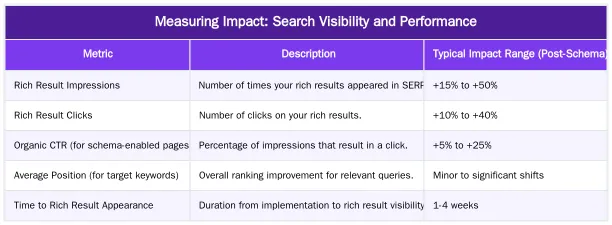
Analyzing these metrics provides concrete evidence of schema’s contribution to your SEO goals. Consistent monitoring and iterative improvements based on performance data are crucial for maximizing the benefits of structured data. For more advanced measurement techniques, refer to advanced schema markup 2026 strategies.
Elevate Your SEO with Automated Structured Data
Implementing structured data is no longer an optional SEO task; it is a fundamental requirement for maximizing visibility and engagement in modern search. Automated schema solutions offer a scalable and efficient way to ensure your website communicates effectively with search engines, securing rich results and preparing for the evolving landscape of AI Overviews. By embracing advanced schema markup automation, businesses can enhance their digital presence, improve user experience, and drive meaningful organic traffic. Take the next step in optimizing your website’s search performance.
Discover how to streamline your structured data efforts and unlock new opportunities for search visibility. Visit abdurrahmansimsek.com to learn more.
Conclusion
Schema markup is a vital component of technical SEO, providing search engines with the semantic context needed to understand and display web content effectively. From enabling rich results to preparing for AI Overviews in 2026, structured data, particularly JSON-LD, enhances search visibility and user engagement. Implementing and automating schema ensures accuracy, consistency, and scalability across websites of all sizes. By leveraging tools and monitoring performance through Google Search Console, businesses can optimize their online presence and maintain a competitive edge. Embrace the power of structured data to elevate your SEO strategy and connect with your audience more effectively. Learn more about advanced schema solutions at abdurrahmansimsek.com.
Frequently Asked Questions
What is schema markup automation and why is it important for SEO?
Schema markup automation involves generating and implementing structured data on a website programmatically, rather than manually. This process is crucial for modern SEO as it helps search engines understand content context, qualify for rich snippets, and prepare for evolving search paradigms like AI Overviews. Automating this task ensures consistency and efficiency in communicating valuable information to search engines.
How does schema markup automation enhance visibility in AI Overviews?
Schema markup automation provides explicit, machine-readable context about your content, which is vital for AI models. By clearly defining entities, relationships, and content types, automated structured data makes it easier for AI Overviews to understand, extract, and summarize information. This significantly increases the likelihood of your content being featured in these prominent search results.
What are the key benefits of implementing schema markup automation?
Implementing schema markup automation offers several key benefits, including enhanced visibility in search results and eligibility for rich snippets. It improves search engine understanding of your content, leading to better indexing and ranking potential. Furthermore, it streamlines a complex technical SEO task, saving time and resources while ensuring consistent structured data implementation across your site.
Can incorrect structured data negatively impact a website’s search performance?
Yes, incorrect or spammy structured data can indeed have a negative impact on SEO. Google may ignore invalid markup or, in severe cases, issue manual penalties. It is essential to use valid, relevant structured data and regularly test its implementation with tools like Google’s Rich Results Test to avoid issues.
What types of structured data are most effective for improving search engine understanding?
Article, HowTo, FAQPage, Product, Review, and Organization structured data are highly effective. These types provide specific, machine-readable details that help search engines and AI models understand the core subjects and context of your content. Implementing relevant structured data types can significantly boost your content’s visibility and rich result potential.
How do AI-powered tools assist with automated structured data generation?
AI-powered tools analyze your content and search intent to dynamically generate accurate and comprehensive JSON-LD structured data. They can handle complex types like HowTo and FAQ schema, ensuring compliance with search engine guidelines. This automation ensures that your website consistently provides high-quality structured data, maximizing rich result opportunities.
Ruxi Data brings together multi-model AI, automated website crawling, live indexation checks, topical authority mapping, E-E-A-T enrichment, schema generation, and full pipeline automation — from crawl to WordPress publish to social posting — all in one platform built for agencies and freelancers who run on results.